


DECEMBER 27 — Students grow in extraordinary ways when they step beyond the classroom — into real places, real conversations and real responsibilities. This was evident during a recent short-term outbound mobility programme, where 27 undergraduates from Faculty of Languages and Linguistics, Universiti Malaya travelled to Taiwan and discovered how much learning can happen in moments big and small.
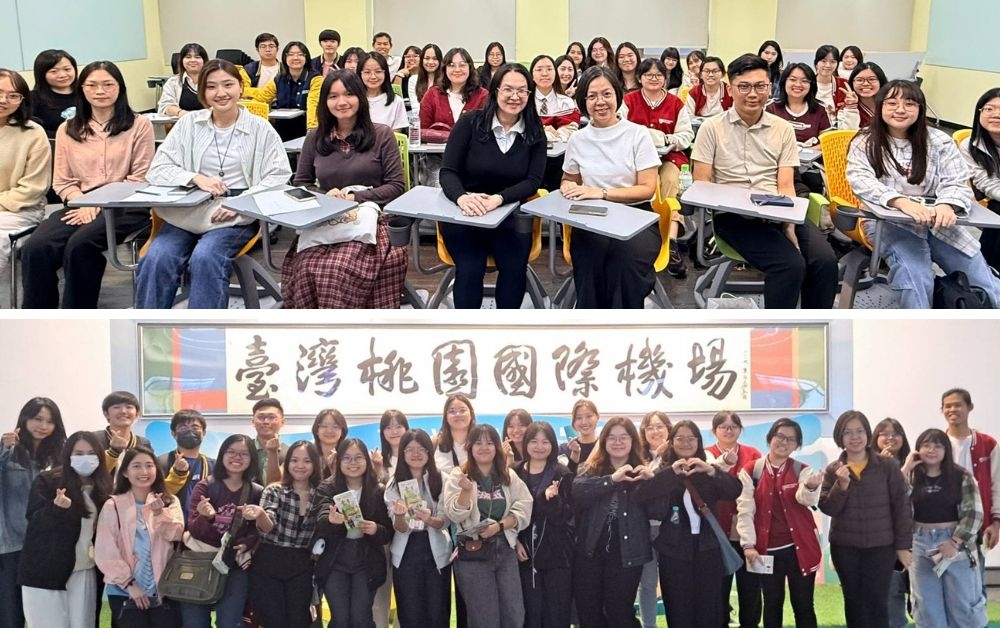
A journey that began before take-off
The learning started even before the trip. One student really wanted to join, but his mother was worried about him travelling abroad. He came to me asking what he should do. Instead of giving him a straight answer, I shared a simple idea often drawn from Confucian thought: travel wisely, with purpose, and always prioritise your duty to family.
So I encouraged him to think about what that meant for him. Two days later, he came back smiling. He had sat down with his mother, explained the purpose of the programme, showed her how he planned to stay safe and promised to update her every day. She felt reassured and agreed to let him go, saying he had spoken to her in a more mature and thoughtful way than before.
Before he even left Malaysia, he had already learned something bigger than travel — how to communicate with honesty, empathy and responsibility.
Lessons beyond the lecture hall
In Taiwan, the students visited National Taiwan University (NTU) and National Chengchi University (NCCU), where they discovered how different learning environments can spark curiosity in unexpected ways. At NCCU, Professor Chung Siaw-Fong from the Department of English welcomed us and led the group to the Dah-Hsien Seetoo Library — a bright, spacious hub thoughtfully designed for learning and well-being. There were open study areas, cosy meeting rooms, video-game corners, a small coffee spot, and wide windows framing lush greenery. It allows students to pause and let the calm scenery ease the tension off them.
Professor Chung’s graduate students, specialising in Teaching Chinese as a Foreign Language, then turned what could have been an ordinary sharing session into a lively interactive game. They guided our students to notice the subtle but meaningful differences between Malaysian Mandarin and Taiwanese Mandarin — differences that only emerge through everyday use and real-life examples.
At NTU’s Language Centre, the roles shifted again. This time, our students took the lead, asking thoughtful questions about the role of AI in language teaching and the growing challenges of teaching Chinese on a global stage. Their curiosity set the tone, and each question revealed a new layer of confidence and intellectual engagement.
Growing on the move
Many of the most meaningful lessons on this trip unfolded not in classrooms, but in the in-between spaces — train stations, airport gates, busy streets and shared group chats. With only two lecturers accompanying a large group, the students quickly realised they had to rely on themselves and on one another. They kept time, looked after their friends and managed their own belongings — everyday tasks that suddenly felt more real when no one was reminding them what to do.
Some learned to convert currencies on the spot; others stepped in to warn their peers about unreasonable prices. A few noticed sudden boarding-gate changes and immediately alerted the group so no one would be left behind. These small but meaningful acts revealed initiative, leadership and teamwork — skills that rarely come to life in traditional classrooms but flourish in real-world situations.
What impressed the teaching team most was that this growth did not begin in Taiwan. It began much earlier, when students applied for the programme, renewed their passports, packed their bags and discussed travel plans with their families. Each step required planning, communication and the courage to step out of familiar routines.
Throughout the journey, the students practised cross-cultural awareness, navigated unfamiliar environments safely and learned to observe differences without judgement. The blend of excitement, uncertainty and discovery created exactly the conditions where resilience and maturity could take shape — reminding us that travel is not just about going somewhere new, but about becoming someone new.
Why mobility programmes matter
This trip reminded us that some of the most meaningful lessons happen when students are encouraged to step out into the world and learn from real experiences. It is essential in giving students these opportunities to gain exposure beyond their own borders — not just to enhance academic learning, but to nurture personal growth.
Through these mobility programmes, students learn to adapt, communicate across cultures and navigate unfamiliar environments with growing confidence. These are soft skills that unfold naturally when students are trusted to explore, observe and make decisions on their own. The classroom remains important, but it becomes even more powerful when it serves as preparation for the world outside.
Classrooms will always be important, but they are at their best when they prepare students to step beyond them. Whether the journey takes them abroad or to another community within Malaysia, the lessons they return with lifelong skills — independence, resilience, empathy. These experiences may not come with a price tag, but their impact on shaping well-rounded, globally minded individuals is truly priceless.
* Dr Gan Yee Chin is a senior lecturer at the Faculty of Languages and Linguistics, Universiti Malaya and may be reached at [email protected]
** This is the personal opinion of the writer or publication and does not necessarily represent the views of Malay Mail.


