


FEBRUARY 11 — I hold an alternative view to DBKL’s road safety project in Taman Tun Dr Ismail (TTDI) compared to my neighbours.
As a TTDI resident of 25 years, I disagree with the recent press statement by TTDIRA to the Malay Mail. Other neighbours share my position and also disagree with the recent press statements made by the RA.
We see this street intervention as multilateral, progressive, advancing public safety, reducing traffic congestion, and balancing service vehicle access with pedestrian safety.
While I love my neighbours, they misunderstand the nature of innovation, especially in the urban realm.
Neighbourhoods all around Klang Valley have big problems which require innovative problem solving, and TTDI is no exception. These are complex problems relating to health, economy, and mobility. There’s no guidebook, no one by-law that presents the answer we’re all looking for.
The problem? Our neighbourhoods are stressful to live in, and move in. Pedestrians have no clear first last mile, their journey is blocked by cars, and often risky.
Our streets are absolutely off limits to children, citing danger. Elderly folks face agoraphobia — it’s simply too difficult to go outside.
Road deaths are in their thousands consistently year on year. We’re frustrated when there’s congestion, no parking spaces. Commuter cyclists have very few places to ride that are safe. The list goes on and on.
Looking ahead, there are even more issues coming in TTDI: Jendela residences will add traffic to the Jalan Tun Mohd Fuad Area. The new Visitor Centre by Jabatan Landskap Negara will feed more people into the neighborhood.
Solving these problems requires agile processes to arrive at a viable solution that’s acceptable by the public.
Innovative companies do this all the time. They test and fail quickly, creating feedback loops that allow them to arrive at a viable product that’s ready to market.
This process is similar at a city level. Pilots are common when introducing new services or products especially when entering new markets to test viability and create feedback loops on what works and what doesn’t.
KL’s pedestrian-bike masterplan 2019-2028 designates TTDI as a pilot neighbourhood by DBKL. TTDI is the sandbox in which new policies, new ways to move, and build neighbourhoods are to be tested and tried.
For many of us, this project is not a hindrance, but rather a pilot or prototype to test out how the street can be built differently.
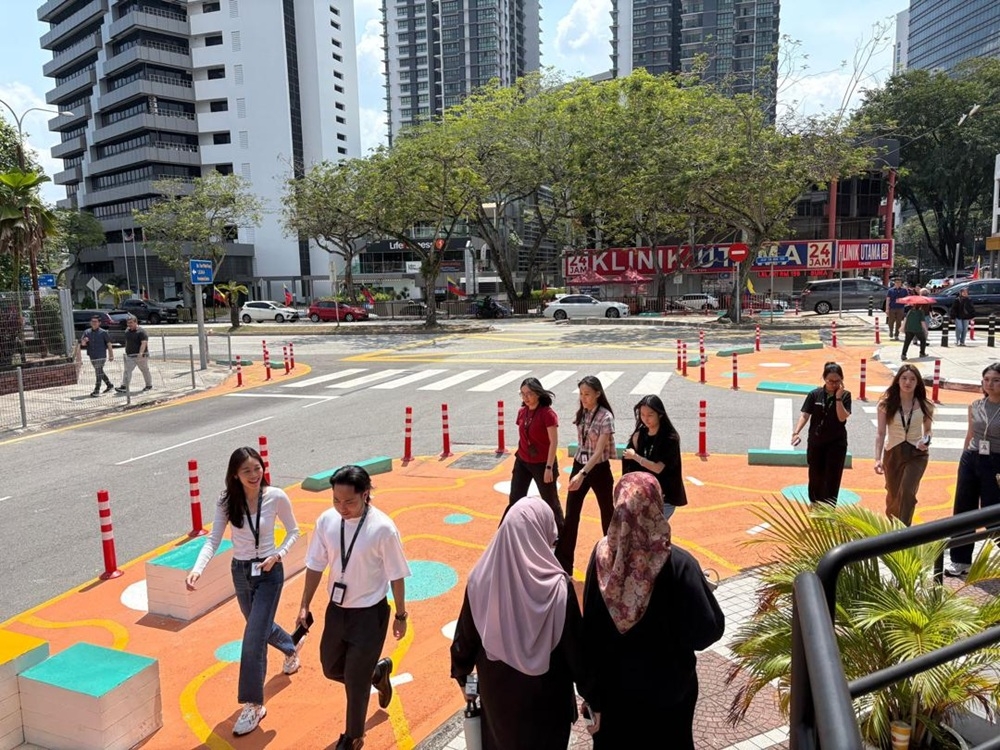
In this prototype, we see DBKL giving space to the hundreds of pedestrians who cross Jalan Tun Mohd Fuad daily.
New geometric standards were deployed to keep the street low-stress, by making it safe for pedestrians.
An accessible ramp, built in an earlier phase connects the two commercial cores for personal micromobility devices. Colorus were introduced to build interest in the pedestrian journey.
Innovation pushes boundaries and asks hard questions. One question brought forward by TTDIRA — compliance of the project with the turning of a fire safety appliance — is an important one.
Projects like this in TTDI are built for the purpose of testing out new hypotheses, and in our case, standards. Existing by-laws and standards are not perfect, and revising them from time to time is warranted.
For example, the American Association of State Highway and Transportation Officials (AASHTO) Standards widely adopted in our 1986 Road Safety Guidelines (ie. ATJ 86/6), uses a method for determining design speeds (85th percentile design speed) that is widely considered dangerous by road safety experts today.
This standard is being recalled in other cities throughout the world for promoting road crashes. Laws, policies, and standards can change, and we should challenge them for the sake of our cities.
Then again, I’m not saying that this by-law is unimportant or should be changed.
I’m saying that the project is purpose-built to test new geometric standards out — including turning radii of large service vehicles.
Take for example the use of flexible bollards, which are meant to fail if arranged in a way that is incompatible with fire service vehicles (it did not fail during the drive through).
Or another, that the design is able to be reconfigured quickly, which happened once after the Fire Department’s visit to the site, enlarging the turning radius as needed for the movement of the truck.
As such, I disagree with the need to immediately comply with the by-law, for the sake of innovating our neighbourhoods to become low stress places for all types of road users.
A variance should be permitted for the duration of the project, before capital injection is made to build permanent street infrastructure.
* OTW is a TTDI resident of 25 years.
** This is the personal opinion of the writer or publication and does not necessarily represent the views of Malay Mail.


