














DECEMBER 9 — The floods and landslides sweeping across South-east Asia in 2025 have made one truth unavoidable: our region is now the most economically vulnerable to extreme climate events anywhere in the world. What was once dismissed as seasonal hazards has now evolved into a high-frequency, high-impact threat that can destabilise economies, shred social safety nets, and erode the legitimacy of governments simultaneously.
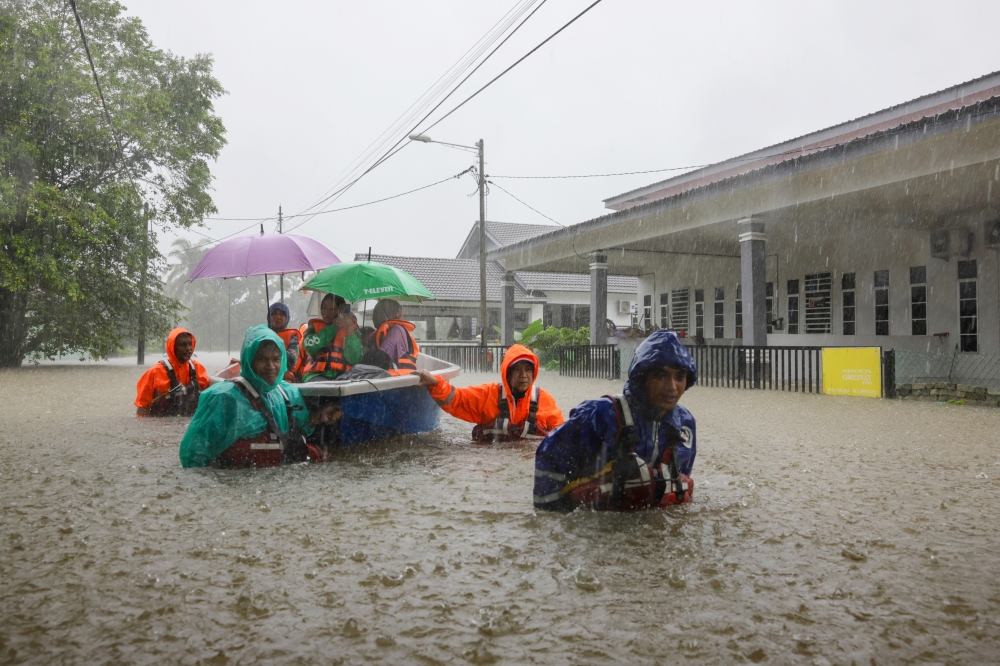
In Indonesia alone, the devastation across Sumatra has displaced almost a million people and killed hundreds. Southern Thailand is still submerged, with entire districts inaccessible. Sri Lanka, Malaysia, Cambodia and the Philippines have each faced variations of the same tragedy: torrential rain turning into lethal walls of water, swallowing homes, roads and livelihoods. The humanitarian toll is enormous. The economic toll may be even greater.
Climate scientists quoted in The Guardian warn that these storms are not becoming more numerous, but far more destructive. Warmer oceans and hotter air systems now hold more moisture, releasing rainfall at intensities that overwhelm any infrastructure built in the 20th century. These are the new physics of climate change. The data are unmistakable, and 2025 provides a brutal confirmation.
Yet the climate alone is not to blame. Human activity has compounded the threat. Across South-east Asia, deforestation, poorly regulated development, erosion of peatlands and wetlands, and the destruction of mangroves have removed the natural buffers that once absorbed excess rainwater. When nature loses its capacity to heal and protect, disasters escalate. When governance fails to enforce environmental standards, disasters become predictable.
This convergence of climate change and human mismanagement has produced what economists call “compound vulnerability.” Each disaster is not a standalone crisis; it is a multiplier. The floods that destroyed homes also destroyed jobs. The landslides that buried roads choked supply chains. The displacement of families has heightened food insecurity. Floodwaters have contaminated water systems, increasing the risk of post-disaster disease outbreaks. Each layer deepens the next.
According to Bloomberg, the cumulative damage in South-east Asia this year alone could cost tens of billions of dollars. For developing economies already stretched by inflation, debt pressures and slowing global trade, these losses cannot be absorbed without long-term consequences. Insurance coverage remains extremely low. Fiscal space is tight. Social protection systems are thin. In many countries, disaster management rests on outdated technology and reactive “post-event” responses.
This is why South-east Asia is now the epicentre of climate risk. It is not only that the storms are more violent. It is that the foundations of resilience — governance, environmental planning, social protection, infrastructure, and early-warning systems — have not been modernised at the pace required by a fast-warming planet.
The Intergovernmental Panel on Climate Change (IPCC) has been warning for a decade that South and South-east Asia will experience the steepest rise in flood frequency as global temperatures climb. But policymakers have been slow to integrate that warning into budgets, land-use laws, and regional cooperation frameworks. Asean, despite establishing the AHA Centre and ERAT, remains largely reactive. The scale of today’s disasters is larger than the mandate of its existing institutions.
2025 is not just a tragic year. It is a turning point. The year we can finally say — with evidence — that climate change is no longer an environmental issue but an economic and security threat that will test Asean’s cohesion far more severely than geopolitical rivalries or trade disruptions.
For example, the destruction in Hat Yai and Sumatra will require years of reconstruction. Tourism-dependent economies will suffer prolonged reputational damage. Agricultural belts — especially rice-producing areas — will face falling yields and rising food prices. Urban centres from Jakarta to Manila will confront crippling traffic paralysis, business disruption and higher insurance premiums. The knock-on effects will ripple across the region’s financial markets, labour migration patterns, and national development plans.
If 2025 is a warning, then 2026 must be the year of action.
Asean must treat climate resilience the way it treats regional security — as a collective responsibility. Shared early-warning satellite grids, real-time disaster alerts, coordinated water management, joint financing of climate-resilient infrastructure, and region-wide enforcement of environmental protections must no longer be subjects of polite diplomatic conversation. They must become anchors of policy.
Member states must also stop pretending that climate disasters are “domestic issues.” The displacement of millions in one country affects neighbouring states. Damage to one supply chain reverberates through the entire region. The floods of 2025 have proven that no South-east Asian country is insulated — geographically, economically, or politically.
The world has entered a new era in which climate extremes are now structural, not episodic. And South-east Asia, by geography and governance, sits directly on the fault line.
2025 has shown the costs of inaction. The only question now is whether the region will learn from this year — or relive it, at greater scale, again and again.
* Phar Kim Beng, PhD is the Professor of Asean Studies at International Islamic University of Malaysia and Director of Institute of International and Asean Studies (IINTAS). Nazwa Evrillea Aryandi and Danica Surya Rahardjo are Emerging Thought Leaders at Universitas Katolik Parahyangan, Bandung, Indonesia.
** This is the personal opinion of the writer or publication and does not necessarily represent the views of Malay Mail.