














DECEMBER 6 — Transport is one key sector contributing to global greenhouse gas emissions.
The fuel used is a key determinant. This explains why electric cars are expanding.
Air transport has come under a lot of pressure to increase the use of SAF, sustainable aviation fuel. So is marine transport, where new maritime rulings insist on greater use of renewable and low-emission fuel.
The other solution is the deployment of mass transport. To move people and goods, the train has emerged as the most efficient mass transport instrument.
Global investments in rail networks are seen rising worldwide for that reason.
As Malaysia steams ahead with the East Coast Rail Link (ECRL), there’s no shortage of opinions about whether it’s a wise national investment or a costly gamble.
Like many ambitious infrastructure projects, the ECRL sits at the crossroads of hope and caution, promise and peril.
The stakes are high not only in ringgit terms but in what it means for Malaysia’s future economic geography, regional equity, and geopolitical positioning.
At its heart, the ECRL is about connectivity. For decades, development in Malaysia has been disproportionately clustered along the west coast, from Penang to Johor.
The east coast, rich in culture, natural resources, and tourism potential, has struggled to keep pace.
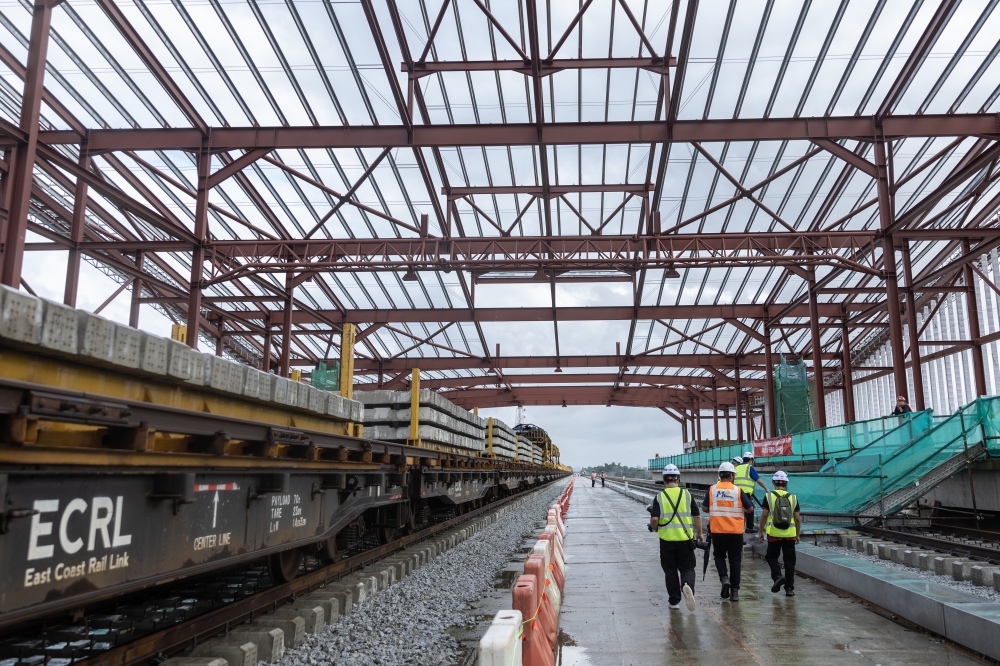
The ECRL promises to narrow this divide, stitching together Kuantan, Kuala Terengganu, and Kota Bharu with the economic heartbeat of the Klang Valley.
On paper, the benefits are compelling: faster travel times, enhanced trade routes, better labour mobility, and the rise of new growth nodes along the corridor.
The Kuantan Port, for instance, could emerge as a strategic logistics hub linking the South China Sea to Peninsular Malaysia’s hinterland.
Tourism circuits, long hampered by poor accessibility, might finally come into their own. Kelantan, which has been wallowing at the bottom of the country’s economic ladder, may suddenly wake up from its slumber.
Yet, infrastructure alone does not guarantee prosperity. History is littered with examples of underutilised mega-projects that failed to deliver promised economic returns because complementary policies, industries, and ecosystems were missing.
The question Malaysia must grapple with is whether the ECRL will be just a railway or the backbone of a broader, integrated development strategy.
There are financial realities to confront too. Even after renegotiations, the ECRL remains one of Malaysia’s most expensive infrastructure projects.
Its success depends on achieving cargo and passenger volumes that may prove optimistic in the short to medium term, especially if road transport remains dominant and east coast population densities remain modest.
Without careful demand management and aggressive industrial development along its route, the line risks becoming an underutilised asset.
Then there’s the geopolitical dimension. As part of China’s Belt and Road Initiative (BRI), the ECRL embeds Malaysia deeper into regional supply chains, an opportunity, but also a strategic risk.
Dependence on external financing, construction expertise, and operational know-how must be balanced with local capacity building, technology transfer, and safeguards for national interests.
Ultimately, the ECRL will be judged not by its length or cost, but by its legacy. Will it reduce regional inequality, catalyse new industries, and create sustainable livelihoods? Or will it become another symbol of misplaced priorities and economic overreach?
The project’s wisdom lies not merely in laying down steel tracks but in what Malaysia chooses to build around them. Ports, industrial zones, tourism clusters, and vocational training centres must all align with this infrastructure to create a viable economic ecosystem.
Only then will the ECRL transform from a bold bet into a wise investment.
As the trains begin to roll in the coming years, so too must our determination to ensure that this project delivers more than promises, but real, lasting progress for all Malaysians.
The ECRL connects underdeveloped states (Kelantan, Terengganu, and Pahang) to the Klang Valley, reducing regional inequality.
Faster cargo transport could cut shipping times between Port Klang and Kuantan Port, enhancing Malaysia’s trade competitiveness.
It strengthens ties with China, Malaysia’s largest trading partner, potentially attracting more BRI-linked investments and aligns with Asean’s Master Plan on Connectivity, positioning Malaysia as a regional logistics hub.
There are long-term infrastructure gains. Shifting freight from road to rail would reduce highway congestion and carbon emissions. We must not forget the tourism potential with improved access to east coast tour destinations.
* Professor Datuk Dr Ahmad Ibrahim is affiliated with the Tan Sri Omar Centre for STI Policy Studies at UCSI University and is an Adjunct Professor at the Ungku Aziz Centre for Development Studies, Universiti Malaya. He can be reached at [email protected]
** This is the personal opinion of the writer or publication and does not necessarily represent the views of Malay Mail.