


SEPT 30 — Last week, during his address at the United Nations, Donald Trump delivered more than a mere political speech. He issued a challenge. For him, migration was not concerned with aiding individuals, generating profit, or engaging in conventional diplomacy. It was portrayed as a conflict between powerful nations that safeguard their borders and weaker ones that “abandon their countries to ruin.”
The meaning of the symbols was evident. The UN was historically a forum for collaboration, negotiation, and the employment of diplomatic terminology. For Trump, it evolved into a battleground. His remarks, occasionally apocalyptic, sardonic, or self-congratulatory, were intended to convey that the world faced peril and that he alone possessed true comprehension of the situation.
A spectacle rather than a regulation
Trump’s remarks were more significant for the imagery they conveyed than for the information they provided. It was not discussed as a succession of displacements resulting from warfare, natural disasters, or economic disparities. Rather, it was referred to as a monster, a force capable of obliterating national identities. Migrants have been reduced to symbols of peril rather than being recognised as individuals, including families, workers, students, and refugees, each with their own dreams and worries.
This is potent material for his admirers. It asserts its ability to elucidate in a frequently perplexing world. However, clarity can be alluring. Trump circumvents the most significant issues by asserting that nations ought to “seal borders and deport foreigners.” What occurs to individuals fleeing from violence? How do economies reliant on migrant labour sustain themselves in their absence? What about nations, such as the United States, whose histories are founded on migration?
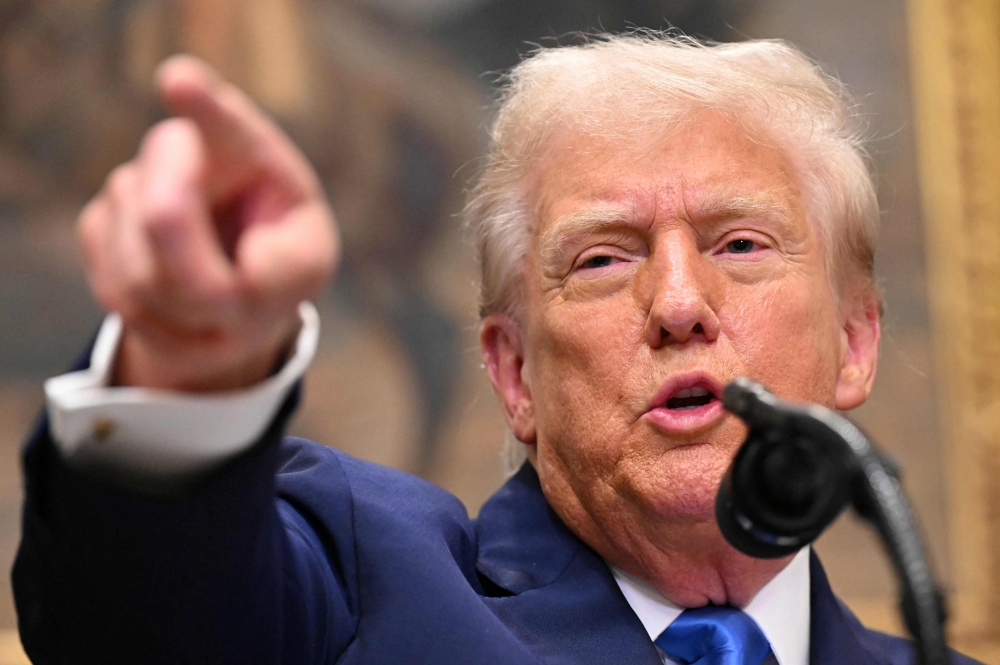
A metaphorical exchange of roles
What stood out was Trump’s endeavour to alter the conventional narrative. Rather than receiving admonitions for human rights or humanitarian obligations, he positioned the U.S. as the instructor. Individuals from Europe were particularly reprimanded for permitting an excessive influx of strangers, which was perceived as undermining their own culture. He informed them, “You are jeopardising your nations.”
The symbolism extends beyond mere border walls. The issue pertains to the determination of the definition of “good governance” in the 21st century. Trump’s America seeks to disengage from the global order. It conveys to others that the system is defective and that only stringent sovereignty; rigid borders, a robust national identity, and scepticism towards outsiders in which to him can provide salvation.
Five concerns with how Trump framed things
His performance was commendable; yet, it resulted in numerous issues.
Initially, oversimplifying matters. Migration encompasses more than merely individuals “entering” or “remaining excluded.” Push factors encompass elements such as warfare and climate change, while pull factors comprise aspects like employment opportunities and security. It is inaccurate to assert that it ceases solely when leaders adopt a stringent approach. The data do not indicate this, either in the United States or abroad.
Secondly, terminology that excludes individuals. Trump portrays immigration as a cultural menace by asserting that “you have nothing in common” with immigrants. This action is politically advantageous, however it adversely affects the populations that want protection the most.
Third, autonomy against reliance. Trump is accurate in claiming that nations have the right to control their borders. In a world where pandemics, climatic disruptions, and refugee migrations may swiftly cross borders, absolute sovereignty is an illusion. No barrier can impede the escalation of sea levels or the volatility in the area. Collaboration is important; it is a question of survival.
Fourth, dismantling without reinstating. Critics who perceive the UN as sluggish and ineffective appreciated his criticism of it. However, his address lacked any proposals for enacting change. Disassembling institutions without providing strategies for their reconstruction may result in more profound deficiencies.
Fifth, tone and reception. Diplomacy requires respect, even during disagreement. Trump garnered notoriety by informing other leaders that their nations are “going to hell” however he did not possess any actual authority over them. International collaboration requires more than mere rhetoric that elicits applause; it necessitates confidence.
The world must be informed about this
One could easily dismiss the speech as mere Trumpian rhetoric. The significance of the symbols is crucial. Leaders in Europe, Africa, and Asia clearly recognise that Trump’s worldview is unchanged and has become more acute: prioritising sovereignty over solidarity, erecting obstacles instead of building bridges, and favouring confrontation over compromise.
In nations like as Malaysia, where migration is intricately associated with economic development and humanitarian responsibilities, this mindset presents significant issues. Do we view migrants solely as issues to be addressed, or do we recognise them as integral to the fabric of contemporary society? Do we accept narratives rooted in fear, or do we seek equilibrium between security and compassion?
Trump’s address underscores that dialogues around migration transcend mere statistics. Their focus is on identity, authority, and the narratives leaders construct on inclusion and exclusion. Trump’s message was unequivocal: nations who fail to secure their borders undermine their own interests. History illustrates that nations can falter when they isolate themselves and disregard the constant movement of people.
One final matter
Ultimately, Trump’s address at the UN prioritised narrative alteration over the formulation of solutions. He transformed immigration into emblems of chaos and positioned himself as the solution. This article addresses certain individuals’ concerns and complaints. For some, it represents a perilous constriction of perspective that may impede the collaboration essential for addressing global issues.
The global community must determine whether to recount his narrative or to create a new one in which migration is approached with empathy, institutions are repaired rather than dismantled, and leadership is evaluated not alone by power but also by accountability.
*Associate Professor Dr. Mashitah Hamidi is the Director of Malaysian Population and Migration Research Centre, Universiti Malaya, and may be reached at [email protected]
** This is the personal opinion of the writer or publication and does not necessarily represent the views of Malay Mail.


