


AUG 20 — So, I went back to the family home in Seremban recently with the parents.
Ever since they moved to the Klang Valley with their three “angels”, trips back home are made every few weeks. Even less for me, due to work.
Balik kampung is a rarity even though Seremban is only about an hour’s drive.
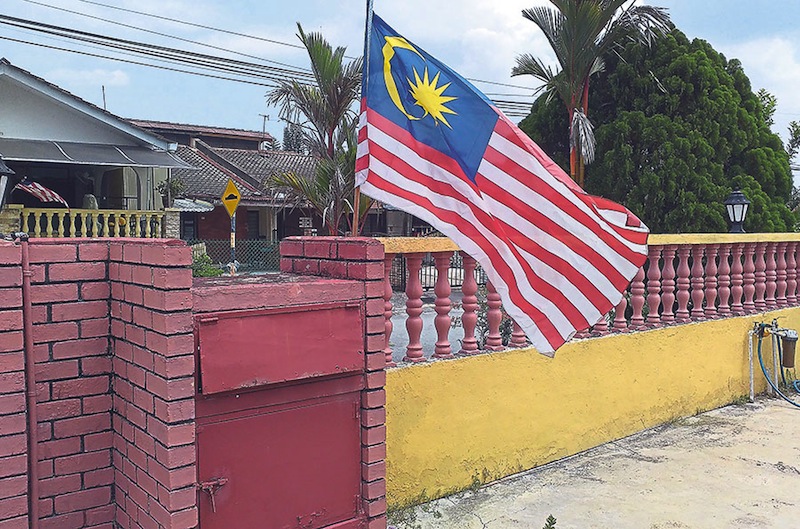
This time, it was a giggle moment when the first thing Dad did was unfurl the Jalur Gemilang and place it outside near the gate.
“Why la you doing that?” I asked him.
To which he answered: “Must what. We are Malaysians. Must be proud.”
Mum then said the neighbour had two Jalur Gemilang in his yard. To which we all laughed.
Later, when I probed Dad about his faithfulness in putting the national flag up every year during Merdeka month, he said he had bought this one from Giant hypermarket.
The previous one was given to us by our neighbour, Ustaz Rock.
Dad also used to put the flag on our cars until they got blown away or at one time, stolen.
“We need to be proud that we are independent.”
Truth be told, I proceeded to interview my parents for this column because I was curious about this pride that both of them have for the nation.
In a time when things are not very rosy for Malaysia, their take on Independence brought back a sense of why all of us need to be proud of our country.
I found out something Dad never told us — he was present at Stadium Merdeka the day Tunku Abdul Rahman cried out, “Merdeka” seven times.
Dad and his three friends drove for about seven hours the day before from Taiping to make it to the stadium that Aug 31 morning.
They stayed at a hotel for the night.
“We planned it for about a month. We needed to save money for the trip,” he said.
He was 19 then and just about to complete his senior Cambridge year.
Dad was one of those who went to school later in life because of the Japanese occupation as his parents did not allow him to go to school during that period.
“We followed Tunku and shouted ‘Merdeka’. I had goosebumps. I was so happy and felt very proud that we were finally independent,” said Dad, proudly recalling that he wore white pants and shirt — his school uniform — for the momentous occasion.
“Everyone was cheering when Tunku entered the stadium. But there were no flags to wave. Those days, where can get such stuff. Not like now, where you can get it everywhere.”
Part of Dad’s pride for the nation, I believe, stems from having lived through the Japanese occupation where every meal was tapioca or sweet potato.
Rice doled out by the Japanese was mixed with lime powder to keep maggots away.
“No matter how much you washed it, the smell would not go away,” he said.
Times were tough.
“My mother had a tattoo of a crucifix that she burned off with acid because at the time, the Japanese were against anyone who had tattoos, especially if it concerned Christianity,” he said.
His family, like my mother’s and many others, took shelter in the jungle.
They later met a Malay family who provided them shelter in their home for a few months in Padang Rengas and returned to Taiping when things settled down.
When the British returned, he said the first thing his mother did was to take out wads of cash and told him to buy rice.
“She had hidden the currency and it was still valid when the British returned,” he said.
He recalled listening to the announcement that Malaya would be independent over the radio with his mother.
“She was so happy too,” he said.
Mum was already a temporary teacher by the time Independence came, having had to stop schooling after 17 to work to support her mother, siblings and herself.
It was life as usual for her that day, although in previous conversations, she had reminded us that Malaysia is an okay country.
Life for her had not been easy, especially during the Japanese occupation when a bomb that was meant for the Standard Chartered bank landed on the wrong side of the road near the shophouse she lived in.
Her father’s pharmacy was destroyed and things were never the same again.
“We would have been comfortable if not for that. Then, my mother had to bring us up alone after father died some years later,” she said.
However, her father, she added, had the foresight to stock up on food during the occupation so the family did not have to suffer too much during those tough years under the Japanese.
As I am writing their memories, one thing that stands out is how small the difficulties in our modern lives are compared to those faced by my parents’ generation.
Traffic jams? Annoying people on social media and in the news? Astro disruption?
Excuse me while I crawl back into my hiding place and feel embarrassed about our whining over first-world problems.
* Audrey Edwards is news editor at Malay Mail. She can be reached at [email protected]
** This is the personal opinion of the writer or publication and does not necessarily represent the views of Malay Mail Online.


