GEORGE TOWN, Jan 24 — A short narrow lane off the early Acheh-Arab enclave of Acheh Street-Lumut Lane is undergoing a transformation... much like many of the other streets in the inner city since George Town was inscribed as a UNESCO World Heritage Site close to six years ago.
The decaying ghost town that was once much of George Town is now filled with restored pre-war shophouses turned into boutique hotels, private residences, and cafes. All living cheek by jowl with original residents and trades operating out of the shophouses.
Looking at the first row of four pre-war shophouses that have been recently restored in Lumut Lane, it is hard to imagine that these buildings were at various stages of dilapidation. One of them was a mere empty husk with trees snaking up its walls a mere three years ago.
As with many of the pre-war shophouses within the city that are built at different periods of time using different materials according to different styles, this row of shophouses was not of a single, uniform architectural design.
The first two buildings were of the early Penang Style, built between the 1790s and 1850s, while the following two were built later, between 1890s and 1910s, in the early Straits Eclectic style.

When architect Michael Ong bought the four shophouses several years ago, the buildings were in a severely bad condition with rotting beams, partially destroyed roofs and one of the buildings was just a vacant lot with overgrown shrubs and trees in place of the long gone walls and roof.

Ong began a year-long journey of detailed restoration work that involved in-depth research and tedious sourcing for local materials like clay roof tiles and timber floorboards so that the buildings could be reconstructed as close as possible to the original design.
“I sourced all these materials locally, even the roof tiles are not new but original ones from other pre-war houses,” he said.
Ong had initially planned to use the restored buildings as an office with living quarters on the upper level but as the work progressed with little discoveries such as Arab-influenced arches in the middle of one of the houses and climbing costs, he decided to turn it into a homestay.

“I did not expect it to cost quite so much as one thing after another cropped up such as having to finish the walls with lime plaster for breathability and to create natural cooling to the internal spaces,” he said.
By early 2012, Spices Residences was completed and became one of the latest boutique homestays in George Town.
Rather than the more common Straits Chinese and Peranakan themes found in many of the boutique hotels in the city, Ong chose a theme that suited the building architecture and its surroundings.
“Acheh Street was once the centre of Islamic studies in Penang and a thriving Muslim settlement frequented by traders from the surrounding Malay Archipelago, Arabia and India,” he said.

Spices is strategically located right next to the Acheen Street Mosque, one of the oldest mosques in Penang, and some of its rooms upstairs even overlook the mosque compound and an ancient Muslim cemetery within the mosque grounds.
“This enclave was known as the ‘second Jeddah’ back when pilgrims would congregate here before they left for Mecca by sea so this area used to be teeming with activities, traders and pilgrims up to the 1970s,” Ong said.
Since numbers 3 and 5 of the Residences were built earlier, in the 1790s up to the 1850s, he believes these used to be homes for Muslim traders of that period.
“Drawing from the rich history of this area and also the surprise discovery of the Arabian-influenced arches in one of the buildings, I started decorating the interiors with a mix of local antique furnitures, Moroccan and Indian Muslim-influence décor, some of which are bought from Turkey,” he said.

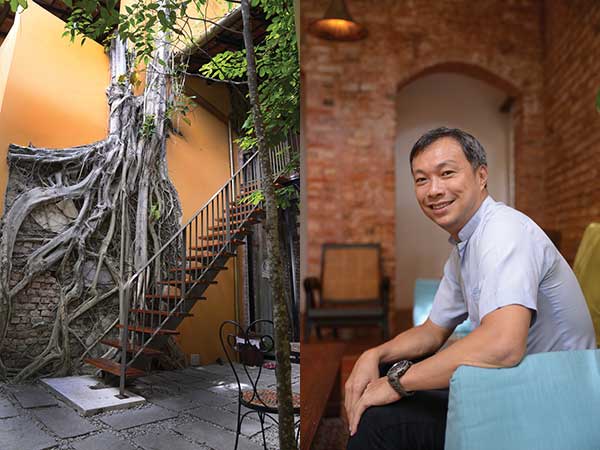
The most interesting section of the small and cosy homestay would have to be the lobby section which overlooks a small garden. It has trees snaking up its red-brick walls.
“I noticed the Bodhi trees growing on the walls which are very similar to the ones in the ruins of Angkor Wat so we decided to trim the trees, strengthen the walls and leave the trees there as part of the garden feature for Spices,” Ong said.
So, instead of completely rebuilding the unit, Ong only rebuilt the second storey and the front portion for the residences’ lobby and turned the back portion into a courtyard with the huge bodhi tree as the permanent feature next to an outdoor staircase that leads to the rooms upstairs.

The courtyard used to be the back lane between the row of shophouses and the perimeter wall of the mosque right behind it.
Instead of building another wall or leaving it vacant, Ong turned it into a landscaped garden that affords the homestay’s small sitting and library area a pleasing garden view.
“The wall supporting the bodhi tree was strengthened by adding on structural steel frames and rafters within the wall to ensure it is able to support the weight of the growing tree,” Ong said.
The upper floor of the unit was used as a semi-outdoor lounge that also acts as a buffer for the studio suite and other guest rooms; there are two loft suites each with a terrace overlooking the mosque compound and two superior rooms facing the main road.
All efforts were taken to comply with strict conservation guidelines by the local authorities as the upper storey of the buildings are all timber flooring, again sourced locally from houses of similar eras while the ground floors all feature local clay tiles.
When you enter Spices Residences, you will feel like you have stepped into an Acheh-Arabian residence. A great testament to Ong’s labour of love.
Spices is managed by Staysyok while Ong, who is a director, architect and urban and regional planner of architectural firm BYG, sticks with his day job.
Spices @ Lumut Lane
Address: 3,5,7,9 Lumut Lane, 10200 George Town
Tel: 04-2623019/016-4166969
Email: [email protected]
Website: spices.staysyok.com
This story was first published in Crave in the print edition of The Malay Mail on January 23, 2014.