


AUG 23 — On Monday, the National Fatwa Council officially declared that the use of electronic cigarettes, or vaping, is haram and therefore is prohibited for Muslims nationwide.
Now, I am pretty sure that there is no such thing as a census on smokers. But I have a feeling that the number of Muslim vapers on Monday did not go down the next day despite the fatwa.
In deciding that vaping is harmful to health, the council had admitted that the Health Ministry itself is still waiting for a final say from the ministry’s own experts.
“We’ve gone ahead of [Health Ministry] because basically, if it’s harmful and wasteful, we don’t support such things from the religious point of view,” National Fatwa Council chairman Abd Shukor Husin told reporters. Which basically was him saying that the council is an expert in such medical matters, even more so than the experts in the Health Ministry.
You can even say that the decision was premature, considering that UK government agency Public Health England just announced two days later that e-cigarettes is around 95 per cent “less harmful” than tobacco cigarettes, and might even one day be dispensed as licenced anti-smoking products.
In an index of “relative harm” of causing death, harming health and economic costs, the body ranked cigarettes at 99.6. E-cigarettes scored a mere 3.4.
In comparison, cigarillos scored 66.6, pipes 22.2, cigars 15.9, and anti-smoking methods such as nicotine patches and nasal sprays scored between 1.0 and 1.6.
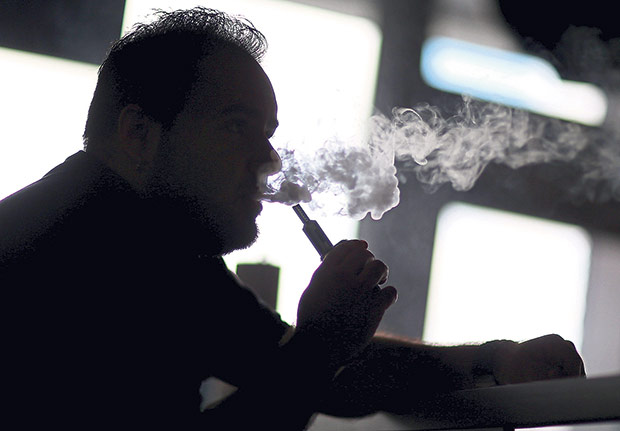
Another survey in UK released this month also revealed that e-cigarettes are not a gateway to cigarette smoking, saying that only 2.4 per cent of children vape regularly, but almost all of them were already smoking.
Now, I am not saying that it is healthier to vape rather than smoke, but the choice to inhale and ingest exhilarating (yet potentially harmful) substances should be a personal one.
Additionally, there are more pressing issues regarding vaping, with public usage at the top of the list. But the issue of regulating the practice should instead be left in the hands of health experts and lawmakers, if anything.
Prior to the introduction of vaping, smoking was becoming a harder and harder indulgence.
Smoking is now generally prohibited by law indoors, and in public facilities. Tobacco advertisements and sponsorships are no longer allowed. Cigarette packagings also now carry graphic health warnings.
In May, the Health Ministry had announced that the smoking ban will be extended to all eateries, even open-air ones, citing the 2011 Global Adult Tobacco Survey in the country that showed 83.5 per cent of respondents wanted 100 per cent of public places to be completely smoke free.
Among the things I remember the most during my recent trip to Tokyo was how the country has made smoking “uncool.”
Smokers were pretty much “ostracised”, forced to smoke in special rooms — although the rooms were thoughtful and some were really nice — and some carried their own portable ashtrays to avoid littering with their cigarette butts. People had to make an effort just to smoke; it was not as easy.
Perhaps one day, we can achieve that level of awareness, with smokers themselves recognising the need for “ethical smoking” to feed their addiction.
But vaping may instead have an opposite effect to this cause, especially among youths in the country. If anything, vaping might have made ingesting nicotine popular and cool again.
Unlike banned tobacco advertisements, vaping has many advocates, including celebrities who openly advertise and endorse the sale of e-cigarettes on their social media accounts.
Maybe it is the thick white smoke that makes vapers feel like they are aping hip-hop stars smoking joints in music videos — minus the stigma and the getting caught by police part.
But lack of self-awareness and the absence of the smoky smell have resulted in vapers neglecting the usual etiquette expected from smokers, with many nonchalantly vaping indoors and in crowds. In return, the public itself has no idea how to deal with vapers, even when they become public annoyance.
Will the fatwa solve this? I doubt it.
The council had already announced in July 2013 that shisha, known elsewhere as waterpipe or hookah, was haram. Fast forward two years, shisha is still a mainstay of some mamak outlets, and among the attractions for Arabic restaurants.
If we really wanted to go to the root of the matter, then the two prohibitions above were derived from an earlier fatwa decreeing that smoking cigarettes is haram. It was decided in 1995, which was 20 years ago.
These fatwas get broken on a daily basis. It is a demonstration of just how toothless a fatwa is in the eyes of the public, especially after ridiculous fatwas are churned out on a regular basis, be it against yoga, tomboys, Halloween or even black metal.
Elsewhere, fatwas are just advisory in nature, but Malaysian states not only gazette some into laws, but have also outlawed questioning fatwas themselves. (In Selangor, opposing a gazetted fatwa is punishable by not more than RM3,000 fine, or jail not more than two years, or both.)
The painfully obvious failures of these fatwas to curb Muslims from smoking cigarettes, and then smoking shisha, and now vaping, should be an indication of how futile it is for Islamic authorities to dictate public lifestyle down to the details, if they have any sense at all.
* This is the personal opinion of the columnist.


