


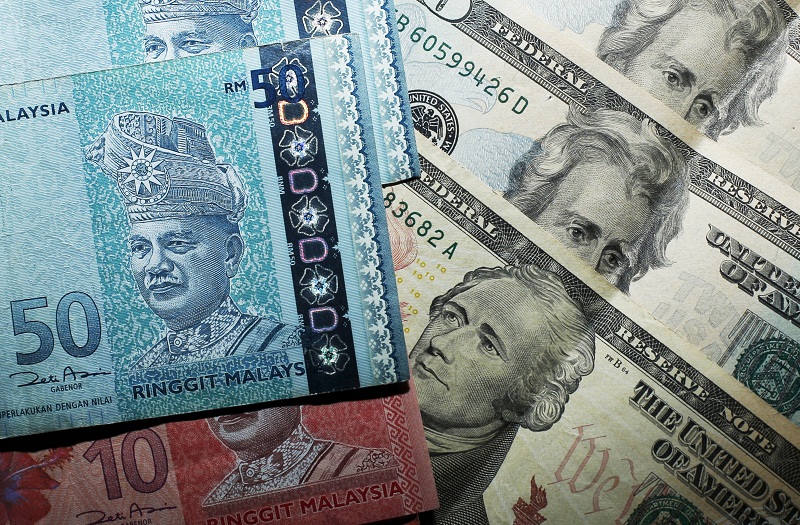
KUALA LUMPUR, Oct 20 — Emerging-market currencies in Asia tumbled, with the Korean won and Malaysian ringgit sliding the most in at least a month after renewed anxiety over China stoked a selloff in commodities and a Federal Reserve official talked up the outlook for higher rates.
Both the won and the ringgit dropped more than 1 per cent as nickel extended declines while US crude held below US$47 (RM201.65) a barrel ahead of American stockpiles data.
The Australian dollar rallied after policy makers said rate cuts earlier this year supported demand. Asian stocks were mixed, with Japanese shares rebounding as equities in Australia fell.
While data yesterday indicated Chinese economic growth was slightly faster than analysts expected, it was still the slowest expansion since the global financial crisis, reigniting concerns that made last quarter the most volatile since 2011.
“The three-week recovery is approaching an exhaustion point,” Matthew Sherwood, head of investment strategy at Perpetual Ltd. in Sydney, which manages about US$21 billion, wrote in an e-mail to clients.
“The key question for investors is how much can growth accelerate in the December quarter and will there be more policy stimulus. The answer to both questions is - not a lot,” he said, referring to China’s economy.
The October rally that has restored more than US$4 trillion to the value of global equities looks to be faltering as the concerns that drove last quarter’s gyrations reassert themselves. Anxiety over the slowdown in China, the world’s biggest consumer of industrial metals and a key oil importer, sent commodity prices down the most in a month yesterday, while the dollar regained some ground after Fed Bank of San Francisco chief John Williams said the central bank should probably start boosting rates later this year.
Stocks
Japan’s Topix index rose 0.2 per cent by 9:36am in Tokyo, limiting losses in the MSCI Asia Pacific Index, which dropped 0.1 per cent.
The measure’s 8.2 per cent surge since the end of September have pushed its average valuation back above a five- year average, with the index now trading at 13.6 times estimated earnings.
A gauge of Asian equities excluding Japan slipped 0.4 per cent after rising the past three days, as energy and materials producers pushed Australia’s S&P/ASX 200 Index down 0.4 per cent and the Kospi index lost 0.1 per cent in Seoul. The S&P/NZX 50 Index in Wellington gained 0.8 per cent in an eighth day of gains, its longest rally since November last year.
Futures on the Standard & Poor’s 500 Index lost 0.2 per cent to 2,024.50 after the US benchmark added less than 0.1 per cent yesterday to remain at an eight-week high as gains in consumer stocks offset losses for commodity producers.
Hang Seng Index futures in Hong Kong were down 0.3 per cent, and contracts on the Hang Seng China Enterprises Index, a gauge of mainland stocks listed in the city, dropped 0.4 per cent. FTSE China A50 Index futures slipped at least 0.5 per cent with those on the CSI 300 Index.
Futures on Taiwan’s Taiex gauge climbed 0.2 per cent before details of a potential merger between SanDisk Corp. and Western Digital Corp., both makers of data storage, emerged after US markets closed. SanDisk is in advanced talks to sell itself to Western Digital, with 2015 a record year for semiconductor mergers and acquisitions.
Semiconductor and semiconductor equipment manufacturers are the biggest group on the Taiex, according to index weightings calculated by Bloomberg.
The US Treasury softened its rhetoric describing the Chinese yuan yesterday, dropping a reference to it being “significantly undervalued” after the devaluation in August saw it drop 2.4 per cent in the third quarter. Still, the yuan remains “below its appropriate medium-term valuation,” and the factors that have driven its appreciation in recent years remain in place.
The US said China intervened “heavily” in the currency over the last three months, spending an estimated total of US$229 billion to prevent the yuan from falling. China should regularly disclose its foreign-exchange interventions, the Treasury said.
The yuan dropped 0.2 per cent in Hong Kong, set for a third day of losses, to 6.3832 per dollar. — Bloomberg


