


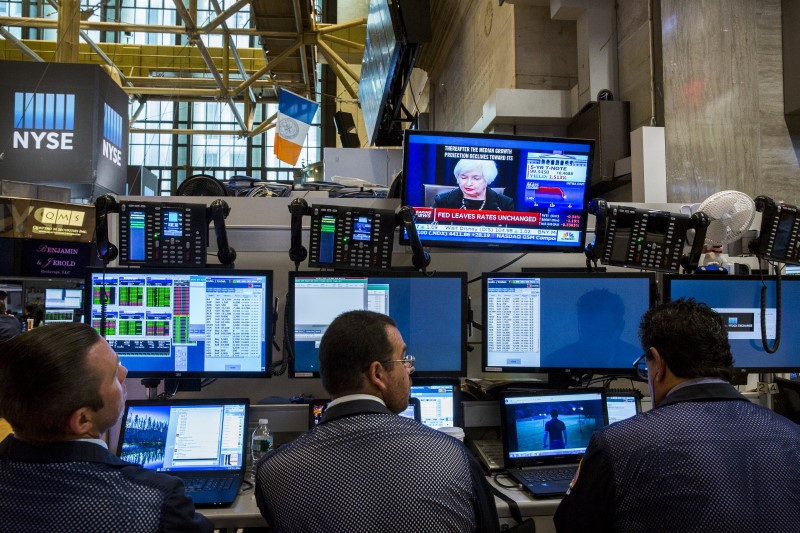
NEW YORK, Sept 18 — Emerging market stocks rallied to a four- week high after the Federal Reserve left US interest rates unchanged, buoying demand for risker assets in developing nations.
The MSCI Emerging Markets Index rose 0.6 per cent to 827.50 in New York, extending its gain from this year’s low to 7.2 per cent. Currencies in eastern Europe and Asia added to this week’s advance, as exchange rates in Brazil, Russia and Turkey weakened amid economic and political turmoil.
The rebound in equities comes after a US$6.6 trillion (RM 27.877 trillion) meltdown between mid-June and late August when concern reigned that a US rate increase will lure investors away from emerging markets and into dollar assets. A Bloomberg gauge of 20 developing-nation currencies sank to a record low last week.
“It’s a bit of an instinctive, knee-jerk relief rally,” Nicholas Spiro, managing director Spiro Sovereign Strategy in London, said by by phone. “Emerging market investors are slightly relieved they don’t have to suffer from the potential rate hike today. We see that the Fed is more concerned about the development in emerging markets, and in particular, in China.”
China slump
The Fed keeping its policy interest rate unchanged shows reluctance to end an era of record monetary stimulus in a time of market turmoil, rising international risks and slow inflation in the US Chair Janet Yellen said most Fed officials still expect an increase this year, reinforcing that the path of rate rises would be gradual. China’s surprise currency devaluation last month, concern that global growth is faltering and political turmoil in countries including Brazil and Turkey weighed on the Fed’s decision.
“Recent global economic and financial developments may restrain economic activity somewhat and are likely to put further downward pressure on inflation in the near term,” the Federal Open Market Committee said in a statement Thursday in Washington.
In China, the Shanghai Composite Index surrendered gains in the last 30 minutes of trading, retreating 2.1 per cent, as traders tested the limits of state support amid the biggest price swings since 1997. Price volatility in Chinese stocks is surging and turnover is slumping on concern government intervention will fail to shore up the world’s second-largest equity market amid signs of a deeper economic slowdown.
Total outflows from emerging markets reached as much as US$40 billion since mid-August, data from Institute of International Finance show. Emerging markets had outflows for 35 days, the longest streak in more than two years, economists including Robin Koepke said in an e-mailed statement.
Currency risk
“If the Fed starts to normalize its stance and the economy continues to recover, we will likely have a pretty serious problem with capital flowing back out of emerging markets,” Stephen Jen, managing partner and founder of hedge fund SLJ Macro Partners, said by e-mail.
The premium investors demand to own emerging-market debt over US Treasuries widened nine basis points to 387 basis points from the narrowest level since Aug. 10, according to JPMorgan Chase & Co. indexes.
Eight out of 10 industry groups in the developing-nation stock gauge rose, led by technology and raw-material companies. Stocks in Turkey rose to the highest in September, while the Ibovespa was little changed in Brazil. Samsung SDI Co., the battery making unit of Samsung Group, advanced 7.9 per cent, the most since October.
The Hungarian forint, the Romanian leu and the Czech koruna rose the most among emerging currencies, while exchange rates in Brazil, Russia and Turkey—countries facing domestic political and economic turmoil—weakened. South Africa’s rand, the ruble and the real weakened after Moody’s Investors Service said they were among currencies most at risk after a US interest increase.
The forint strengthened 1.9 per cent against the dollar, the most among currencies. Poland’s zloty jumped 1.2 per cent. The Bloomberg gauge of developing-nation currencies rose less than 0.1 per cent, increasing for an eight day in a row.
Emerging-market stocks have fallen 13 per cent this year and are valued at a 28 per cent discount to advanced-nation shares, according to data compiled by Bloomberg. — Bloomberg


