


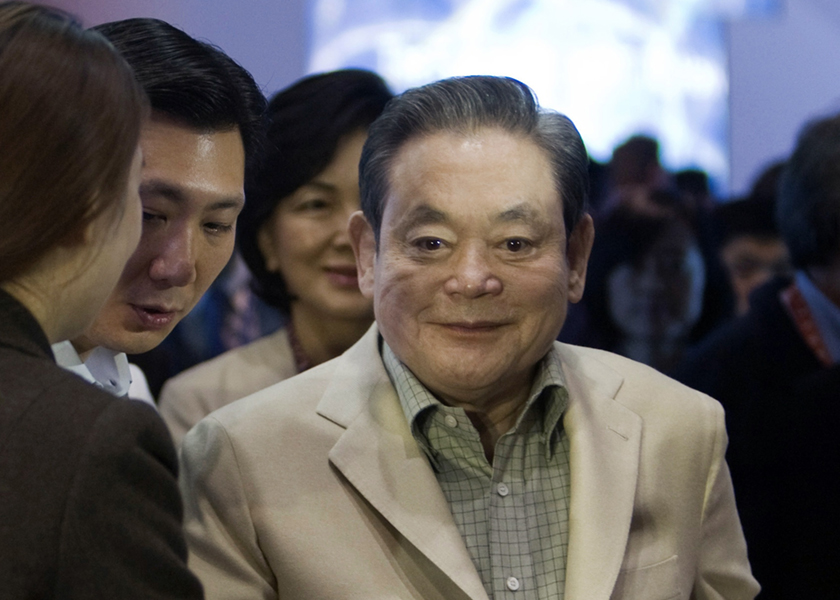
SEOUL, May 11 — Samsung Electronics Co Chairman Lee Kun Hee is in stable condition after suffering a heart attack, the Samsung Group said.
Lee, 72, underwent surgery following an acute myocardial infarction early this morning at Samsung Medical Center, after being resuscitated and stabilised last night at Soonchunhyang University Hospital, according to a statement e-mailed from Samsung Group spokeswoman Rhee So Eui, citing the medical centre. Lee, who had lung lymphoma treatment in 2000 and was hospitalised last August for a cold, was taken to the hospital after he had breathing difficulty at about 11pm.
Since taking over the Suwon, South Korea-based business in 1987, Lee helped build it into Asia’s biggest technology company and the world’s largest maker of smartphones, televisions and memory chips. In 2012, he appointed his son, Lee Jae Yong, as vice chairman, and his daughter, Lee Boo Jin, as president of affiliate Hotel Shilla Co.
Naming his son as vice chairman “was a clear step” in terms of succession, Heo Pil Seok, Chief Executive Officer at Midas International Asset Management Ltd in Seoul, said by phone today.
Company makeover
Samsung Electronics shares have surged about 137-fold since Lee replaced the group’s founder, his father Lee Byung Chull, as chairman.
The patriarch chose his third son in 1971 ahead of two older brothers because they weren’t interested in the business, according to “The Lee Kun Hee Story,” a biography published in 2010. Lee Kun Hee was ranked among the World’s 100 Most Influential People by Time Magazine in 2005.
Lee also leads Samsung Group, which has more than 70 affiliated companies globally, including the electronics business. He has an estimated net worth of US$11 billion (RM35 billion), according to the Bloomberg Billionaires Index.
Since Lee Kun Hee took control in 1987, sales at Samsung Electronics surged to 228.7 trillion (RM71 trillion) won last year, making it the world’s largest electronics company by revenue. Lee initiated a company makeover in 1993 when he gathered employees in Germany to lay out his plans.
That year, Lee began overhauling Samsung Electronics after seeing the company’s products gathering dust in the corner of an electronics shop in Los Angeles, the biography says.
Phone sales
By 2013, the Samsung Group affiliates generated 333.9 trillion won in sales according to data from Korea’s Fair Trade Commission, which is equivalent to about 23 per cent of South Korea’s gross domestic product based on 2013 figures from the Bank of Korea.
Samsung Electronics last month posted the lowest sales in five quarters at its mobile-phone business, which accounts for 76 per cent of operating income. Chinese producers are gaining in emerging markets with cheaper, feature-packed devices, and Apple Inc is boosting iPhone sales through China Mobile Ltd to better compete with Samsung’s high-end Galaxy S series.
Shares of the world’s largest smartphone maker have dropped 2.7 per cent this year, tracking the benchmark Kospi index. The stock had lost 9.9 per cent last year after more than tripling in value in the four years through 2012.
Two members of South Korea’s biggest business group are combining, with Samsung SDI Co, a supplier of batteries to Apple, agreeing to buy chemical and electronic materials maker Cheil Industries Inc for about 3.5 trillion won in stock.
Life insurance
Meanwhile, Samsung Securities Co, South Korea’s largest brokerage by market value, will sell its entire stake in Samsung Asset Management to Samsung Life Insurance Co for 272.8 billion won.
Another affiliate, information and communications technology provider Samsung SDS Co, plans to sell shares in Korea this year, according to a regulatory filing.
“This year we have seen a lot of handovers among the group’s affiliates—Samsung SDS’s announcement that it’s going public, and Samsung Life Insurance taking over Samsung Asset Management,” Midas’s Heo said. “This was seen by the market as part of the succession speeding up.” — Bloomberg


