


KUALA LUMPUR, Feb 28 — In February 2017, a high-profile assassination at Kuala Lumpur International Airport (KLIA) gripped the nation.
The victim was Kim Jong-nam, the estranged half-brother of North Korea supremo Kim Jong Un, who died within minutes after two women smeared the VX nerve agent on his face.
The VX, an amber-coloured, tasteless and odourless liquid, is banned under the 1993 Chemical Weapons Convention.
The suspects later claimed that they thought they were part of a reality prank show and were unaware of the poisoning.
A diplomatic uproar ensued, leading both countries to expel each other’s ambassadors.
Diplomatic ties were eventually severed following a separate extradition case in March 2021.
How the assassination exposed a gap
A lesser-known outcome of Jong-nam’s assassination was the creation of a special police unit called CBRNE – short for Chemical, Biological, Radiological, Nuclear and Explosives – by the end of 2017.
Inspector Muhammad Syafiq Zakaria said the Royal Malaysia Police had no specialised first responders capable of handling chemical threats while concurrently conducting criminal investigations.
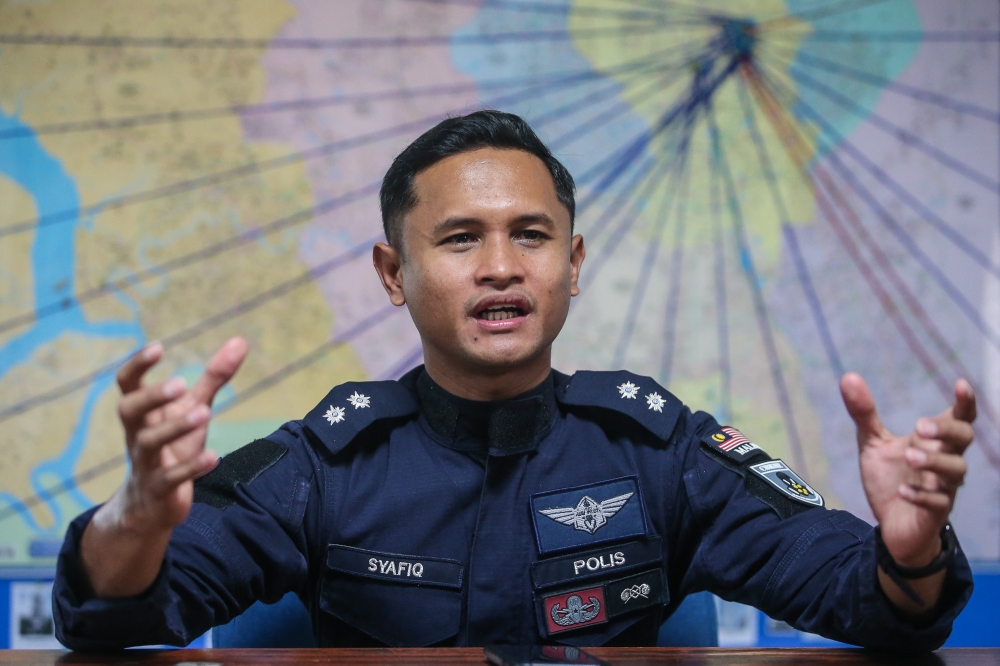
“The Criminal Investigation Team led the investigations while the Fire and Rescue Department’s Hazardous Material Special Team led the sampling, detection and cleaning efforts.
Hazmat is usually deployed for disasters or industrial incidents but this was a criminal case.
So, the police established the CBRNE to handle both tasks concurrently for smoother operations,” Syafiq told Malay Mail at the CBRNE operation centre at the Police Training Centre here.
Syafiq, formerly with the bomb disposal unit in Perlis, joined CBRNE as an armament inspector in 2024.
Although discussions to form CBRNE were already underway following regional threats, Jong-nam’s murder expedited the process.
Regional threats
Several CBRNE threats emerged in 2017.
A few days before Jong-nam’s assassination, radioactive materials containing Iridium-192 were found at a Shah Alam flat, where stolen equipment from a Klang-based oil and gas company had been dismantled.
Iridium-192 is sought by terrorist groups to build a radiation exposure device (RED) or a radiological dispersal device (RDD), also known as a “dirty bomb”.
That same year, Indonesian authorities foiled a pro-Islamic State (IS) plot to build an RDD using uranium-233, while Australian authorities arrested two IS-linked brothers planning to disperse hydrogen sulphide in public spaces.
CBRNE’s role today
CBRNE consists of 15 officers across three units in peninsular Malaysia, Sabah and Sarawak.
They are tasked with screening and security for high-profile leaders, particularly during political events such as the Sabah election last month and high-level diplomatic gatherings, including the 47th Asean Summit in October.
In industrial incidents, the unit assists Hazmat with detection and monitoring while helping the CID collect samples for investigations, including the 2019 Sungai Kim Kim toxic waste crisis in Johor and, earlier this year, soil and water sampling after the Putra Heights pipeline explosion.
CBRNE also trains officers in Armament Departments nationwide to become competent first responders to chemical, biological, radiological and nuclear threats.
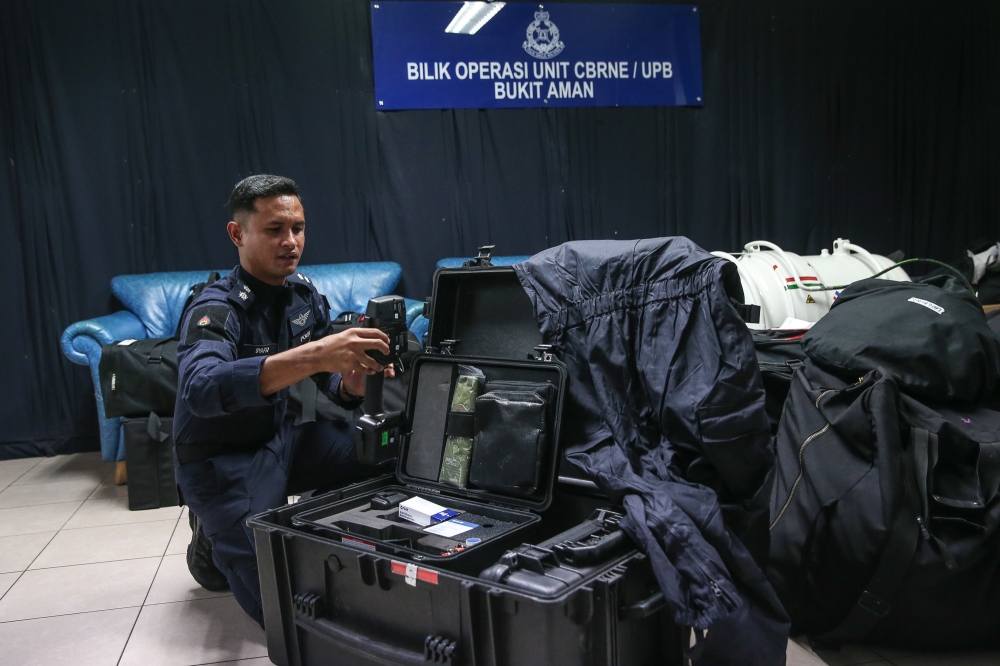
Explosives and robotics
Syafiq said the unit typically handles explosives improvised with chemical, biological, radioactive and nuclear elements, while the bomb disposal unit defuses conventional and handmade explosives, as well as old war-era ordnance.
“At CBRNE, we don’t send a man to do a machine’s work,” he said, highlighting the unit’s reliance on robotics.
“Currently, CBRNE has two robots here in the capital.
The first is a smaller version that can be fitted with tools to neutralise explosives remotely.
The other is a special robotic vehicle, built to detect and neutralise threats in risky terrains or dense forest areas.”
Citing a recent investigation in Vietnam involving possible radioactive threats in imported substances, Syafiq emphasised the need for vigilance.
“Our job is not a fast and furious one, like what you see in movies.
It is a constant cycle of learning and relearning about new threats and the tech to tackle them,” he said.


