


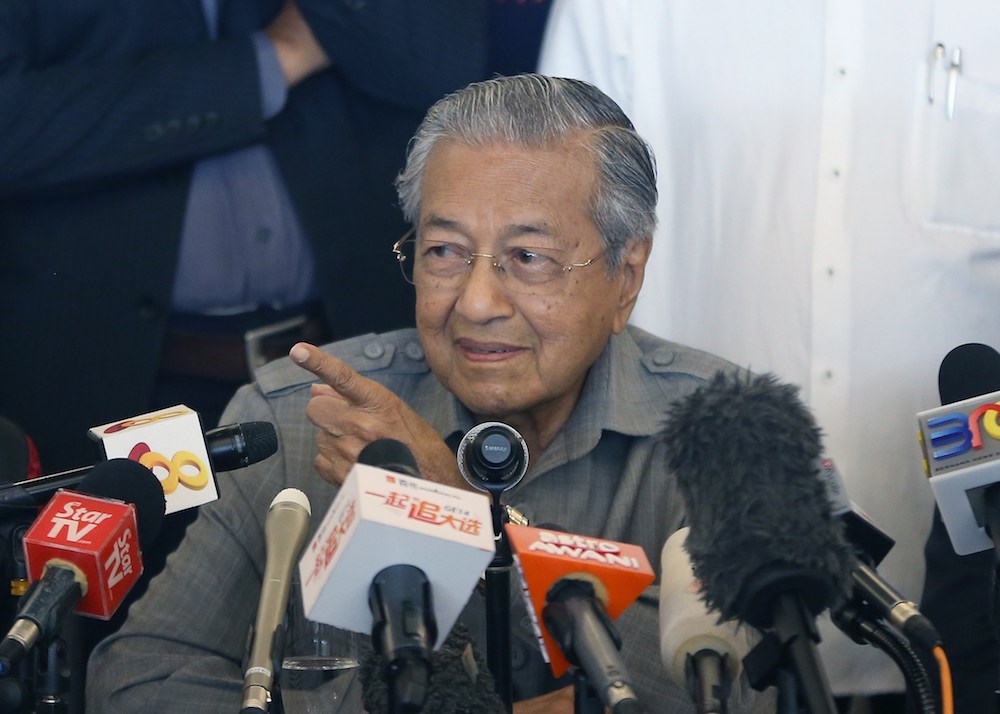
KUALA LUMPUR, May 10 — Pakatan Harapan is receptive of China’s One Belt One Road (OBOR) initiative but will still re-evaluate its place in Malaysia’s context, said Tun Dr Mahathir Mohamad.
In a press conference here, the prime-minister-elect said it was vital to determine the programme’s effects on Malaysia’s finances and the region’s stability.
“As far as the Belt and Road (OBOR) problem is concerned, we have no problem with that, except of course, we would not like to see too many warships in this area, because warships attract other warships, and this place may become tense because of the presence of warships,” he said.
The OBOR is among China’s most ambitious trade initiatives, through which the republic underwrote billions of dollars for investments in infrastructure development in countries located along the Silk Road, and linking them to Europe.
Dr Mahathir stressed that the review of Malaysia’s part in the OBOR was just one of many matters to be revisited by his incoming administration.
He said this was because China has shown that it was skilled at getting the better end of such agreements.
“In the first place, we need to study all the things done by the previous government. It is not only about China. It’s about a lot of things within the country,” he said.
Dr Mahathir expressed particular concern about financing arrangements for such massive infrastructure undertakings in Malaysia such as the East-Coast Railway Link (ECRL), which he said may place undue burden on public coffers in the country.
Dr Mahathir pointed out that a responsible government must try and reduce its debt to other nations.
Expounding on how he would approach the OBOR initiative, Dr Mahathir said that he had written a personal letter to Chinese president Xi Jinping, suggesting to create a land connection on the Silk Road, using trains.
“As you know, when the demand for oil grew, ships were built bigger and bigger until they were almost half a million tonne, but trains have remained small, and not long enough.
“So I suggested to Xi Jinping in a personal letter to him, that we should have big trains, and China has the technology to build big trains, which can carry goods from China to Europe, and will also make Central Asia-Kazakhstan and Uzbekistan, and all that, more accessible,” he said.
This, he added, would also advance the export of raw materials from Central Asia, to China, Japan, Korea and Southeast Asia.


