


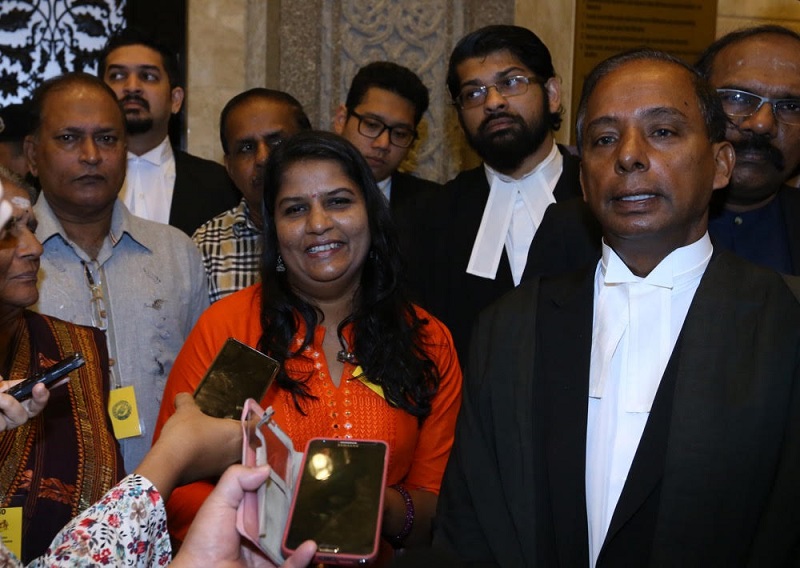
KUALA LUMPUR, Jan 30 — The Federal Constitution does not preclude the civil courts from assessing or reviewing issues concerning Islamic law, the country’s highest court said in a landmark decision.
In its summary judgment after annulling the unilateral conversion of Hindu mother M. Indira Gandhi’s three children yesterday, the five-member panel at the Federal Court said clause 1A from Section 121 of the Constitution did not diminish the powers or the scope of civil courts on matters considered the purview of Shariah courts.
Clause 1A was inserted in the Article in 1988, and stated that civil courts will not have jurisdiction in respect to any matter under the jurisdiction of the Shariah Courts.
The Shariah courts are primarily concerned with Muslim familial matters, such as marriages, divorce and inheritance. The civil courts have previously deferred to their Islamic counterparts in such matters.
“Article 121 (1A) does not constitute a blanket exclusion of the jurisdiction of civil courts whenever a matter relating to Islamic law arises,” Justice Tan Sri Zainun Ali wrote.
The court, which ruled unanimously in favour of Indira, also said the clause does not remove the “inherent” powers of the civil courts to conduct judicial reviews, or make statutory and constitutional interpretations.
Prior to yesterday’s watershed decision, even the country’s superior courts had previously said it was not the correct venue to consider matters related to Shariah laws.
“The powers of judicial review and of constitutional or statutory interpretation are pivotal constituents of the civil court’s power under Article 121 (1).
“Such a power is fundamentally inherent in their constitutional role as the bulwark against unlawful legislation and executive action,” she wrote in the summary.
The court also said such powers given to the civil courts are the “basic structure” to the Constitution, and cannot be removed from civil courts or given to Shariah Courts by way of a constitutional amendment.
“It would be invalid, if not downright repugnant, to the notion of judicial power inherent in the basic structure of the constitution,” it said.
“If (a case) it involves constitutional issues, it (the court) should not decline to hear it merely on the basis of no jurisdiction,” it said, stressing that Shariah Courts cannot be vested with “judicial powers” as they are not the superior court according to constitutional provisions.
The court stressed that the jurisdiction to review the actions of public authorities lies “solely” with civil courts.
Article 121 (1) of the Federal Constitution says that the “judicial power of the Federation shall be vested in the High Court.”
Yesterday’s Federal Court ruling reversed the Court of Appeal decision in 2015, where two judges in a majority judgment ruled against Indira after deciding that Shariah Courts have the “sole jurisdiction” in deciding on the conversion of Indira’s children.
The judges that decided Indira’s case were Court of Appeal president Tan Sri Zulkefli Ahmad Makinudin, Chief Judge of Sabah and Sarawak Tan Sri Richard Malanjum, and Federal Court judges Zainun, Tan Sri Abu Samah Nordin and Tan Sri Ramly Haji Ali.
A Muslim lawyers group yesterday responded to the decision by seeking for the Shariah courts to be on par with, instead of subordinate to the civil courts.
Malaysia employs dual legal systems, with secular civil courts that apply universally and a Shariah version that only binds and acknowledges Muslims.
Although technically distinct, the parallel legal systems have led to jurisdictional conflicts between the civil and Shariah courts, most notably in interfaith disputes such as in the case of Indira Gandhi and her children.


