












KUALA LUMPUR, Sept 26 —The final alignment and design of the Rapid Transit System Link (RTS Link), which connects Johor Baru and Singapore, will be decided before the expected signing of a bilateral agreement on the project in December.
Minister in the Prime Minister’s Office Datuk Seri Abdul Rahman Dahlan said the Sultan of Johor had proposed alternative alignments that would be looked into.
“We have set Bukit Chagar in Johor Baru (as the terminal in Malaysia) but there are different routes for the rail track to reach there,” he said.
“Once we have completed the month-long study on the new alignment, we will present it to our Singaporean counterpart.”
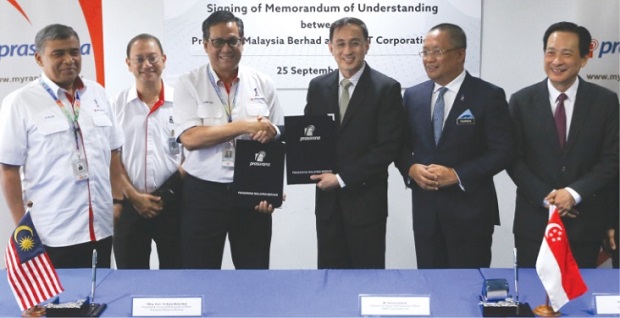
Abdul Rahman said this at a press conference after the signing of a Memorandum of Understanding (MOU) to form a joint venture company for the project, SMRT Corp Ltd.
The MOU was signed by Prasarana president and group chief executive officer Azmi Abdul Aziz and SMRT president and group CEO Desmond Kuek at Prasarana’s corporate headquarters in Menara UOA here yesterday.
The ceremony was witnessed by Prasarana chairman Tan Sri Khalid Abu Bakar, as well as SMRT chairman Seah Moon Ming.
On Aug 8, the Sultan of Johor Sultan Ibrahim Sultan Iskandar had expressed reservations on the proposed design of the RTS Link.
Abdul Rahman said he was granted an audience by the Sultan on Sept 19 in Mersing, Johor, and had explained the actual scenario of the project.
“Some of the perception that His Majesty had was based on third party information, so we gave him the true story,” he said.
“We took heed of his ideas and will improve the alignment. At the end of the day, His Majesty agreed the project is valuable to both countries and has to be done, the sooner the better.”
Abdul Rahman, who was given the task to brief the Sultan on the project progress from time to time, said some options are available on the bridge design crossing the Straits of Johor, which will take about two to three months to be finalised, in time for the signing of the bilateral agreement.
“There are some alternatives to the bridge design, such as high bridge, low bridge, diagonal bridge, or whether it will run parallel to the Johor-Singapore Causeway,” he said.
“We are mobilising and have doubled our resources in finalising the alignment and other technical details. Give it a little bit of time (to complete).”
The total costing of the project has yet to be decided on, said Abdul Rahman, as it is dependent on the final alignment of the rail track.
He said certain details, such as who will take control over the joint venture company, would be ironed out after December.
“We don’t believe it is on a 50-50 basis because there could be a deadlock in making decisions,” he said.
“We are approaching this in a brotherly way and both countries has agreed that one party has to take a majority. This will make it easier to make decisions and to carry out whatever plans we have for the link.”
Abdul Rahman said the RTS Link represents a significant milestone in the bilateral relations between Malaysia and Singapore, and would help to elevate connectivity between the two countries and help alleviate congestions at the Causeway.
He said the link, first announced in 2010, further enhanced the connectivity and mobility between Malaysia and Singapore.
It was expected to be completed by 2024 and would mobilise 10,000 people each direction per hour.
The main terminal for Malaysia has been selected in Bukit Chagar in Johor Baru, while Singapore has chosen Woodlands North to locate its terminal, along its Thomson-East Coast Mass Rapid Transit (MRT) line, which will include 31 stations and to open in stages from 2019 to 2024.