


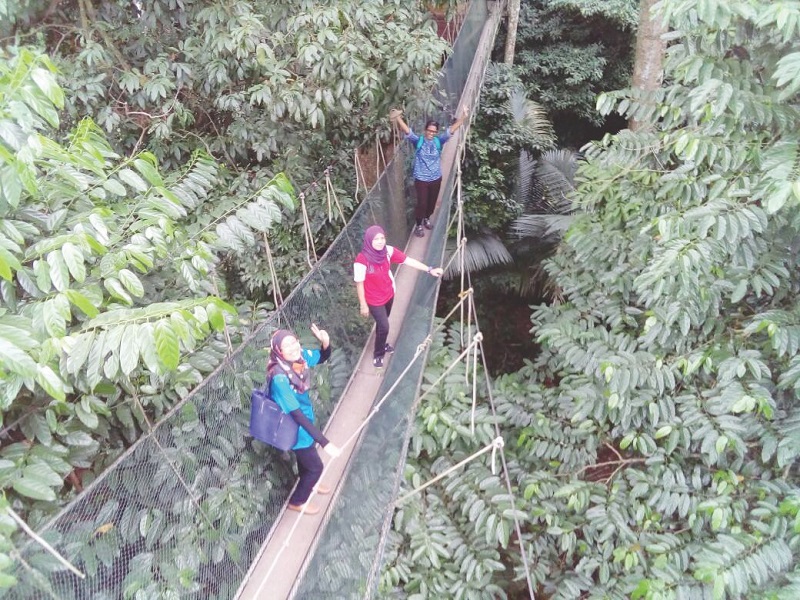
 KUALA LUMPUR, July 1 — The 25-year-old canopy walkway at the Forest Research Institute Malaysia (FRIM), on the fringe of the city’s North, saw its last batch of environment buffs walk through the trees taking in the sights and the air yesterday.
Beginning today, it will be closed to the public, after the iconic “bridge in the sky” exceeded its typical structural lifespan.
Countless visitors and storm damage have left the suspended walkway structurally unsafe and in need of constant maintenance, while also affecting the health of the trees it was built on.
Ecotourism and Urban Forestry programme head Dr Noor Azlin Yahya said the structure was part living organism and subject to natural limits.
“The average lifespan of canopy walks is a decade or slightly more but ours has been exceptionally hardy thanks to specific conditions and regular upkeep,” she said.
“But storm damage in 2015 had caused severe damage which the anchor trees holding up the structure have not recovered from.”
Noor Azlin said the closure would be a loss to the public especially as the entrance fee was minimal.
“The walkway is not about commercial interests but rather giving the public access. We do not justify its existence as a means to generate income,” she said.
Built in 1992, it allowed researchers to observe the area’s flora and fauna while being immersed in a natural environment. It was open to the public the following year.
The 150m structure, held up by steel cables and a maze of ropes and netting, sits on five large trees which “anchor” the walkway along with four smaller support trees.
At 300m above sea level, three platforms allow a steady and uninterrupted view of the surrounding hillside with Kuala Lumpur being visible in the distance on clear days.
In its heyday, the walkway had 250 visitors a day, six times a week between 9.30am and 2.30pm, but this was reduced to 100 following storm damage.
Plans are under way to build a replacement made out of aluminium scaffolding and platforms, which would not depend on trees for support.
Forestry and Environment division assistant research officer Wan Mohd Nafizul Wan Ahmad, who had overseen the walkway for the past decade, said closing the canopy was the right thing to do.
“Damage to the bark of supporting trees is preventing nutrients from travelling to major branches and numerous cracks have appeared,” he said.
“This has resulted in loss of leaves, rotting and termite infestations, degrading their ability to support the structure.”
Squirrels also often chewed away sections of the rope.
Wan Mohd Nafizul said measures to relieve the strain had not slowed the deterioration, and predicted the trees might not recover to support the canopy walkway system.
“We have replaced old brackets and shifted their positions to avoid straining the same spot. We also installed steel cables running from the supporting trees to anchor points on the ground,” he said.
“It is safe in the sense that we are able to come up here and carry out low intensity activities. But on a long-term basis, we feel that it is about time to retire the walkway and let the trees recover.”


