




PETALING JAYA, June 26 — As families share photographs of items belonging to those on board the missing MH370 that were washed up on a beach in Madagascar, American lawyer Blaine Gibson, who has been dubbed a modern day Indiana Jones, shares his footsteps leading to the discovery of new items that could be part of the Malaysia Airlines plane. He speaks to Sunday Mail about his experiences.
“I travelled to Nosy Baraha, a small island on the northeast of mainland Madagascar on June 5 with France 2 television crew as they were filming a documentary about the search for MH370.
I chose the island because my research with oceanographers David Griffin and Dr Chari Pattiaratchi indicated the east coast of Madagascar was a possible place for debris to wash ashore from virtually anywhere in the equatorial or the southern Indian Ocean.
The conditions were also favourable as Cyclone Fantala, which could have shaken debris loose from the middle of the Indian Ocean, had recently passed north of Madagascar, making this a good time and place to look.
I began my search on Riake beach on June 6, heading out with my guide Cyriak Tiana and the France 2 TV crew on quad bikes, travelling 18km to the northern part of the island.
While we rode, something caught my eye and I asked my guide to stop. This is where I found the first piece of debris that could have belonged to MH370.
The debris was a light grey smooth panel with empty hi-lock pin holes in it, which was 77cm by 50cm and greatly resembled a panel I found on the coast of Madagascar last February, which had the words “No step “ stencilled on it.
After the first find, I decided to move further north with my guide while the France 2 TV crew turned back.
As we went further north near the end of the beach, we found a second piece among the rocks, a smaller fibreglass composite panel with the inscription "FB" in what seemed to be in black on light grey paint.
The other side of the panel was flat and smooth, with light grey colour and green scratches.
I also found a third and, if confirmed to belong to MH370, was a crucial part of the investigation. It was a plastic frame or case which wraps around a screen monitor, usually placed at the back of a passenger seat, consistent with the design on a Malaysia Airlines 777-200 economy class section.
The third piece has a coat hook attached and Velcro with small pieces of fabric attached to it with three small barnacles at the back. If confirmed to be from MH370, it tragically proves the main body of the cabin broke apart in a forceful impact and disproves any sort of controlled ditching.
After a few days, Cyriak and I were unable to find any new debris on the same stretch we went along on June 6.
It was only days later that I found a panel with six hi-lock pins intact, the fourth debris along the stretch of the beach.
The intact pins on the panel were 10mm in diameter, with the debris being 12mm long with the word “ON” stencilled on it, almost similar to the panel with “No Step”, which I found earlier this year.
On our way back, we also stumbled upon a fifth piece, a small fragment of a plastic fibreglass composite which had no distinguishing marks on it.
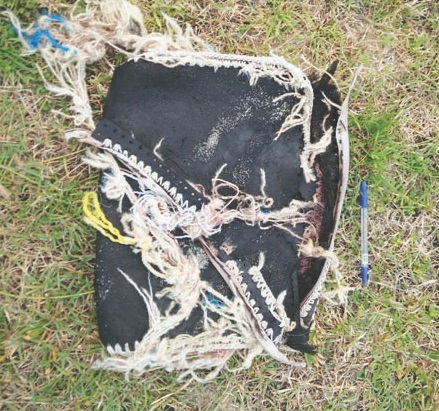
Apart from the five main pieces of debris, I have also collected a total of 17 carry-on sized bags along with half a laptop computer case, two small cases that strap onto a belt, possibly used to hold a camera or other portable device.
Checks on the inside of all these bags, that have no identifying marks on them, revealed they were tattered and empty as they had been in the water for a long time.
The only identifiable bag was the laptop case which had the word “Mensa” on it, but there is no way to know their origins, be it from a boat or a plane, aside from confirmation from family members.
Identifying the belongings was very difficult for me, emotionally — to caption the photos and send it over to the surviving family members I knew — but they gave me the courage to do so.
Since all five pieces, except the monitor case, are devoid of barnacles, my guess is they have been washed ashore, back out to sea, and back in, perhaps many times. That is how the ocean works and slowly, the sea is revealing its secrets.
The barnacles will hopefully provide some clues to the location of the crash site and route followed, as do buoyancy tests, drift analyses, and examination of marine micro-organisms.
Stress tests by experts will also hopefully give some clues about the plane’s final moments and nature of the impact.
I have handed over all these items to the relevant authorities with the understanding they will be investigated thoroughly and if no positive identification is made through tests, the items will be returned to family members at their request.”


