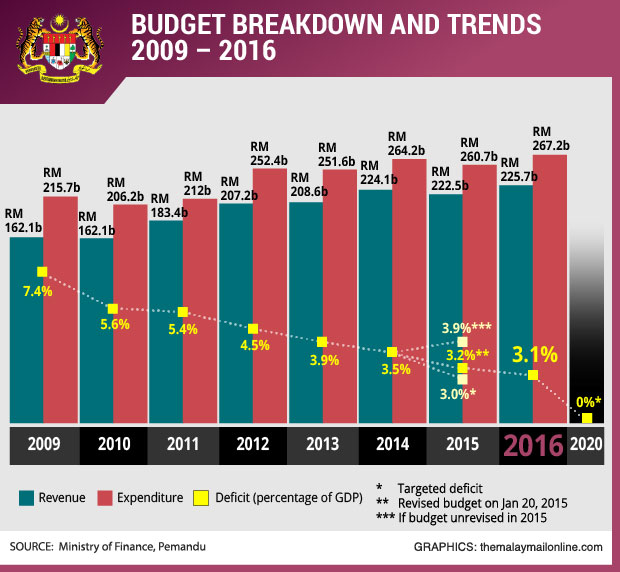
KUALA LUMPUR, Oct 23 — Three academics gave the thumbs-up to the 2016 Budget, saying that it has to a certain extent succeeded in addressing the rising cost of living, particularly for households in the bottom 40 per cent or B40 income group.
The number of B40 households, with an average monthly household income of RM2,537, is estimated at 2.7 million.
Themed ‘Prospering the Rakyat’, the Prime Minister Datuk Seri Najib Razak outlined five priorities: STRENGTHENING economic resilience, INCREASING productivity, innovation and green technology, EMPOWERING human capital, ADVANCING the Bumiputera agenda, and EASING the cost of living of the rakyat.
Best budget
Dean of Universiti Utara Malaysia’s College of Legal, Government and International Studies Asso Prof Dr Ahmad Marthada Mohamed, in fact, described the budget, which was tabled at the Dewan Rakyat today by Prime Minister Datuk Seri Najib Tun Razak, as “the best one” in recent years.
He said it was obvious that the government had been listening to the people’s grievances and was committed to easing the financial burden of the rakyat, following its decision to retain the 1Malaysia People’s Aid (BR1M) programme although certain quarters had criticised it.
“Households in the lower income groups are feeling the pinch as a result of the rising prices of goods and services and they truly appreciate the BR1M payouts.
“However, the general feeling among some sections of society, particularly those who are not concerned about the plight of the poor, is that BR1M is unnecessary (and should be abolished),” he told Bernama.
Create effective mechanism
Ahmad Marthada suggested that the government come up with a proper mechanism to implement the BR1M programme effectively and ensure that only the target groups benefitted from it.
He said while discontinuing the programme was out of the question, the government could, however, make some improvements to the payment process.
In his budget speech today, Najib said some 4.7 million households and 2.7 million single people would benefit from the BR1M programme, for which the government has allocated RM5.9 billion.
Under the new BR1M payouts as outlined in the 2016 Budget, people earning less than RM1,000 will get RM1,050 while those with incomes below RM3,000 will receive RM1,000 (previously RM950 for both categories). Those earning less than RM4,000 will receive RM800 (previously RM750) while unmarried people above 21 with monthly incomes below RM2,000 will receive RM400 (previously RM350).
Head of Universiti Putra Malaysia’s Department of Resource Management and Consumer Studies Asso Prof Dr Mohamad Fazli Sabri welcomed the higher BR1M payouts but he, however, did not approve the inclusion of young single people in the programme.
“These people have the physical ability to work hard and earn more. The BR1M money allocated to them should, by right, be channelled to the more deserving senior citizens and single mothers who are finding it hard to cope with the rising cost of living,” he said.
On the removal of the Goods and Services Tax (GST) on more essential goods, including controlled medicines for cancer, diabetes high blood pressure and heart disease, Ahmad Marthada said the move was timely as healthcare costs for most Malaysians had escalated following the implementation of GST on April 1 this year.
“This is good news for the lower-income groups as the prices of diabetic and blood pressure medicines will come down when the GST is removed,” he said.
Reforms
On the government’s decision to set the minimum starting salary in the civil service at RM1,200 a month, Mohamad Fazli said this was long overdue and hoped that more reforms were in store for the public sector.
He said the move would not only benefit some 60,000 workers in the civil service, but also spur them into becoming more proactive, competent and efficient in discharging their responsibilities.
“All these years, we have been championing for better salaries for the foreign workers and did not pay much attention to our civil servants. Now finally the government is doing something for them... it should have been implemented earlier,” he added.
Dean of Universiti Malaysia Sarawak’s Faculty of Economics and Business Prof Dr Shazali Abu Mansor said although the allocation for the 2016 Budget was not all that substantial, it still managed to meet the aspirations of the people.
He said despite uncertainties in the nation’s economic climate, the government could still afford to meet the social, educational and health needs of the people.
“Of course, there will be people who will continue to make derogatory comments (about our government and the budget), but the truth is it has the ability to give the best to the people and the nation.
“I hope the government accepts the criticisms and views expressed by the people... being more open-minded will help the government to gain the confidence of the rakyat,” he added. — Bernama