


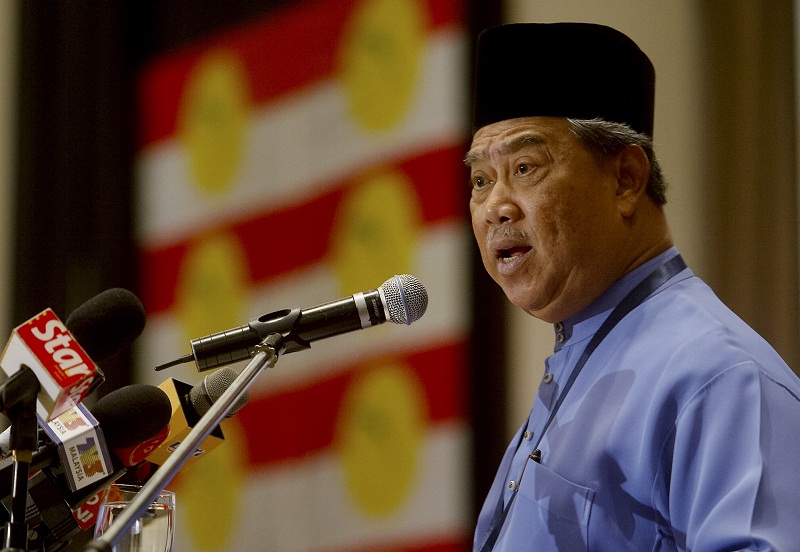
KUALA LUMPUR, Aug 26 — Tan Sri Muhyiddin Yassin cautioned today that Malaysia could turn into a “failed state” if the government fails to boldly tackle a looming national crisis fuelled by political and economic instability.
The former deputy prime minister said his keen awareness of this risk led to his continued push for the government to immediately take corrective measures.
“I wish to remind that if we fail to boldly tackle the crisis that has come upon our country and face it or ‘take the bulls by the horns’, I worry that Malaysia will become a failed state,” the Umno deputy president said in a statement today.
Muhyiddin listed the factors that could cause Malaysia to be a failed state as an unstable global economic climate, plunging ringgit value, extraordinary political turmoil, price hikes and rising living costs.
He also cited the “uncontrolled” influx of foreigners and cooling investor sentiments.
Last Tuesday, Prime Minister Datuk Seri Najib Razak said Malaysia and its government may not be perfect given the current problems plaguing the nation, but insisted that this does not mean that the country is a “failed state” or a “rogue nation” as claimed by critics.
The prime minister cited Malaysia’s scoring of the highest margin in the Global Islamic Economy Indicator 2014-15 ranking against 70 other Islamic nations as evidence that his administration is steering the country in the right direction.
He also cited Malaysia’s “top spot” in the Global Competitiveness Report and the World Bank Report of Doing Business.
A columnist with US-based magazine The Diplomat recently wrote that Malaysia was fast becoming a “rogue” nation and a “failed state” due to alleged corruption in the administration, despite its leaders’ repeated pledge to address the problem.
The column, titled “Going Rogue: Malaysia and the 1MDB scandal”, claimed that the controversy over 1Malaysia Development Bhd (1MDB) showed how many of the country’s key institutions have lost credibility as they are deemed to have been “co-opted” to help keep Barisan Nasional in power.
But Najib claimed critics of his administration had “vested interests”, and expressed regret that many of the country’s youths trusted such propaganda more than their own government.
He also called those who spread such alleged propaganda as the “enemies of Islam”.


