


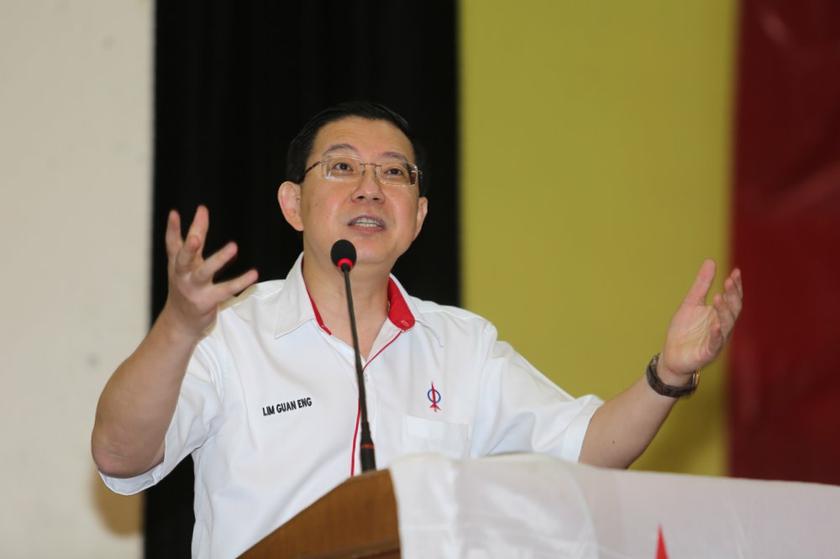


GEORGE TOWN, June 2 — Continued investments and tourism will help Penang recover faster from the impact of the Goods and Services Tax (GST) compared to other states, Chief Minister Lim Guan Eng said.
The DAP leader said the consumption tax, which came into effect from April 1, has taken its toll on spending power, pointing to how some small businesses like sundry shops and traditional medicine shops had been forced to close down.
But he said within two years, he was confident the state’s flourishing economy could bounce back.
“This is because our people depend on themselves and we continue to bring in investments and tourist dollars,” he said.
“We know people are suffering and we truly understand so we are doing what we can to alleviate (the burden), such as the local councils absorbing GST for its services,” Lim said in an interview with Malay Mail Online.
Lim added that as long as the state practices good and clean governance under its CAT (competency, accountability, transparency) principles, Penang will be able to cope much better than other states.
The state, known as the Silicon Valley of Malaysia, is now not only dependent on its electronics and electrical (E&E) manufacturing sector to drive its economy, but also on its services sector with a focus on tourism.
“We have an equalisation where 48 per cent of the economic contribution is by the manufacturing sector while 47 per cent is by the services sector,” he said.
He said the state government deliberately made both sectors on par so that Penang’s economy does not wholly depend on one sector.
Lim is also confident that investments, in the E&E as well as in medical devices, will continue to come in this year and the next.
He refused to divulge details on investment projects in the pipeline, but hinted that more multinationals in the E&E sector will be setting up shop in Penang.
The state government is also working to boost medical tourism by trying to attract more hospitals to open in the state, said Lim.
As for balancing tourism and heritage conservation, particularly within the Unesco heritage zone of George Town, the Air Putih state assemblyman said Penang has to allow development within the zone to turn it into a vibrant city.
“It was a ghost town previously and now, it is a tourist town but the attractions are still very Penang, the wall murals are very Penang, the shops and the architecture are still very Penang,” he said.
He expressed hope that the Special Area Plan, which aims to help strike a balance between development and heritage conservation, will be finalised and gazetted by the third quarter of this year.


