


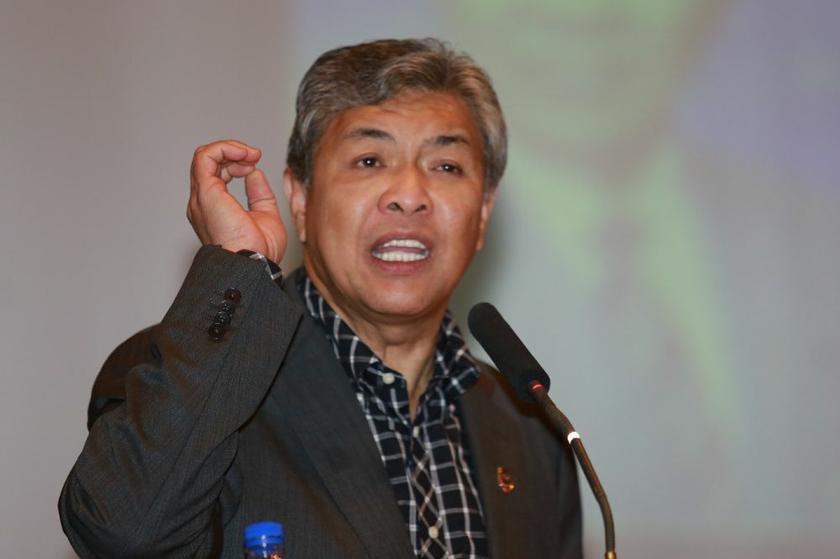


PUTRAJAYA, Feb 23 — Despite saying people smuggling is the price to pay for development, Home Minister Datuk Seri Ahmad Zahid Hamidi reiterated today the government’s commitment to revise the Anti-Trafficking in Persons and Anti-Smuggling of Migrants Act 2007.
He said the government will push through with several amendments to the law in Parliament next month, which includes granting more power to enforcement agencies as global scrutiny intensifies over Malaysia’s ranking in the US State Department’s annual Trafficking in Persons Report.
“The Malaysian government wants to give an assurance that we are serious in this though we know it is a hefty price to pay for development purposes… it is not like what is being accused by several parties,” he told reporters here after meeting with Maria Grazia Giammarinaro, the UN special rapporteur on trafficking in persons, especially in women and children.
Zahid said four high-level committee meetings on the amendments have also been held with five other ministries.
“These meetings involved six ministries besides the Home Ministry to coordinate all action plan and to find solution to several problems, including the granting of protection and finding third countries to place human trafficking victims as agreed by the United Nations,” he said.
The other ministries roped into the effort are the Human Resources Ministry; Foreign Affairs Ministry; Women, Family and Community Development Ministry; Transport Ministry and the Communications and Multimedia Ministry.
“Malaysia is one of main choices in the Asean region for human trafficking businesses. The problem that arises is not because of the victim but the third party who trades them in the workforce... they are the one who need to be penalised heavily,” Zahid said, adding that this was why Malaysia’s aforementioned anti-human trafficking law must be strengthened.
Zahid said that in his closed-door meeting with Giammarinaro, they also discussed legalising United Nations High Commission for Refugees (UNHCR) card holders in the country to make them a legitimate part of Malaysia’s workforce.
However Zahid pointed out that Malaysia’s laws do not permit such a move, but said he assured Giammarinaro of further discussions on the matter.
The minister then insisted that human trafficking issues were still under control in Malaysia.
In June last year, the US State Department downgraded Thailand and Malaysia to the lowest possible rating in its annual report on combating modern slavery, while lifting China and Sudan from that status to a “watch list.”
According to the US agency, countries on the lowest tier may be subject to certain sanctions, including the withholding or withdrawal of non-humanitarian, non-trade-related foreign assistance.


