


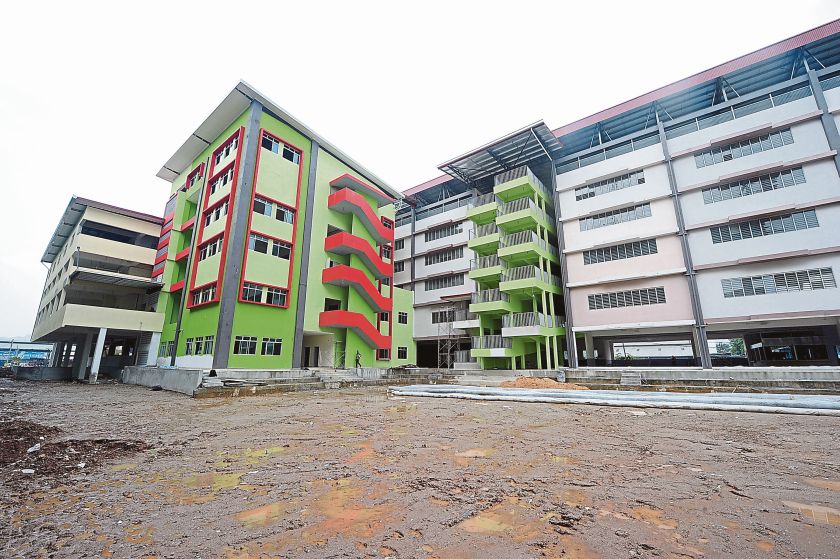
KUALA LUMPUR, Oct 31 — With a strong belief that education is life’s most valuable treasure, Federal Territories MCA chief Datuk Yew Teong Look has given his all to ensure SJK (C) Wangsa Maju becomes a model education institution when it begins operations next year.
Yew, 58, a former Wangsa Maju MP, has been actively involved in the setting up of the school in the last decade.
“Residents and community leaders formed a committee in the 1980s to request a Chinese school to be set up in the area,” said Yew, who is also a board member of at least 10 Chinese schools in the country.
“My interest in education led me to join their struggle in the 1990s, and I was later appointed the secretary of the committee.”
Yew, who is the SJK (C) Wangsa Maju board chairman, said that during the initial years, countless letters were sent to the Education Ministry and the MCA asking for the school to be built.
“Many MPs came and left, but our struggle to set up the school never stopped,” he said.
The school remained his top priority when he was elected the Wangsa Maju MP in 2004.
“Whenever I met people, they often asked about the status of the school and I was determined to ensure it was built for the community,” he said.
A window of opportunity opened in 2006 when MCA conducted a nationwide study to ascertain the number of Chinese schools needed to cater for the community.
Yew said Tan Sri Ong Ka Ting, who was then the MCA president, had pushed the request for the setting up of the school on top of their list which was submitted to the government.
However, in the 2008 general election, Yew lost the seat to PKR’s Wee Choo Keong by 150 votes.
“I was sad I lost my seat with such a narrow margin, but I told myself I was not going to give up. I continued to serve the people and often championed for causes related to education,” said Yew.
There was, however, a silver lining as barely a few months after the general election, the Education Ministry announced it had given the green light for a new Chinese school to be built in Wangsa Maju.
Yew said it was the only school which received approval from the ministry from the 10 which were proposed by the MCA.
“I had mixed feelings. While I was happy and relieved that approval had been granted, I knew the journey had only just begun, as I had to secure land for the school to be built,” he said.
Yew said it took him three years to negotiate with a host of corporate figures and individuals before housing and commercial developer Platinum Victory Sdn Bhd donated land for the school.
He said the developer had offered two pieces of land — in Jalan Genting Klang, which was within the Wangsa Maju constituency and another parcel in Jalan Usahawan which was under the Setiawangsa constituency.
“My choice was the one along Jalan Usahawan as it would be able to cater for those living in Taman Sri Rampai, Wangsa Maju and Taman Danau Kota,” he said.
“It did not matter even if it did not come under the constituency I am serving as I believe when it comes to education, one should put all differences and ideas aside and focus on contributing to the society.
“So what if it doesn’t fall within Wangsa Maju, as long as it is in the same area and it serves its purpose, I am more than happy.”
Yew said the land worth RM20 million, measuring 2.08ha and located near the main road, was ideal for the school.
“The planning works for the building began in 2011 and I visited the site everyday when construction began to ensure there were no hiccups,” he said.
Yew said he held the project close to his heart and he paid interest in every single feature — from the layout, to design to even accessory which was fitted in the building.
“After more than 20 years, Kuala Lumpur will witness the opening of a new Chinese school with a smart concept,” he said.
“A school is an education home for our children who are the future of the country and we must give them our best.”
Yew said his work would not end when the school received its first intake of pupils next year, as the school board was already envisioning a new chapter for future developments.
“We have 17 members on the school board, and we will have to work hard to ensure operations are smooth,” he said.
“We have been entrusted with a responsibility which we must pursue with full integrity.”
The 52 classrooms are expected to be fully utilised in the next few years with a maximum capacity of 1,800 pupils.


