


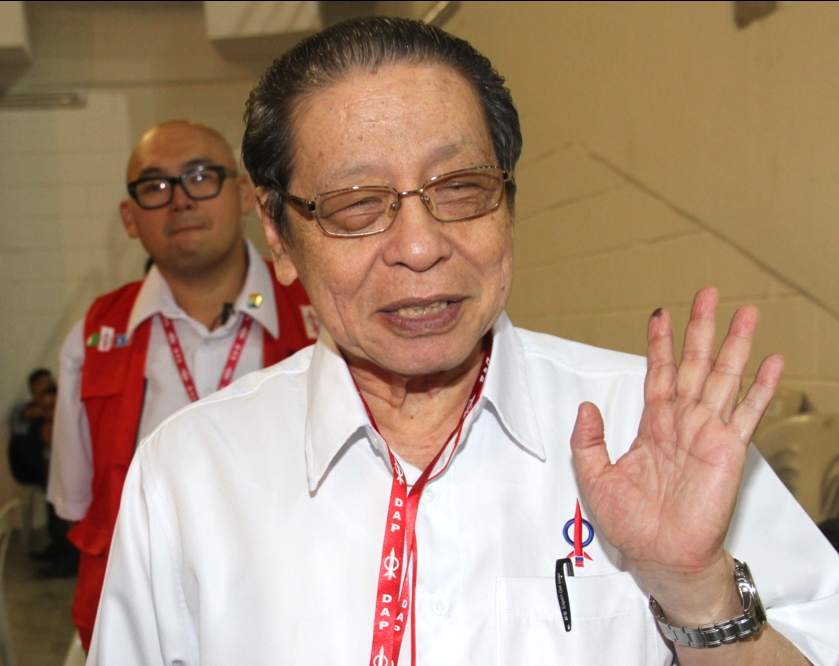
KUALA LUMPUR, Oct 6 — DAP’s Lim Kit Siang today shredded Universiti Malaya’s (UM) explanations for sitting out one international university ranking when it readily participated in another.
Noting that the Times Higher Education Supplement’s Top 400 World University Rankings (THES) uses similar citations as the QS World University Rankings, the DAP stalwart said it was questionable that UM and Universiti Kebangsaan Malaysia (UKM) elected not to participate in the former.
Lim added that the UM vice-chancellor Prof Datuk Dr Mohd Amin Jalaludin’s claim that UM lacked funds to match the output of older and more established universities globally was dubious, since UM and UKM each received more than half a billion ringgit in funds under Budget 2014.
“If both of these institutions feel that they are underfunded, what about the other public universities including UUM (Universiti Utara Malaysia) which is listed as one of the participating institutions (in the THES) in Malaysia with only (a) budget of RM260 million?” Lim said in a statement.
“Clearly, the point of participating is to see how much our public universities can improve over the years with a given amount of budgetary allocation. Without participating in the THES rankings, we won’t know if the performance of our public unis have improved over time,” Lim added.
Last week, Amin was quoted by news portal The Malaysian Insider as saying that UM had only started building up its publications and citations in the Web of Science database in 2008, a policy which he described as “not yet sufficiently mature to make an impact”.
The senior academic added that UM is “not yet in a strong enough financial position” to compete with “richer, older and better-ranked universities”, and that it will take time for the university to come up to scratch.
UM Students Association (PMUM) President Fahmi Zainol later supported the move to opt out of the THES ranking, arguing in a statement run by Malaysiakini that lecturers and universities had ended up chasing citations and funds from commercial activities to prop up their rankings, at the expense of quality of education.
Lim today acknowledged that both the THES and QS rankings have come under their fair share of criticism over the years in terms of their ranking methodologies, but stressed that it should not be left to the dons to arbitrarily decide which rankings to pursue and when to participate.
“It would be a good for (them to) hold a referendum to let the 50,000 undergraduates and post-graduate students of UM and UKM decide whether the two university should join or continue to boycott the THE university rankings, and let the proponents of both the pros and cons of the argument to state their case, not only to the university student-and-lecturer population but to the nation at large.
“This referendum proposition is a subject which PMUM and the UKM Students Council should seriously consider to take up with the university authorities,” he said.
UM initially ranked 89th among the world’s universities when the THE-QS World University Rankings had its first run in 2004, after which the varsity floated in and out of the top-200 ranking over the next five years.
UM progressively improved its ranking to 151 for the 2014-2015 season when it shifted to the QS world rankings, which started in 2010 after Quacquarelli Symonds - an education consultancy initially commissioned to run the THES survey - split ways with the Times, which continued to maintain the THES.
UKM’s ranking on the THES, meanwhile, was more volatile. After entering the fray ranked 289th in 2005, their position went as low as 309th to as high as among the top-200 in a five-year period up to 2009.
Their ranking normalised after switching to the QS ranking in 2010, hovering below the 270th rank from 2010 onwards, save for in 2011 when UKM was ranked 379th among the world’s participating universities.


