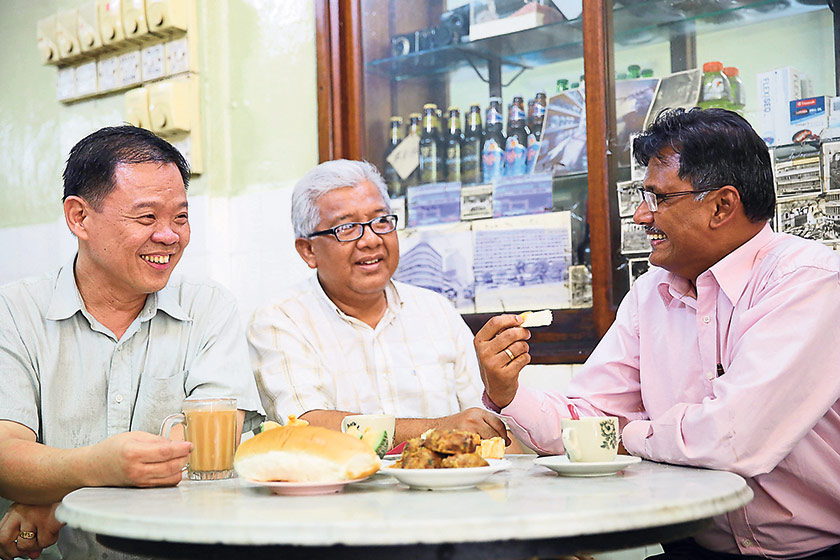


KUALA LUMPUR, Aug 31 — The picture of the three men — Chinese, Malay and Indian — sitting there enjoying their tea break is like something out of a Lat cartoon. Something from a time past when things were simpler, right?
The thing is, the picture was taken just a few days ago and those three men have been friends for years.
KY Lin, 55, owns and runs Capital Cafe on Jalan Tuanku Abdul Rahman with his siblings. He grew up with Asril Wahab, 56, who now runs the Nasi Padang stall which was first started by his father in 1962.
Daniel AS Rajan, 53, first ate at the cafe when he was 10 years old. Coincidentally, Lin and Daniel both worked in the same place in Sungai Petani.
While Lin returned to Kuala Lumpur earlier to take over the reins of the cafe from his father, Daniel returned only in 2004.
Since then, they have met up in Capital at least once a week so yes, these three know each other very well.
But what about the rest of Malaysia? How much do we know of each other?
A straw poll conducted by Malay Mail Online earlier this month showed that Malaysians do know each other... but not really that well.
The survey, which polled about 61 Malaysians across Malaysia, tested their knowledge of other ethnic groups in five areas: language, cuisine, superstitions, festivals, and if they have been to East Malaysia (for those from the peninsula) or West Malaysia (for those from Sabah or Sarawak).
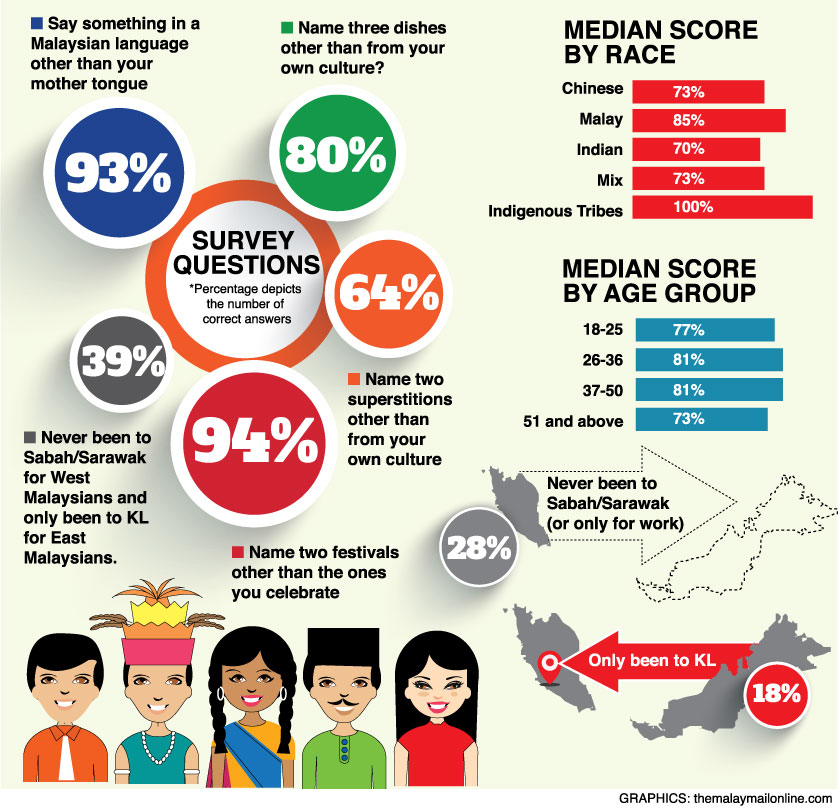
Those from Sabah or Sarawak scored the highest at 100 per cent, while the Malays came in second at 85 per cent.
The Chinese and those of mixed parentage scored 73 per cent each, while the Indians scored 71 per cent.
So, we know a little about each other.
Survey participants showed the greatest knowledge of festivals of other races and having the ability to say something in a language other than their mother tongue.
Participants were also rather familiar with what people of other races eat, scoring 80 per cent when asked to name three dishes from another culture.
Although most could name a cuisine other than that of their own race, some were unable to differentiate between dishes of other ethnic groups, such as calling nasi biryani a Malay dish (it’s actually an Indian-Muslim dish). Participants scored the poorest on the superstitions of other ethnic groups.
The common superstitions correctly cited by some were Chinese ones like four being an unlucky number and Indian ones like not cutting fingernails at night. Some could also name supernatural creatures in Malay culture like pontianak (vampire) and jin (djinn).
Almost one-third of participants living in the peninsula (28 per cent) have never visited Sabah or Sarawak before.
 Kadazandusun Julie Jude Kanun, who has lived in peninsular Malaysia for five years, said she knew a lot about the Malays, Chinese and Indians, but noted that peninsular Malaysians did not seem to be very familiar with Malaysians from Sabah and Sarawak.
“Sometimes, I wonder if Sabah and Sarawak are part of Malaysia or not,” said Kanun, a 26-year-old administrative assistant.
Many participants said they felt that Malaysians in general were not very well-versed with each other across the racial divide. Apart from superficial things.
“Some might only know things about other religions because we learn about it in school, and others may mingle with other races and some might just stick to their own kind,” ethnic-Indian student Ranjali Ragupathi, 22, told Malay Mail Online.
Asrul Hadi Abdullah Sani, a 32-year-old Malay political analyst, felt Malaysians have “grown more suspicious of each other’s culture and practices” in recent years.
Ethnic-Chinese HR executive Ang Yiang Yiang, 27, said Malaysians were typically unfamiliar with other cultures, citing an example of not knowing what Muslims do during Awal Muharram or Hari Raya Korban. “For me, I think it’s because it doesn’t really affect my life as I don’t hang out much with people from different cultures. We don’t learn them in school too.”
Muslim Mohd Nazari, a 26-year-old HR executive who has Malay, Welsh, Indian and Jawa blood, said his mixed parentage has led him to mingle with all races in Malaysia.
“So I guess I don’t discriminate, nor do I get discriminated against. It makes it easier for me to mix with all races or cultures.”
While some participants said they noticed a measure of distrust between ethnic groups in Malaysia, one noted the multi-cultural country’s potential to be a great democracy if Malaysians were treated equally.
“To treat a person based on their personality and character, rather than race and religion, and to give equal opportunities to all,” said Pritiss Nair, a 28-year-old ethnic-Indian doctor.
The survey participants comprised Malays (33 per cent), Chinese (31 per cent), Indians (20 per cent), mixed parentage (8 per cent) and East Malaysian natives (8 per cent). Those residing in peninsular Malaysia comprised 85 per cent.
Maybe the real trick to getting to know each other is to spend time with each other. Like Lin, Asril and Daniel.
We have to invest time in each other for a relationship to grow. For the distrust to lessen. Lin said this about his friend: “Daniel is my spokesperson... he knows everything about me.”
The challenge for us as we head towards the next Merdeka Day is this: to get someone of another race to say that about us. To make friends, to become a friend.
Selamat Hari Merdeka!