


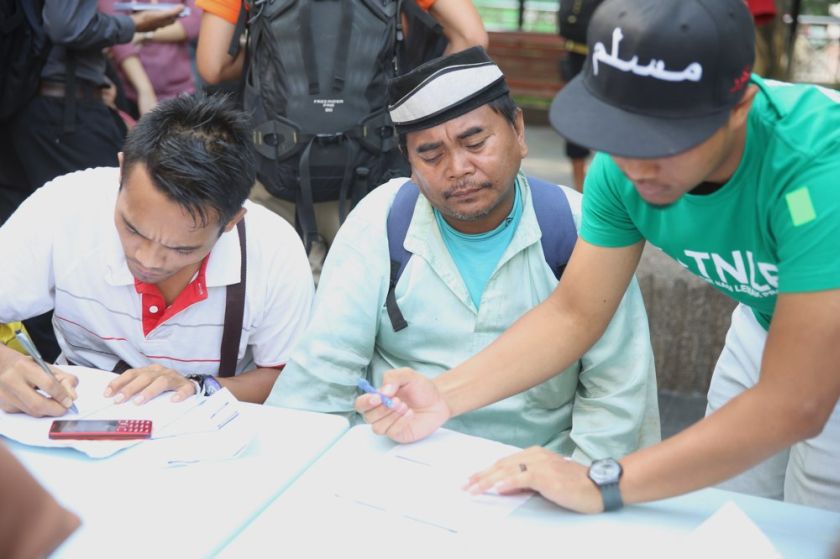


KUALA LUMPUR, July 22 — Two weeks ago Murugan (not his real name), was severely beaten up and had all his belongings, including his identification documentation, stolen.
He came to the city to work as a supervisor at budget hotel near Kotaraya, one of the city’s earliest shopping malls, but was not able to secure a living quarters with his salary.
Out of desperation the 30-year-old has lived on the city’s streets for the past two months after leaving his hometown in Port Dickson, before he was robbed.
Concerned that he might be held up under “Ops Qaseh” anti-vagrant operations and put behind bars for sleeping on the streets, Murugan showed up at a temporary booth set up by Persatuan Kesedaran Komuniti Selangor (Empower) to assist the homeless in replacing their stolen or lost identity cards (MyKads).
WIth the help of several soup kitchens in the capital, Empower took up the cases of 10 vagrants occupying the city’s streets to prevent them from being wrongly identified as foreigners.
“We are fearful that they may be arrested and held up at immigration depots because they lack documentation,” Empower president Janarthani Arumugam said when met yesterday morning.
According to Janarthani, their applications for replacement MyKads were either hampered by the fact that they did not possess the police reports required when the document is lost or their inability to pay the minimum RM100 fine imposed on those who lose the card for the first time.
All 10 of the homeless individuals, some of whom have been without identification papers for more than eight months, had appeared as early as 9am yesterday to fill out applications to replace their stolen and lost MyKads.
Murugan was the first of the applicants today who was issued a temporary identification document, after all their thumb prints were recorded by the NRD.
“I will wait around to collect it and then I will go back to Port Dickson, to my parents’ house.
“I’ve not showered for a week… I’ve had enough of this city,” he told The Malay Mail Online, looking relieved.
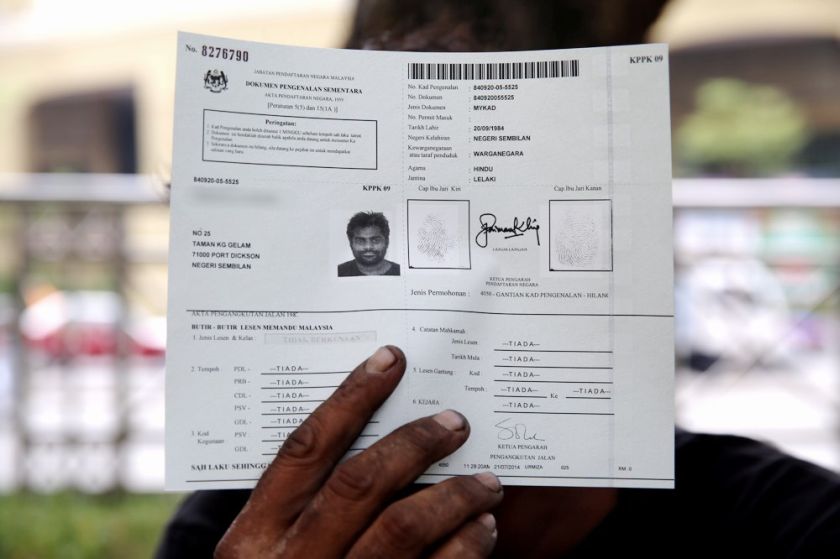
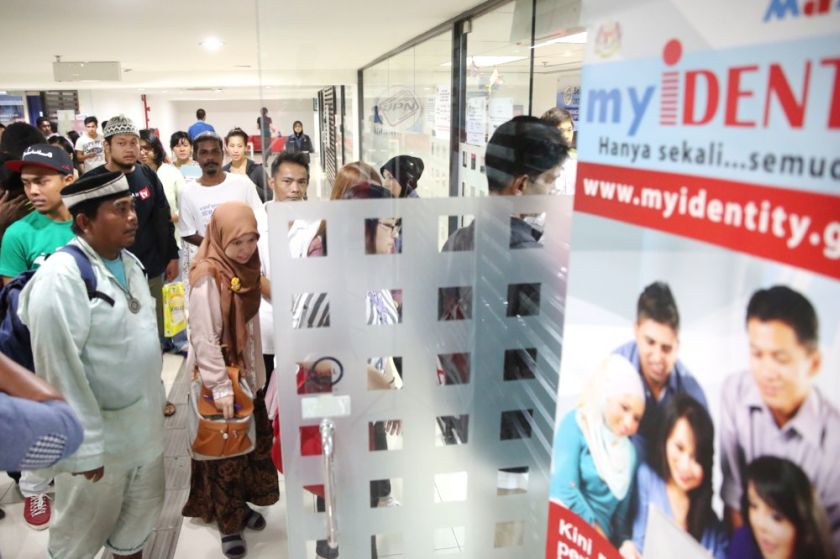
With the assistance of Lawyers for Liberty (LFL), the homeless submitted their applications to the National Registration Department (NRD) in Pudu Sentral yesterday.
“Some of them who are here today had their applications denied previously because they couldn’t pay the fine… NRD insisted that to have the fee waived they have to obtain a letter from the Welfare Department, which is not possible because without a MyKad they can’t even register with the department,” said LFL executive director Eric Paulsen.
“It is not possible… they are falling through the cracks, they don’t fit into the requirements imposed,” said Paulsen.
After several rounds of negotiations, the NRD branch head agreed to raise their concern on the fine to the department’s headquarters in Putrajaya, after which the applications will be processed.
Muhammad Sulaiman, 31, was a lorry driver before he was arrested for being in possession of a weapon in March. He was released from the Kajang prison in June but he refused to return to his family, whom he feels are ashamed of him.
“I was sleeping by sidewalks here last week and someone stole by bag with my MyKad in it… I need to look for a job… I came here hoping they can help me get me a new identification card,” said Muhammad.
The Women, Family and Community Development Ministry began its crackdown, codenamed Ops Qaseh, on the homeless in the capital city two weeks ago.
The Star reported last week that 10 were caught in one of the operations by the Social Welfare Department, the Kuala Lumpur City Hall, the National Anti-Drug Agency, the Immigration Department and other enforcement agencies last week.
According to 2010 survey by the Welfare Department and NGOs, there were 1,646 homeless people in four cities in Malaysia: 1,387 in Kuala Lumpur; 150 in Georgetown, Penang; 99 in Johor Baru, Johor; and 10 in Kuching, Sarawak.
The Malay Mail Online understands that under Ops Qaseh, those aged below 60 years of age would be placed in centres where they would be given shelter, rehabilitation, counselling and vocational training, while the homeless aged above 60 years would be placed at homes. Both facilities are located outside the capital city.
Those who suffer from drug addictions or mental illnesses, for example, would be handed over to the Anti-Drug Agency or the Health Ministry.
The ministry also continues to operate “Anjung Singgah”, a halfway home frequented by urban migrants and vagrants. The facility which was initiated in 2011 temporarily homes them for two weeks to enable them to seek out employment.


