


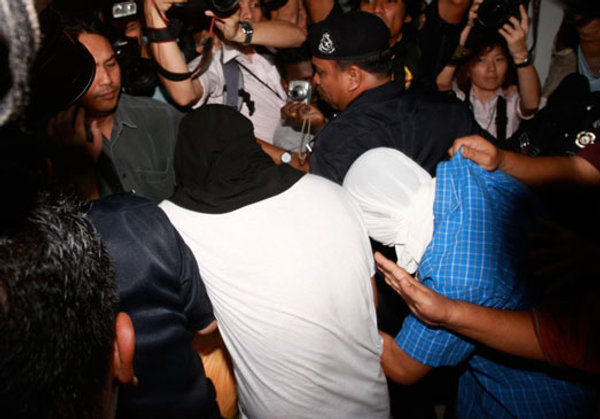
PUTRAJAYA, June 24 — The Court of Appeal had erred when it failed to consider evidence that two ex-commandos accused of murdering Mongolian Altantuya Shaariibuu in 2006 had easy access to explosives, the Federal Court was told today.
Former police commandos Chief Inspector Azilah Hadri, 37, and Corporal Sirul Azhar Umar, 42, are facing a three-day appeal over their acquittal that will decide if they remain free or return to facing the gallows for Altantuya’s 2006 murder.
Datuk Tun Abdul Majid Tun Hamzah, the lead prosecutor in the appeal, said the Court of Appeal should have taken into account a prosecution witness’s testimony that the duo had “ample opportunity to possess unused explosives during training sessions”.
Citing the testimony of the deputy commander of the police’s Special Action Unit (UTK) that the two were previously attached to, Tun Abdul Majid said extra ammunition that were not used during training were sometimes not returned to the storeroom as required procedurally.
He further said that the Court of Appeal was wrong on the facts when the appellate court labelled the explosives that were used to blow up Altantuya as “C4”.
This was despite the prosecution never having described the explosives as “C4”, the government lawyer said.
“UTK never used C4 explosives. We never said the explosives was C4. We never said that but these people from day one, they said C4.
“Police don’t use C4. We do not know how could the Court of Appeal say C4. We told them from the very beginning,” he said, saying that the word “C4” was also not found in the record of evidence but the label had persisted “until today”.
Tun Abdul Majid clarified today that the explosives used in Altantuya’s murder are PETN and RDX.
Last August 23, the Court of Appeal acquitted Azilah and Sirul, ruling that the High Court trial judge’s misdirection had rendered the 2009 death sentence and conviction unsafe.
Azilah and Sirul, both formerly with the police’s Special Action Unit (UTK), were found guilty in 2009 of murdering Altantuya in Mukim Bukit Raja in Klang between 10pm on October 19, 2006 and 1am on October 20, 2006.
During the course of their trial, it was revealed that the Mongolian model was shot and her body blown up with explosives in a jungle clearing on the night of October 19.
Former political analyst Abdul Razak Baginda was charged with abetting Azilah and Sirul in the murder but was acquitted on October 31, 2008, after the Shah Alam High Court ruled that the prosecution had failed to establish a prima facie case against him.
The prosecution did not appeal against the 2008 acquittal of Abdul Razak.
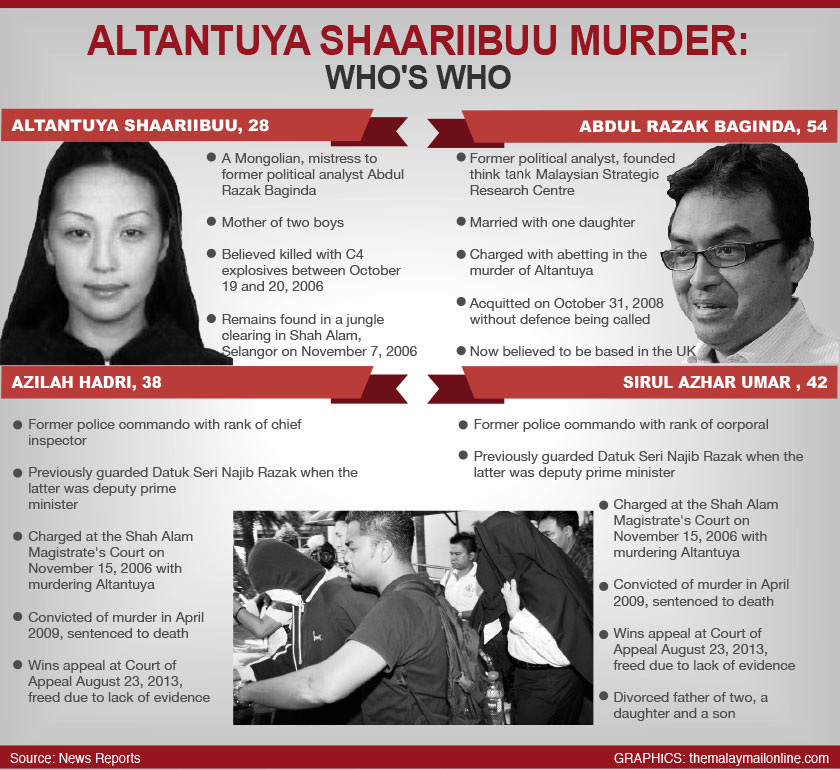 Abdul Razak was formerly a political analyst and an advisor to Prime Minister Datuk Seri Najib Razak
Today, Tun Abdul Majid also said the Court of Appeal was wrong to draw an adverse inference over the prosecution’s failure to call Najib’s former chief of staff DSP Musa Safri to testify during the High Court trial.
Musa had played a minimal role as he had merely introduced Abdul Razak to police personnel to watch over his safety and home, he said.
Musa had also contacted Azilah who then met Abdul Razak, but that was the extent of his involvement, Tun Abdul Majid said when arguing that he was not a crucial witness.
“It is our submission that in murder cases, the most crucial thing is who killed the deceased,” he said instead.
Tomorrow is the last day of the three-day appeal hearing before a five-man Federal Court bench headed by Chief Justice of Malaysia Tun Arifin Zakaria.
The four other judges on the panel are Chief Judge of Sabah and Sarawak Tan Sri Richard Malanjum, Tan Sri Abdull Hamid Embong, Tan Sri Suriyadi Halim Omar, Tan Sri Ahmad Maarop.


