


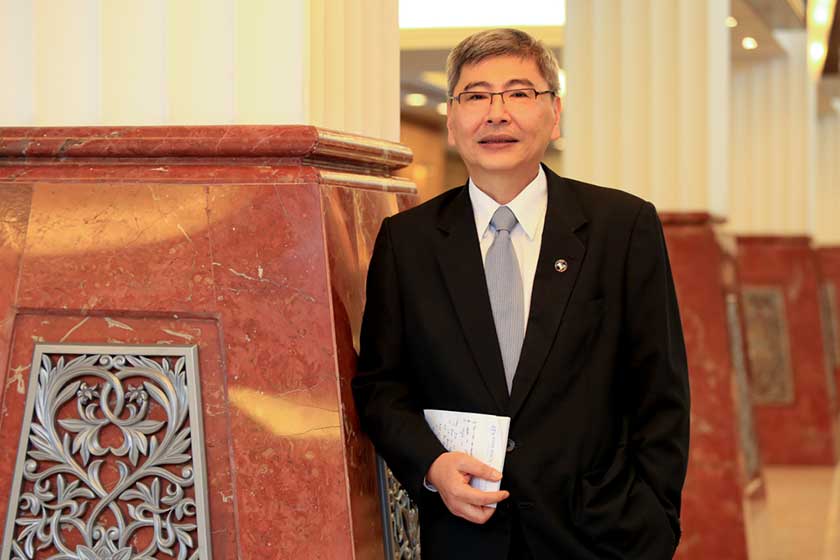


KUALA LUMPUR, June 22 — In one of Malaysia’s most-watched by-elections, Gerakan president Datuk Mah Siew Keong narrowly defeated DAP’s Dyana Sofya Mohd Daud for the Teluk Intan seat last month, his third try after losing the federal seat in the 2008 and 2013 general elections.
Mah, 53, started his political journey almost 20 years ago when he was elected Pasir Bedamar assemblyman in Teluk Intan, Perak, in 1995, the first time Barisan Nasional (BN) won the state seat.
For Mah, who was Teluk Intan MP for two terms from 1999, contesting the Teluk Intan by-election was a must despite failing twice before, so that he would not be a “lame duck” president, leading Gerakan without the “legitimacy of the rakyat.”
Here, Mah talks about the future of Gerakan and race-based politics, why he does not want his three children to enter politics, and how the role of an MP should grow beyond resolving local constituency issues.
In his own words:
I’ve been away from Parliament for seven years...During my time, everything was done manually. Now I can see a laptop permanently based on the table. There’s a lot of changes... It’s good to be back.
My favourite food is mee rebus and chee cheong fun. When I say make Teluk Intan a place for tourists, I was being serious. I’ve tried chee cheong fun and mee rebus in KL and other places. Sorry lah, you lose to Teluk Intan, and Teluk Intan is half the price.
We may be 80 per cent Chinese members, but we’re very multi-racial in our outlook. Gerakan has got two Muslim leaders: deputy speaker Syed Razak and vice-president Dr Asharuddin. We have Ketua Pemudas who are Muslim, and both state Ketua Pemuda and Ketua Wanita who are Muslims. Parti Gerakan when we have discussions, we take longer. We need consensus. Sometimes, this may be seen as not being ultra enough... some people see certain political parties as being very firm in certain issues, but you see, we have to take into account...we also have a number of Indians among our leaders, like Kohilan, our vice-president, Jayanthi, sec-gen of Wanita, Param, our unity head. We have to take into account all this when we actually make any decision, when we decide to make any statement, to reflect the multi-racial outlook of our leaders. I think that reflects the country. That’s why sometimes Gerakan doesn’t get on the front page… only extreme views get front page.
To me it is a real possibility, although it hasn’t happened yet, that in the near future, Gerakan will be led by a Malay or Indian. It’s a big possibility. Race doesn’t count as a factor.
We’re not yet a perfect model for a multi-racial party, but we’re trying to reach there. We still have a lot of complaints that we’re too Chinese. Even sometimes, certain non-Chinese Gerakan leaders, they feel hurt, but it’s only a small sector with certain remarks made... We have to focus on various issues, other than just Chinese issues. There are also Indian education issues, Indian estate issues, and certain kampungs where there is still a lack of facilities in terms of Internet access, as compared to urban areas. We’re having dialogues with Malay NGOs, Indian NGOs, Chinese NGOs.
When I was Ketua Pemuda Gerakan 10 years ago, I suggested joining BN as one multi-racial party and some BN components insulted me, saying that I’m not a practical person and saying no way. But when I brought it up last year, many BN leaders said it’s a viable idea. But it needs time, it needs effort and political will. But it’s a doable thing. And I think that after 2020, which is our Vision 2020, the direction will be towards a multi-racial Barisan Nasional.
I think that local councils should actually think of ways to upgrade their services… and then MPs will have more time to concentrate on national issues. I can tell you that if there is a fire or a flood and if the MP does not get back to the kawasan on that day, whether there’s Parliament or not, there will be an uproar. So, in a sense, this is still seen as a role – a caring MP. But I think we should also focus more on national issues.
The one thing I learned in politics is that for a lot of things which are urgent, a lot of decisions and comments are made in the spur of the moment, which I think is not necessarily good. So now, I tend to position my mind to make comments and decisions for the medium- and long-term, which I think benefits the country more. I think that maybe we’re giving in too much to pressure groups of the moment… I think there’s not even one lobby group that says good things about the TPPA. Everybody attacks the TPPA. But after hearing out everything, I still think the TPPA is good for the country. My stand is still that we should proceed with the TPPA because we cannot be left out… Of course there are people who say that medicine prices will be higher, but we can make exemptions to make sure our SMIs are protected. Of course there are people who say the TPPA doesn’t give the government the right to avoid negotiated contracts; it must all be transparent, there’s no leeway for the agency. But to me, there’s no need for leeway, we give it to the most competitive and the most open tender. That’s what we’re fighting for… I thought that’s what everybody wants.
I would like to have been a lawyer.
For my children, I will not stop them if they want to be politicians. But I have to tell them, it’s a tough life. Definitely nothing glamorous about it. And it’s not something I’d encourage them to go into. You must be ready for it. Politics is a long struggle. If you believe in a cause, it’s a long struggle. Do not think that you can change the country overnight, five years or even 10 years. It’s a long struggle. I have been here 20 years. From my Pemuda days, we fought against the ISA. Last two years ago, the Pemuda Gerakan went to the palace and did a demonstration against the ISA. Only recently, the ISA was abolished.


