




KUALA LUMPUR, March 27 — Deputy defence minister Datuk Abdul Rahim Bakri admitted today that when he told Parliament that MH370 could have been ordered to divert from its Beijing-bound flight path, his remark was merely based on his own assumption, which was inaccurate.
“In relation to my statement in the debate on the royal address in Parliament last night (March 26, 2014) which said the MH370 flight may have turned back after receiving orders from the control centre, I wish to explain that it was only my andaian (assumption) and also possibilities that could have occurred.
“After carrying out checks, I wish to stress that my assumption was not accurate,” Abdul Rahim said in a two-paragraph statement issued by the Defence Ministry.
Yesterday, Abdul Rahim said the military initially assumed that a Malaysian jet detected on its radar on March 8 was ordered to turn back by air traffic controllers.
Questions had been raised over the military’s failure to immediately report the detection of the missing MH370, but Abdul Rahim repeated the Malaysian government’s explanation that the aircraft was considered non-hostile.
“The turnback was detected in our radar, only we thought the turnback was done by MAS, an aircraft that was not hostile or a friendly aircraft, so we thought maybe it’s an order from control tower,” the Kudat MP said in Parliament yesterday in the ministry’s winding up speech.
MH370, a large wide-body Boeing 777 aircraft carrying 239 people, first disappeared from civilian radar at 1.30am on March 8, shortly after it left the Kuala Lumpur International Airport (KLIA).
Initial search operations were concentrated on the South China Sea and the waters between Malaysia and Vietnam as the aircraft was last spotted hovering 120 nautical miles off the coast of Kota Baru.
On March 9, the search was expanded to the Straits of Malacca, while Vietnam authorities briefly scaled down their efforts after the search was expanded to the Andaman Sea on March 12.
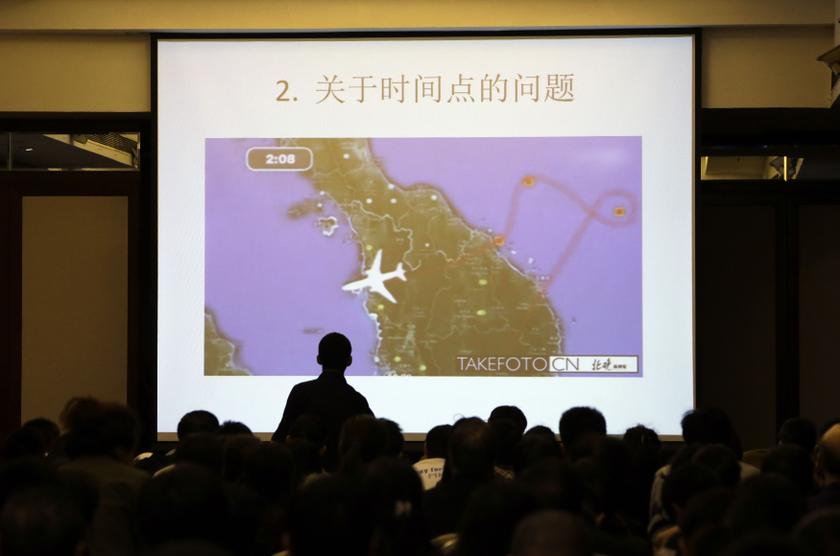
On March 12, local authorities confirmed that military radar had spotted an aircraft northwest from Penang in the Straits of Malacca at 2.15am on the same day it went missing, but could not determine it was the MH370.
In a press conference on March 13, Royal Malaysian Air Force (RMAF) chief Tan Sri Rodzali Daud explained that Malaysia was still working and corroborating with experts to confirm the aircraft was indeed the missing MH370.
Although Rodzali said the plane was then considered non-hostile, he did not elaborate.
In the same March 13 press conference, Department of Civil Aviation (DCA) director-general Datuk Azharuddin Abdul Rahman explained that the primary radar used by the military gives no other information and only shows the presence of an aircraft.
Civil aviation radars are secondary radars which receive information from aircraft transponders showing the type of aircraft along with other identification details.
On March 15, the search in the South China Sea was called off after satellite data suggested that the MH370 could be either in a northern corridor that stretched into Central Asia or a southern corridor that went over the Indian Ocean.
As new information appeared based on analysis of satellite data, Malaysia announced the conclusion on Monday that the flight MH370 was assumed to be lost in the Indian Ocean.
The multinational search for the MH370 and the 239 people on board is still going on.


