


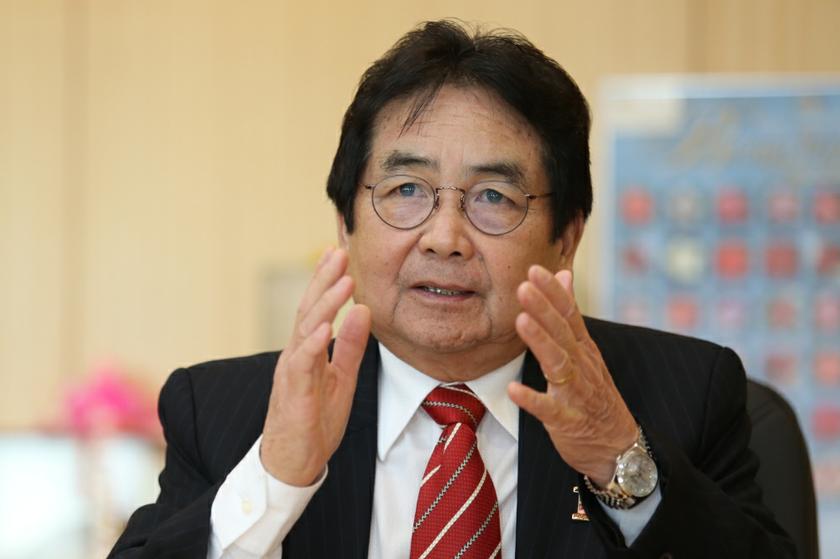


PETALING JAYA, Aug 26 ― Three months after Election 2013, minister in charge of national unity Tan Sri Joseph Kurup (picture) will now seek the Cabinet’s approval for a new council to help heal the societal rifts that widened during the country’s most divisive general election.
The National Unity Consultative Council (NUCC) was first mooted by Prime Minister Datuk Seri Najib Razak after his Barisan Nasional (BN) coalition retained its hold on power despite losing the popular vote to federal opposition Pakatan Rakyat (PR).
In the aftermath of the polls that saw BN winning 133 of Parliament’s 222 seats ― a new nadir since Election 2008 ― non-Malays were targeted for abandoning the ruling coalition in what was dubbed a “Chinese tsunami”, although later analysis showed that voters had chosen along class rather than communal lines.
“As you know, after the general election, GE13, there seems to have some gap that is created, arising out of this, that’s why the prime minister talk about national reconciliation.
“Of course, the main objective, this is the body that will act as a vehicle to address those problems. The objective is to unite and integrate the various races in Malaysia,” Kurup told The Malay Mail Online and Sin Chew Daily in an interview last week.
Kurup explained that the NUCC will act as an independent body in advising the government on policy matters.
The proposed council would take an “inclusive” approach when gathering feedback and studying the source of grievances that cause disunity before making recommendations to Putrajaya, he said.
“First of all, they will help to go to the grassroots to find out exactly what are the differences that possibly result in disunity, so they have to find out the sources of that.
“After that, they’ll make an analysis and then it’ll be returned to the government to work out a policy. I consider this as the most effective way of dealing with problem of misunderstanding,” said the minister in the Prime Minister’s Department.
When elaborating on the NUCC, Kurup said it would have a diverse membership which would be appointed by the prime minister.
“They will be from all sections of society, about 30 of them coming from anybody whoever is committed to unity and integration,” he said, adding that some of the members would be academics and from non-governmental organisations (NGOs).
It is understood that the council would likely see youths, businessmen and trade association representatives as its members.
The NUCC appears to be aimed at improving the ties between Peninsular Malaysia and east Malaysia, which are geographically separated by the South China Sea and economically divided by an income gap.
“The members are not only from Semenanjung (Peninsular), the members will be from Sabah and Sarawak,” he said, saying that the NUCC would “look at national integration between rakyat (people) of Semenanjung and Sabah and Sarawak”.
Kurup explained that there will be about five sub-committees in the NUCC, which The Malay Mail Online understands will look into matters such as law, youth and unity, inclusive development, national integration, as well as nation-building and cross-cultural understanding.
Kurup said there was “overwhelming” support from the public for the formation of the NUCC, citing eight sessions of roundtable talks held nationwide.
After the formation of the NUCC, its first task will be to draw up a Unity Blueprint, Kurup said.
“The NUCC will obviously have to have something to act upon. We want to be clear what we are going to do. People want results later on, not just (to) form the NUCC.”
On June 26, national news agency Bernama reported Najib as telling Parliament that the proposed NUCC would focus on three issues, namely identifying an approach to address racial polarisation, promoting interfaith harmony and to aiding in the formulation of socially inclusive government policies.
Kurup also said an Interfaith Blueprint will be drawn up by an existing interfaith committee, the Committee to Promote Understanding and Harmony Among Religious Adherents (JKMPKA).
The term of the members of the JKMPKA, which was established in 2010 and runs on a biennial basis, had quietly expired this June amid a controversy over a proposed Bill that would allow the unilateral conversion of minors to Islam.
Kurup said he will be officially informing the Cabinet of the interfaith committee’s new members within these two weeks, saying that both the non-Muslim and Muslim groups have agreed on the new line-up.
“After we have got a note from Cabinet to form them, then we can then sit down to work out a plan of action, the blueprint,” he said.
Kurup explained that when the new committee is formed, Minister Datuk Seri Jamil Khir Baharom would also be consulted.
“When we draw up a blueprint, it will have to be done in consultation with the minister in charge of Muslim affairs,” he said.
Both Kurup and Jamil Khir are advisers of JKMPKA, overseeing the affairs of non-Muslims and Muslims respectively.
When asked if the JKMPKA would play a bigger role in the future, Kurup replied: “Only after we have looked at the blueprint properly, we will then evaluate the function.”
Both the proposed NUCC and the existing JKMPKA will be carrying out public consultation when drawing up the blueprints, he said.
The Malay Mail Online understands that Kurup had submitted the proposal for NUCC’s formation and the JKMPKA’s new line-up to the Cabinet last Wednesday, but both matters have yet to be discussed.


