




KUALA LUMPUR, Jan 28 — As healthcare systems across South-east Asia accelerate their digital transformation, outpatient clinics and wellness providers are facing mounting operational pressure, from national electronic health record (EHR) initiatives and stricter data protection regulations to staffing constraints and rising patient demand.
A Malaysia-based healthcare software provider, Kumo™, has emerged as one of the regional platforms supporting clinics navigating these changes, with its cloud-based healthcare management system now used by more than 2,500 clinics and over 25,000 users across Malaysia, Indonesia, and Thailand.
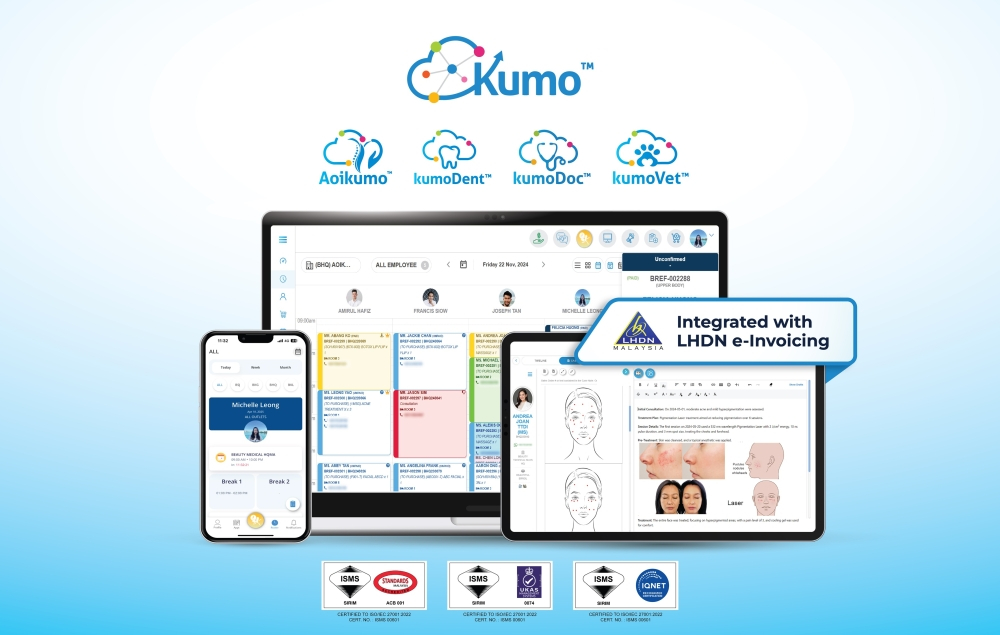
Founded a decade ago as a management system for wellness and beauty centres, Kumo has since expanded into a multi-sector healthcare platform serving dental, veterinary, aesthetics, grooming and primary care providers under four dedicated product lines: Aoikumo™, kumoDent™, kumoVet™ and kumoDoc™.
Across South-east Asia, many clinics continue to operate using fragmented systems, where patient records, billing, regulatory compliance, and laboratory coordination are managed through separate tools. These operational inefficiencies can increase administrative workload, staff burnout, and challenges in maintaining consistent patient care, particularly as governments introduce national digital health programmes and tighter data governance requirements.
Kumo is designed to consolidate clinical and operational functions within a single platform, supporting patient registrations, EHR, third party administrator claims, invoicing, and payments, including fully automated LHDN e-Invoicing. The platform also provides dedicated applications for doctors, patients, and nurses, enabling communication and care coordination across different touchpoints of the clinical journey.
To improve interoperability efforts between private healthcare providers and public health infrastructures, Kumo also incorporates structured clinical terminology through SNOMED CT and integrates with national health initiatives such as Indonesia’s SATUSEHAT.
Beyond core clinical systems, Kumo connects with commonly used third-party services including Whatsapp, Google, LINE, and Stripe. The company is also expanding its laboratory connectivity, allowing digital transmission of test orders and results between clinics and labs, reducing reliance on manual handoffs that have traditionally delayed outpatient care.
Built to evolve alongside the healthcare industry, Kumo also supports emerging AI capabilities and adapts to changing healthcare policies, allowing providers to focus on delivering care while operational complexity is managed within a unified digital environment.
In recognition of its role in healthcare digitalisation, Kumo received the MD Asia Pacific ICT Award 2024 and was named a 100 Go Digital Supporting Partner in 2023 and 2024. The company is also certified under ISO/IEC 27001:2022 for Information Security Management Systems and SIRIM UKAS, revealing its focus on data protection and clinical data governance.
Kumo has also expanded into academic and training environments, with institutions such as MAHSA University and Penang International Dental College using its software in teaching clinics, allowing healthcare students to gain exposure to digital clinical systems that reflect real-world practice.
For Kevin Nair, founder of Kumo, the company’s direction has remained consistent since day one.

“Nothing has changed since the start. Kumo will continue to evolve, driven by our customer-centric approach. We strive to establish ourselves as the leading technology provider in the industry. To achieve this, we work closely with our clients, treating them as partners. By actively listening to their feedback and making necessary software adjustments thus ensuring Kumo is at the forefront of technological advancement for clinics.”
As national healthcare systems across the region push toward more connected digital ecosystems, platforms such as Kumo are increasingly positioned as part of the infrastructure bridging private clinics with national health programmes, compliance frameworks, and emerging clinical data standards.
“The next decade of outpatient care will not be defined by more apps and features, but by integrated, interoperable, and intelligent clinical ecosystems with value-driven AI. Tiny changes can make a difference.” Nair said.
Kumo plans to remain at the forefront of that shift.


