


GEORGE TOWN, Jan 4 —When Lithuanian-born artist Ernest Zacharevic painted his first mural of his neighbour on the wall of a shop along Armenian Street back in 2011, no one paid any attention to it.
Then, he submitted a proposal to produce a series of murals drawn from everyday life to then-George Town Festival (GTF) director Joe Sidek for the 2012 art festival and the latter immediately warmed to it.
What resulted was an experiment in public art that grew into a phenomenon where the murals have since become part of George Town’s cultural identity while at the same time reshaping how people look at art.
Storytelling, not just art
According to Joe, when Zacharevic first came to him with the idea for the murals, he found it interesting as it was more about storytelling than about murals.
“There was storytelling to his murals, they are about the people, the place and the identities of the communities,” he said.
He said he had agreed to Zacharevic’s proposal as he wanted to bring art out into the public space with storytelling aspects.
“I wanted the public to be able to look at an art piece outside, in a free open public space, as these people who don’t go into galleries don’t know what art is,” he said, adding that some people are reluctant to enter art galleries as they believe those are for the elite.
He said Zacharevic’s murals worked because of the stories he presented through the images.
“Somehow, his murals fitted with George Town, they are about the people in the street, scenes you see in the street, the local communities,” he said.
Zacherevic’s series of murals for George Town Festival 2012 became such a hit that till today, his murals continue to draw huge crowds.
Interestingly, Zacharevic started painting graffiti at a young age in his hometown of Vilnius in Lithuania and refined his skills while studying in London.
“Over the years, both my style and subject matter evolved—from lettering to figurative work, and later to contextual narratives and storytelling,” he said.
Beginnings of a legacy
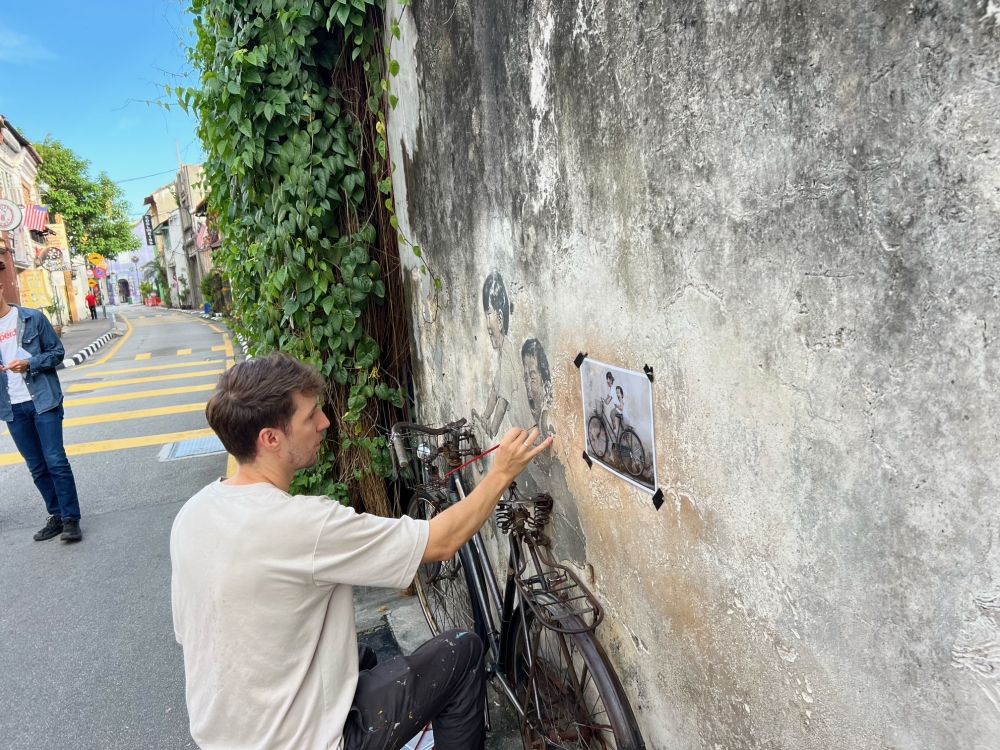
His first mural in George Town, of the old man, was based on his friend, the late Ng Chai Tiam, who was a respected Chinese stamp carver and calligrapher.
“He was a teacher and a constant source of inspiration to me after we became neighbours in 2010,” he said.
He said the building on Armenian Street where he painted the mural of Ng was managed by another friend, the late Tan Chor Whye, who was another strong supporter of his work.
“Their contributions to George Town’s cultural and heritage landscape are immeasurable and will continue to inspire future generations,” he said.
His observations of everyday life in George Town inspired the series of murals that he proposed to Joe for the 2012 GTF.
“The series was rooted in observing everyday life in George Town—its people, gestures, humour, and contradictions,” he said.
“I chose subjects and locations that already carried social or architectural meaning, allowing the artworks to interact with their surroundings rather than dominate them,” he added.
Zacharevic never expected the murals to become a huge sensation and to remain popular till today, even after 13 years.
“I always believed public art has the power to resonate with communities, but the scale and speed at which it grew continues to surprise me even today,” he said.
Murals boom
Joe recalled the initial flak he received from various parties when Zacharevic’s murals were first announced as part of GTF’s art programme because he was not a local artist.
“I was looking at the proposals, if it’s a good proposal, I support but if you come to me with bad proposals, I won’t support it, I don’t care if you are a foreign or a local artist,” he said.
He said Zacharevic’s mural did benefit local artists in the long run because what followed was a boom in murals in Malaysia.
“Actually, the mural boom came out of Ernest. In Malaysia, the popularity of murals started with Penang and with Ernest,” he said.
He said graffiti or street art are different, having been around for a long time, since the 1970s.
“Graffiti is different, it was like the art revolution of messaging on walls, an expression of anger, most have very strong social or political commentary,” he said.
Joe said there were also official paintings on walls in institutions, such as in schools or along prison walls.
Starting a trend
However, after the iconic GTF murals, many local artists were beginning to paint murals on commission and they were making good income from it.
“One of them was Azmi Hussin, he was drawing caricatures and doing coffee drawings, then he started doing murals and that’s when he started doing well,” he said.
The murals boom showed no signs of abating but Joe believed that the success of murals should not lead to creative stagnation.
“To me, it was a good exercise. But then after a while, I thought it should stop — because shouldn’t you all get tired of murals? Shouldn’t artists think of what’s next?” he asked.
Zacharevic said artistic forms and mediums are constantly changing so only time can reveal what will be the next big thing in artistic expression.
“Public art has opened important conversations about access, ownership, tourism, and cultural value,” he said.
“Its popularity brings opportunity, but also responsibility — to treat artworks not just as backdrops, but as cultural expressions that deserve respect and care,” he added.


