




PETALING JAYA, Sept 18 — Paul Timings (pronounced Timmings) watches his screen, a white page with green and black lines of code written across it. It is mathematical, coldly exact, information in its starkest form.
Yet the noise that this code produces is anything but: It is natural, melodic, beginning with the sound of a pool of water, and was recorded in Timings’ native town of Christchurch, New Zealand.
Timings, a sound artist, is the recipient of an Asia NZ Foundation award for the three-month Vision Culture Artist Residency at Shalini Ganendra Fine Art (SGFA). He is the first sound artist SGFA has hosted.
The Vision Culture residency is focused on cross-cultural exchange and this is a concept that Timings has, carefully, embraced, aware that “referencing culture as an outsider can be a tasteless exercise”.
A trip to Machang proved fruitful in clarifying Timings’ concepts of inclusiveness, and the removal of his own presence to bring the audience further into his work.
He was witness to a Dikir Barat piece, performed and recorded around the back of a restaurant, in a large group: “I think of music in terms of a social engagement and Dikir Barat epitomised all that I was hoping for. The improvisation of the performance appealed to me: it is not for an audience, it is an informal gathering of friends who were there to have a good time.”
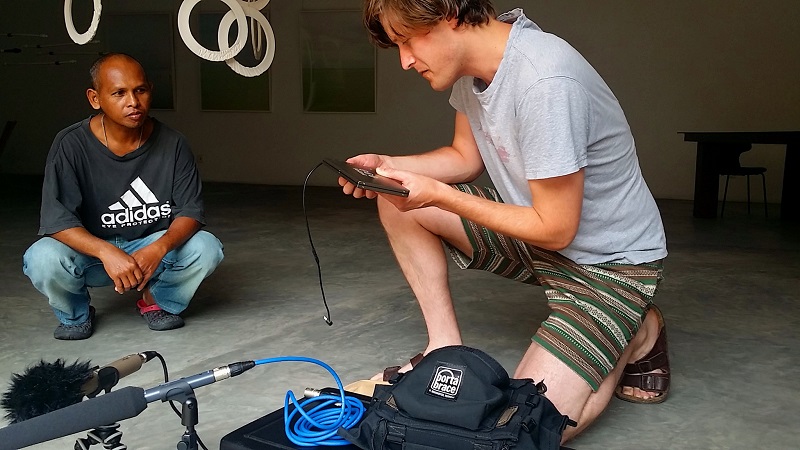
One of the difficulties, as has been the case throughout his three months in Malaysia, was making the recording itself. As Timings notes, trying to record an environment, while placing yourself and your equipment at its centre, is somewhat problematic.
He recorded the second night of Dikir Barat performances with a handheld recorder, as opposed to the large microphones and headsets of the first night.
This mode, known as guerrilla recording, makes the process surreptitious and thus reduces Timings’ impact on the outcome. This is also the method Timings used to make his field recordings in Kuala Lumpur. The recordings, in Titiwangsa Park, Bangsar, and the MIPA are complete within themselves, yet also tools to create from. They can be processed through audio effects and then used to form textures within an algorithm.
Timings’ idea of an algorithm was born out of conversations with Malaysian composers during his “nervous gestation period” in which he wondered how he was going to create a soundscape of a place so defined by its noises.
Twenty-two soundscapes will populate Timings’ KL Soundscapes exhibition algorithm, which has risen out of the SGFA residency and will be installed at a space with ambisonic surround sound, the Auricle Sonic Arts Gallery in New Zealand, during December 2015.
Every stage of Timings’ process is concerned with the total sound and experience of the work, rather than the ego of the artist, a rare quality in post-modernist art.
SGFA and its Gallery Residency have been, for Timings, “invaluable”, providing him with the time and space that have allowed him to become more confident with his conceptual approaches, which he now defines by his “own personal philosophies and beliefs.”
It is at SGFA that Timings made his Malaysian debut yesterday with his soundscape Pools, and other new recordings.
Though Pools opens with the sound of a pool of water in New Zealand, it also incorporates the impressions that Timings gleaned from the sounds collected in the bamboo grove near KL, used for the Pavilion construction at SGFA.
Rather than the sounds themselves, bamboo shoots being harvested or laced together, it is the idea of sound in the production process of aesthetic design that is explored. Pools soon becomes otherworldly: Timings uses a synth in the piece to produce a fundamental frequency below human hearing; the harmonic structures produced by this frequency in audible hearing range are determined by a process that moves outside of a natural harmonic series.
Timings worries at this point in his explanation that he is “making it sound really complicated, when I’ve always wanted my work to sound simple, because I think that that is far better than taking something simple and making it complicated.” It is impossible not to agree, yet his concerns are misplaced. Timings work is, quite simply, about inclusion and an individual engagement with his listener. Timings’ soundscapes ripple through your head, long after they have stopped playing.
Sound art, Timings says, is a multidisciplinary exercise, explaining that “in the same way you might see colours in a landscape, you can see sounds in a soundscape.” The experience of listening to successful sound art becomes one of synaesthesia, as senses interact cross-modally. Sound art, Timings comments, creates a more individual experience than visual art is capable of. It is this specificity of experience that he plans to emphasise in the exhibition KL Soundscapes.
Sound art invites “someone to spend time with a piece, locking them into a predetermined temporality.” Timings, however, plans to balance this restriction with the liberation he will afford his audience, who will be able to interact with and alter his work. The exhibition will be a kinaesthetic experience: a lever will allow anyone that comes in to change the volume, tempo, and spatialization of the piece, turning his digital work and process into something tangible.
The decision to allow listeners to communicate with and change his piece was taken to ease Timings of his concerns about 21st century art. For Timings, post modernity aims to exclude people from engaging with it through its intellectual prejudices: he wants his work “to be free of all bias and completely accessible.” Timings’ vision is that a child is just as free to explore tactility and noise as an academic is to intellectualise how digital language and information pathways, much like social and musical folk traditions, are developing through the kinaesthetic.
Hear Paul Timings’ sounds at SGFA through the month of September. You can follow him on Facebook as well as listen to his work on his Soundcloud here. Alternately, you can visit his website here.


