NEW YORK, June 3 — As a group, classic utility vehicles, such as Land Rover Defenders, Jeep Scramblers, and Ford Broncos, are massively popular.
The recent Scottsdale auctions saw the sale of 21 Broncos alone. At Barrett-Jackson’s sale, the second-highest-priced car of any sold was a US$82,500 (RM351,821) 1968 Bronco pickup. The average value for a first-generation version of that car is US$47,025, up from US$23,400 five years ago, according to data from Hagerty.
And for Jeep CJ-8 Scramblers, values have risen from US$22,500 to nearly US$30,000 in the past three years. Hagerty experts say the increase for each will continue.
But this story is not about those utes. It’s about a Toyota.
In fact, the Toyota FJ Land Cruisers — which started the current vintage SUV craze — got hot years earlier.
“Where our parents’ generation wanted a Corvette convertible, today [we] are looking for something more fun and rugged,” said Nelson Calle, chief executive officer of Classic Motors, which makes US$100,000 restorations of the old Land Cruiser models. “We are an active generation, and this vehicle reminds us of simpler times.”
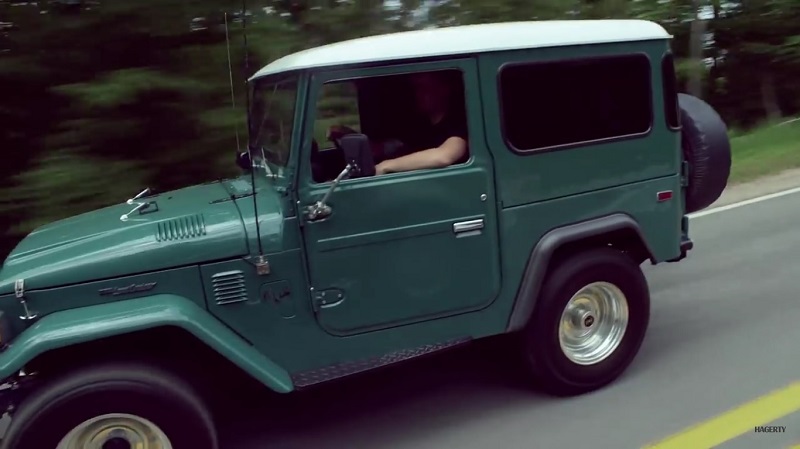
Toyota started making the consumer version of its tall, square, WWII-inspired FJ40 Land Cruisers in 1963, and by 1965 they were the brand’s bestselling model in America. The company sold 50,000 of them in their first year alone. (This was many years before SUVs began to dominate the entire market, in the early 2000s.)
Early models were two-door, hardtop, 4x4-wheel-drives with six-cylinder 145 hp engines. They came with bench seats, tiny, close-set, round headlights, and a bare, waterproof interior. The Japanese had developed early versions for military use during the Korean War, so their design optimised function and utility.
Modern obsession
Auction-block demand for Toyota Land Cruisers experienced dizzying spikes in recent years, from as low as US$26,000, on average, in 2006 to more than US$80,000 today. In 2015, prices for FJ40s in mint condition averaged more than US$105,000.
That frenzy is what set off the current craze for vintage Rovers, Jeeps, and Defenders. It worked like this: In 2015, when Land Cruisers got so expensive at the top end of the condition spectrum (respected collectors were paying top dollar for the really pristine ones) and so deplorable on the unrefurbished end (everyone and her brother pulled out the piles of rust they had abandoned in the shed decades ago), buyers started looking for other utility vehicles to purchase instead. That’s how they warmed to Broncos and Scramblers and the like, which still present a more moderate grouping of pricing and quality in general when they go on sale.
So you might expect that Land Cruisers have faded from their dazzling status as the premier classic SUV. After all, the same FJ40s worth more than US$100,000 two years ago are worth closer to US$80,800 now, and the world record US$137,500 paid for a FJ40 happened three years ago.
But Land Cruisers have as much appeal as ever, says Hagerty spokesman Jonathan Klinger. The world-record US$176,000 paid for any stock (original production) 1968-83 Land Cruiser was set at a Gooding auction just last year. And they are considered the go-to choice for buyers cultivating the exact right car collection — especially those who want to include more cars from abroad.
“If someone was looking to add a vintage SUV to a highly curated collection, the Land Cruiser would be more desirable than the others,” Klinger said this week — it’s more Japanese artistry than red-blooded American industry, like the Bronco. “It attracts more attention for a person looking for a curated collection, certainly more in the U.S., and it is absolutely a global vehicle.”
Where to find the good ones
There are some caveats. Don’t buy them if you hope to earn tens of thousands of dollars by flipping in a few short years — don’t buy any car for that. Do buy if you want something worth the amount of money it’ll take to put it into proper working order.
“They will hold their value, so now it’s worth the investment in restoration,” Klinger said. “Their values have risen enough so that people can justify spending more money on repairs.”
It helps if you were prescient enough in 2006 to buy an FJ when you could get a good one for less than US$13,000. Prices these days will stab you a bit deeper than that.
Last year at Amelia Island Concours LINK weekend, Bonhams, RM Sotheby’s, and Gooding & Co all offered Toyota FJs for sale. Hemmings lists them for US$41,900, or as high as S$79,900, with even lower prices (US$20,000 or so) for those that need work. On EBay you can get a decent 1970 FJ40 for less than US$40,000.
Modern classics
Or cut out the middleman and buy one restored by professionals. Icon in Los Angeles is perhaps the best-known brand.
Miami-based FJ Company sells 80 or so special-project, fully restored FJ40s annually.
They come in the shellacked colours of an Easter basket with such modern accouterment as power steering, modern disc brakes, climate control, and LED headlights, plus the same rugged 135-horsepower Toyota 2F engine. (The name “FJ” is taken from the engine name plus the first letter of its colloquial body style — a jeep.)
Choose FJ40 and FJ43 variants from 1976 to 1983 model years and a four- or five-speed manual transmission. The restoration on each takes nine months to a year, depending on the complexity of the build.
As with any vintage purchase, watch for rust. It’s far better to spend more money on a specimen with a good body and faulty engine than one with a rusted body and a working engine — it costs less and requires less work in the long run, because the mechanisms under the hood are relatively simple and inexpensive to repair or replace.
After all, these are really just old work trucks reborn as hipster mobiles. That’s the whole point.
“We live in a world where everything is automated for us, from voice-activated home assistants to cars that can park themselves,” Calle said. “There’s just a real charm and amazement when you get behind the wheel of a classic Land Cruiser. It’s like going back in time.” — Bloomberg