KUALA LUMPUR, May 8 — If you are one of the many who work hard all week in the concrete jungle and are looking for a break from the humdrum nine to five work, you might want to join the Land Rover Owners Malaysia Club, one of a number of registered clubs to cater for 4 x 4 enthusiasts and off-road lovers.
First registered two decades ago, the Land Rover Owners Malaysia (LROM) club celebrated its twentieth anniversary with a Jamboree at the Petai Jungle Lodge near Karak, Pahang. Interestingly, club membership is open to non-Land Rover owners as well. There is no requirement to own a Land Rover, just a love of the outdoors and 4x4 off-roading. (More information can be obtained at www.lrom.com.my)
Curious to know what a Land Rover Jamboree is all about, I took up an invitation from the club to be a part of their 20th Anniversary celebration, and although I missed the early Saturday morning convoy from the Land Rover premises in Petaling Jaya, it was not a problem for me to drive my own 4WD truck there. I caught up with the activities at the camp site in the afternoon — the drive from Petaling Jaya to Karak, Pahang, a distance of approximately 90 kilometres was not that bad, considering that the traffic was building up a fair bit as a result of the minor exodus from Kuala Lumpur as a result of the May Day log weekend. There were the usual ‘few-times-a-year drivers who had no inkling at all regarding lane change habits and hogging the right hand lane at crawling speeds that were causing long lines resulting in angry faces — but I was in no particular hurry, and eventually left the maddening crowd when I took the off-ramp to Karak.
Karak Town used to be a small town that was on the old main trunk road to Kuantan, but has now become a little sleepy hollow since the new East Coast Highway has bypassed it. Traffic through the town is still moderate as the connection to Manchis and Bahau to the west is just on the fringe of town on the trunk road, and many of the local folk still use the road to save on tolls. I remember passing through Karak many times since the 70’s, and the town has not changed that much. The campsite is off a kampung road that starts in the town — the kampung road peters our after about a kilometre, and the going gets rougher and rougher until we have to engage 4WD — even though the entire stretch is about 3.6 kilometres, it takes about 25 minutes on account of the potholes, ruts and muddy areas — at one point, I saw the remains of a vehicle number plate, probably a rear plate of a truck (not a Land Rover, because a Land Rover has a very short rear overhang) that must have gotten scraped off the rear bumper.
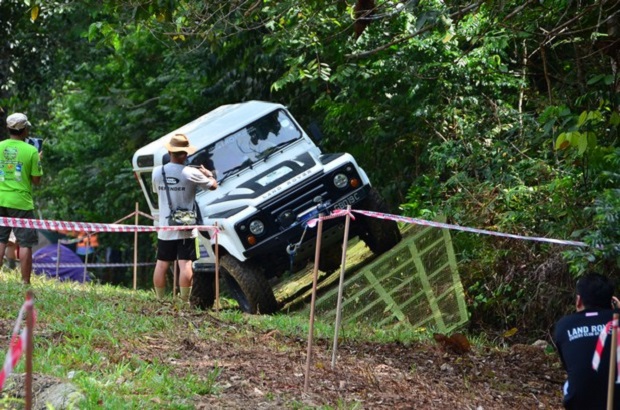
When I got to the Petai Lodge Campsite, it was already close to 3pm, and it was a flurry of activity — campsites were already marked out by the organisers in an attempt to create some kind of order in the layout, and to leave some lanes open for traffic, plus keep free some space for the “Special Stages” that were planned. Some “communal” tents, basically 6x6m army-type tents were set up by the organisers for various contingents from the neighbouring countries and states, such as Indonesia, Sabah, Sarawak and Sabah.
I was given the choice to bunk in with another journalist, or join any of the communal tents — I chose to join the communal tent shared by Indonesia and Sarawak. My tent community was made up of Pak Hari, the chief of the Indonesian contingent, his three friends and Paul Si, an old friend and his friend, “Ah Foo”, representing Sarawak — seven of us in a tent that could take ten or more beds. By beds, I mean camping cots of the folding kind. No carpets on the floor, no lights, no electricity, and you bring your own sleeping bag — in short, it means roughing it out.
Of course you are at liberty to bring your own camping gear, in fact you can bring everything, including the kitchen sink — and you will be surprised at some of the gear you can see. A few of the campers had what looked like an entire home, assembled on a metal frame that was propped up by the vehicle. There were regular tents, family tents, special tents that were affixed to the roofs of the Land Rovers — it was quite fascinating.
There were also many Land Rovers — ranging from the early editions of Land Rover, the Series 1, first introduced in 1948. Yamin Vong, a media colleague and old friend, brought along his Series 1, a little battered and worn-looking, but still serviceable. There were a couple of 88’s, so called because the length of the wheelbase was 88 inches, launched in 1958. The long wheelbase version was 109 inches. Then there were the Series 3 Land Rovers, first introduced in 1971. Most of the other Land Rovers were the Land Rover 90 and the Land Rover 110, launched in 1983 and so named also due to the length of their respective wheelbases. The Land Rover 110 was renamed the Defender in 1990.
The Singaporeans were there in strength too, with a few units, mostly new — bearing in mind that there is a scrapping law in Singapore that does not encourage ownership of vehicles over 10-years-old. Amongst the Malaysian participants too, there were a few gems — Land Rovers that have been lovingly restored — looking at them, you would find it hard to imagine that they are more than 20-years-old.
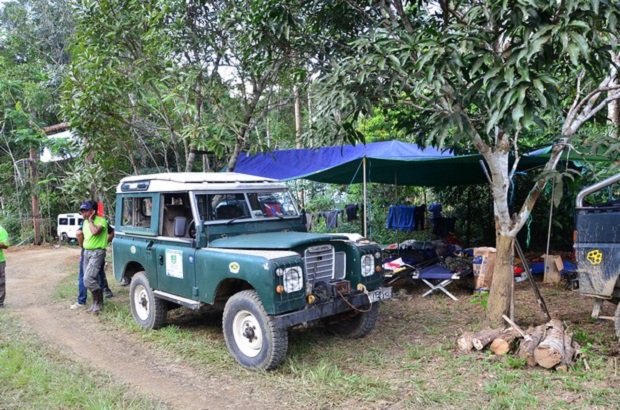
However, one must bear in mind that Land Rovers are built by hand, and over the years, the frames have remained much the same, and so have the body panels — you can pretty much attach a new “skin” to the Land Rover, or even a new body. Anyway, rumour has it that approximately 65 per cent of all Land Rovers ever made are still on the road. Production of the latest model, the Defender, has stopped — it seems the world has “outgrown” it, passing it by, as new collision and safety standards leave it stranded in no man’s land.
Why is it that this group of people like that piece of machinery we know as the Land Rover? It certainly is not the cutest looking nor is it the nicest thing you can see on the road. I really don’t know — I spoke to a few people about it, and I glean that it is a love for something that is unique — that is already here, in huge numbers, a machine that opened up, built and defended nations. Add to this one of the best off-road machines in the world — not so great on the road due to it being narrow and tall — but put it off the asphalt and onto the gravel, and see it flourish.
The latest Land Rovers (since the 90 Series) feature coil springs all round, and the Land Rover has a high articulation angle that enables it to survive in the toughest of conditions. In addition, short front and rear overhangs, and a high ground clearance allow it to clear most obstacles in off-road conditions. Personally, I have been on a few off-road adventures myself, and have driven quite a few off-road vehicles — this included a year of road building in the forests of Kelantan more than 35 years ago, when our only transport to and from the worksite was a beat up Series 2 Land Rover.
Not once did it fail us, faithfully carrying all the fuel and all the workers in and out, never faltering, at least mechanically, although the body was falling apart, since we had got it second hand from some army surplus yard. I will be the first to agree that the Land Rover is undoubtedly one of the best 4 x 4 vehicles of all time. Perhaps these are some of the reasons why there is such a following — and now that Land Rover has ceased production, the Land Rover will soon be almost cult-like.
At the jamboree, the organisers cooked communal meals for those who didn’t want to cook, and there was also a drinks stall set up to sell iced drinks and of course cold beers. Many campers brought along food to cook or barbeque, and from the sound of the merriment, you could tell they also brought along their own supplies of intoxicating spirits.
In case I forget, a jamboree like this is for the entire family — many of the participants did exactly that, and the entire campsite took on an almost carnival atmosphere — some of the enthusiasts even brought along parts and accessories for sale.
So did I enjoy the night? Yes, I did — it was totally different from what I am used to now, but it wasn’t that different form when I was a kid — this time, the water was piped from a stream whereas we had to draw water from a well — we had torch lights instead of oil lamps, but then I did not have any school homework to do. Whereas we slept at nine at night in my village to save on the usage of kerosene, we caught up with old friends and talked to new friends till late at night with just the single bulb in the Event HQ tent next door, powered by a single gen set placed about 80 metres outside the perimeter — so you might say the quality of life was a tad higher her than what I had as a kid. Would I do it again? Probably, but it much depends on the company I am going to get. It is no fun to go it alone.