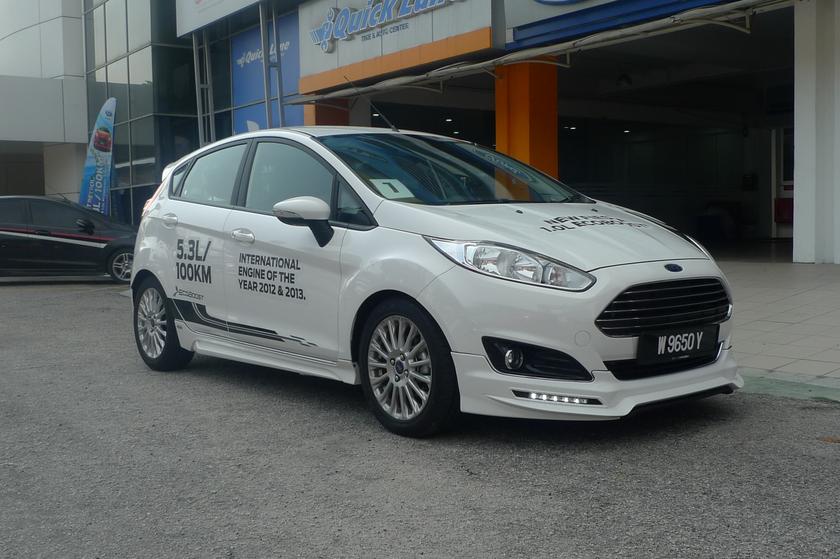
KUALA LUMPUR, May 6 ― The latest excitement on the streets must be the Ford Fiesta 1.0L Ecoboost – what you get is the Ford Fiesta, which is basically the same car we have seen around for a couple of years, first with a 1.6 litre engine, and then the recent facelift last year with a 1.5 litre engine.
The latest one comes with Ford’s own 3-cylinder turbocharged engine, with DOHC (Double Overhead Camshaft) configuration, and the latest Direct Injection technology. That’s about the best technology package you can get – and it is all in a tiny 999 c.c. (cubic capacity) package producing 125PS, and 170Nm of torque.
This kind of power output is comparable to, or better than a conventional 1.6 litre engine, a case in point being the Proton 1.6 litre engine, which delivers 110 PS, and 148Nm of torque. Yet another comparison would be the Peugeot 208, which produces 122 PS and 160 Nm of torque. The Toyota Vios, with a 1.5 litre engine, produces 107 PS and 141Nm of torque, while the new Honda City has 120PS of power and 145Nm of torque. On paper, the Ford’s tiny 1.0 litre beats all of the 1.5 litre and 1.6 litre naturally aspirated (without turbo-charger) cars above, so does this make it a ‘pocket rocket’?
I took a short drive around Petaling Jaya, following the Ford Urban Playground (current weekend road show) test route, and here are my driving impressions.
Just in case you are a car nut and are looking for an urban racer, let me state that, yes, the Fiesta 1.0L Ecoboost is a quick little car, but if you are looking for breath-taking acceleration, it does not have enough grunt to do that.
You would be wondering why the Laser TX3 of the 80’s with 110 horsepower seemed to be faster – well, in those days, the Laser TX3 weighted in at only 890kg, while the Fiesta is 1091kilogrammes due to today’s more stringent chassis strength requirements, and the engines of today are actually choked back by emission regulations too.
The later model TX3, popularly known as the ‘gondola’ due to its shape, had close to 130 horsepower, weighted in at 1055 kg, but it did not have the emission regulation parts to choke it down. The sad news is that a ‘pocket rocket’ type of car of this size in today’s context will require a power plant that is at least 140 horsepower or more.
Still, the Ford Fiesta 1.0L will easily out-accelerate most of the cars that are in the 1.5 litre and 1.6 litre (naturally aspirated) category, so you can still have good fun driving one – that is, until you hear of the 1.6 litre Fiesta Ecoboost, which exists in other parts of the world, with no confirmed news that it will ever get here. That one would be definitely a pocket rocket.
It is my opinion that the Fiesta 1.0L Ecoboost is designed more as an alternative to the current 1.5 litre Fiesta, as a package that offers more features, better driving dynamics in terms of response to throttle, better acceleration, good handling, plus approximately 7 per cent better overall fuel economy. The rated fuel consumption of the Fiesta 1.0L Ecoboost is 5.3 litres per 100 kilometres, making it one of the most economical cars in its category, and beyond.
Aesthetically, the Fiesta 1.0L has the same body as the 1.5 litre Fiesta S, but is more attractive with a body kit that includes a new front lower lip with built-in daytime running lights (DRL), side skirts and a rear diffuser. The body kit certainly does make the Fiesta 1.0L Ecoboost stand out, but I do have some reservations about the ground clearance at the front, where the lower lip is. Inside, the front seats are sporty-looking, and the black interior is tastefully appointed.
The Fiesta 1.0L Ecoboost will endear itself to many car buyers in Malaysia as a great-looking small car that comes with good driving dynamics, and is economical to run.
*A previous edition of the story contained an error which has since been corrected.