

KUALA LUMPUR, Oct 22 — Does anyone out there remember the good old days when the Laser S was the king of the road? Small 1.5-litre engine with twin carburettors, the dream car of every young driver, and thought to be very sporty? That car had all of 75 horsepower. I did race one for a bit in Batu Tiga at that time, under the Ford banner, for Series Production cars. With a little bit of ‘tweaking’, we managed to get all of 82 horsepower from the standard engine by playing with the ignition timing and using racing fuel. That car was replaced by the TX3 1.6 litre with a DOHC (Twin Cam) engine that made 110 horses. The ultimate that came in the early nineties was the ‘black beauty’ 1.8 DOHC version that made 135 horses, later dubbed the ‘Gondola’ on account of its shape. The last of these Gondolas was sold in the mid-nineties.
The next great car was the Proton Putra 1.8 the Wira 1.8, and of course the Satria GTi, all with 1.8-litre DOHC engines and 135 horsepower. Yet another great car is the Suzuki Swift GTi, a very high-revving 1.3-litre hatch with a high performance DOHC engine pulling 110 horses, brought to world fame by my rally friend, ‘Monster Tajima’.
The common denominators with all the above are that they were affordable, handled well and could be used for racing, rallying, or autocross. Today, if you go to a GRA (Grass Racing Autosports) autocross event, you will still see 15 to 20 year old Satrias and Putras, still in excellent condition, racing and winning. The other legend is of course the Toyota AE86, first released in 1983, and still fetching resale values in excess of RM50k.
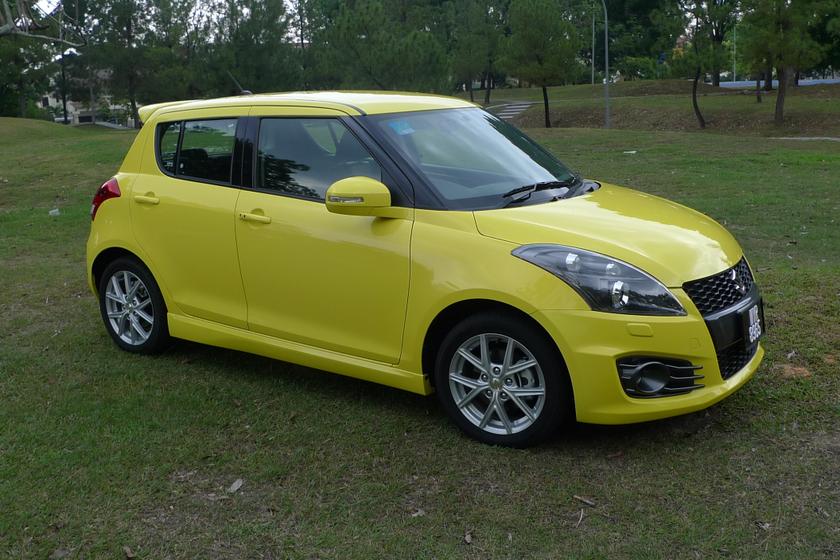
The market has been crying out for a worthy replacement for the above, which brings us to the recent test I did on the new 2013 Suzuki Swift Sport. This is the second generation Suzuki Swift Sport, and after testing it, I can tell you that it is an undiscovered gem and makes me wonder if it is being under-marketed.
Just digest these numbers — 135 horsepower @ 6,900 rpm, 160 Nm of torque @ 4,400 rpm, a six-speed manual transmission, in a sporty 5-door hatch, 16-inch wheels with 50 Series low profile tyres, sitting in a body that weighs in at 1,070 kg, or 1085 with full accessories. Yes, there are many cars with power figures above this, but they are usually heavier, and probably cost a lot more. The above package is available at RM100, 672, and that is on-the-road with insurance.
When I drove the car, I felt good — good in that it had a very peppy engine that was always raring to go, but would still allow a relaxed drive when I need to ‘chill’. Just step on the accelerator and the Swift responds instantaneously — provided that you are in the correct gear of course. What it lacks in out and out power, it makes up in engine revs, and the speed at which it builds up from mid-range to maximum revs. This engine is built with sporty performance in mind, and in fact the entire car is designed for the young (who cannot afford to pay too high a price) who love driving.
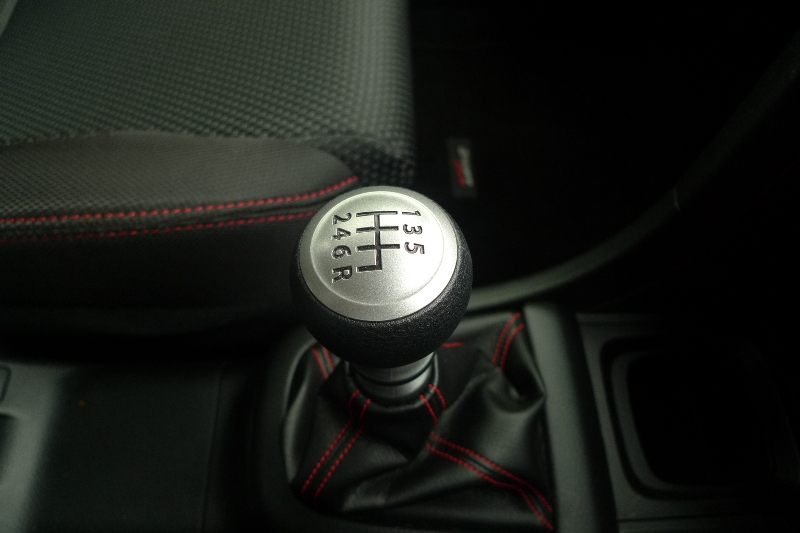
The six-speed manual, as explained to me by the MD of Suzuki Malaysia, Mr. Keiichi Suzuki, who is an avid motorsports fan, has a short first gear, mainly for easy take-off, whilst second to fifth are ‘close ratio’ gears (the ‘gap’ in between gears is relatively small, and engine rev drop while shifting up is minimal, allowing the engine to stay within its optimum power band, and thus produce good acceleration characteristics) with sixth gear being a high ‘overdrive’ gear for fuel economy. Translated to the road, the Suzuki Swift Sport delivers the kind of driving that will appeal to driving enthusiasts. To get the Suzuki Swift Sports to race or rally mode, all that is needed would be a longer first gear and a shorter sixth gear to make the gear box a full close ratio gearbox.
Suspension is Macpherson struts in the front, a torsion beam arrangement at the rear, coil springs all around, with vented disc brakes at the front and discs at the rear.
Despite the rear torsion beam, the Swift Sport handles well around corners, helped to some extent by the fact that its four wheels are placed very close to the corners.
The body looks very much like the outgoing model, but upon closer inspection, you will note that this is a totally new body, and what you probably will not know is that inside the frame are chassis improvements that actually make the body shell handle better, like a stiffer frame, and high tensile steel in the right places. I figure that Suzuki consider this a key model (which has a high customer acceptance in other parts of the world, and that they would want a shape and silhouette that is not too far off from the successful outgoing model. Changes are very subtle.
On the whole, I had a great time evaluating this Suzuki Swift Sport, and the best part about the car, which I know will make people take another look at it, is that the fuel consumption is exceptionally good for an engine with such a sporty character. With my hard driving, and heavy acceleration (interspersed with moments of normality), the car returned an average consumption of 14.4 kilometres per litre, which translates to 6.944 litres per 100 kilometres for those who are more used to this way of looking at it. By any standards, this is really excellent fuel economy, and I know that I drive the car quite hard at least 60 percent of the time that I had it. If I were thirty years younger, I know that this would be on my list of ‘must haves’. Has anyone got an age reversal machine lying around somewhere?