


JULY 13 — Every nation is shaped not only by its political leaders but also by the civil servants who quietly transform vision into reality.
Among the finest was Datuk N. Sadasivan, whose distinguished career helped shape Malaysia’s industrial transformation during one of the nation’s most consequential decades.
His tenure as Director-General of the Malaysian Industrial Development Authority (Mida) from 1984 to 1995 coincided almost exactly with the life cycle of the First Industrial Master Plan (IMP1) — from its preparation and launch in 1986 to its completion in 1995 — making Sadasivan the one constant institutional hand guiding the entire programme.
It was a defining historical period in the nation’s industrialisation under the premiership of Tun Dr Mahathir Mohamad. While Mahathir articulated the vision of a modern industrial economy, Mida became one of the principal institutions entrusted with attracting investment and facilitating industrial development.
Central to Sadasivan’s leadership was his conviction that Mida should become a genuine “one-stop centre”, capable of moving an investment proposal from initial interest to approval, and from approval to an operating plant.
Alongside the launch of IMP1, the Promotion of Investments Act 1986 was introduced, providing the legislative framework, while Mida became its operational engine.
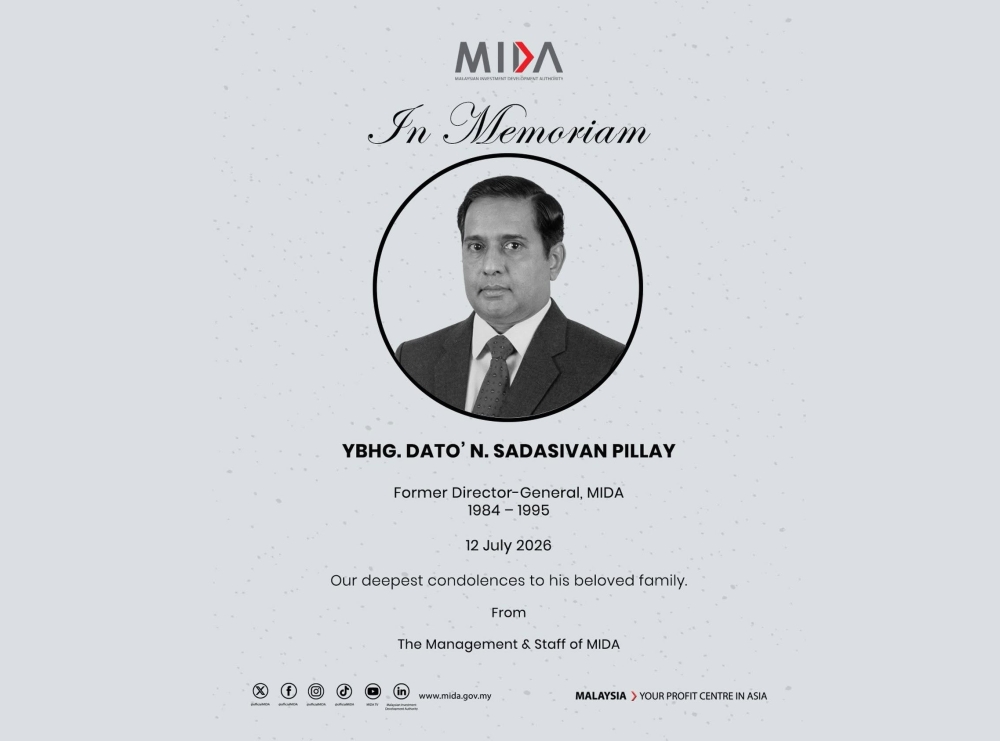
Sadasivan played a pivotal role in strengthening Malaysia’s reputation as a trusted destination for foreign direct investment, helping lay the foundations for the country’s emergence as one of Asia’s leading manufacturing and trading economies.
Mida also championed an export-oriented manufacturing strategy that positioned Malaysia as a competitive production base for regional and global markets. It encouraged investments that strengthened industrial clusters, developed local suppliers, facilitated technology transfer and integrated Malaysian manufacturers into global supply chains.
Sadasivan was born in Ipoh in a leap year, on February 29, 1940. He was one of nine children whose father was a clerk with the Central Electricity Board. His parents prioritised education above everything else.
After studying at the Victoria Institution, Sadasivan had hoped to pursue law. Financial circumstances, however, led him to study economics at the University of Malaya instead — a decision that would ultimately shape both his own career and, in many ways, Malaysia’s economic future.
Upon graduating in 1963, he joined Singapore’s Economic Development Board (EDB), where his talents were recognised. Within three years, he was heading one of its divisions, working alongside some of the finest architects of Singapore’s industrialisation during a pivotal period in the republic’s economic development.
Following Singapore’s separation from Malaysia in 1965, Sadasivan faced a defining choice — whether to retain his Malaysian citizenship.
“I chose to return home. I was not ready to give up my Malaysian citizenship,” he later recalled.
That decision brought him back to Malaysia and to the Federal Industrial Development Authority (Fida), later renamed Mida, in 1968.
The organisation appointed him to set up and lead its first overseas investment promotion office in Düsseldorf, Germany, in 1972 before posting him to Paris three years later.
At a time when Malaysia was still establishing itself as an industrial destination, Sadasivan spent years promoting the country’s potential across Europe, patiently building relationships and confidence among international investors.
His efforts helped attract leading multinational companies such as Robert Bosch, Siemens, Schott Optical Glass, Kim Fabrics, O&E Designs and ZDF. These were not merely investment successes of their time. Many continue to operate and expand in Malaysia decades later, creating employment, transferring technology and strengthening the country’s manufacturing and export ecosystem.
By 1995 — the year of both his retirement and the conclusion of IMP1 — manufacturing had decisively overtaken agriculture and commodities as Malaysia’s principal engine of economic growth.
Export-oriented industries flourished, while manufacturing became a major source of employment, foreign exchange earnings, technology diffusion, and supplier development.
Just as importantly, the institutional framework he helped build continued to shape Malaysia’s industrial policies through the Second Industrial Master Plan (1996–2005).
Sadasivan’s post-retirement appointments reflected the confidence that corporate Malaysia continued to place in his judgement. After retiring from public service, Sadasivan founded SKA Management Consultants Sdn Bhd before serving on the Board of Bank Negara Malaysia, becoming Independent Deputy Chairman of Malaysia Airlines, and holding long board tenures at Petronas Gas Berhad and APM Automotive Holdings Berhad.
He understood something fundamental about investment promotion: before investors commit capital, they must first believe in a country’s future. Perhaps that is why he became one of Malaysia’s quiet merchants of confidence.
If Mahathir was the face of Malaysia’s industrial transformation, Sadasivan was one of the trusted hands behind the curtain — quietly persuading investors, business leaders and multinational corporations that Malaysia was ready for the future.
Perhaps one of Sadasivan’s most admirable qualities was his understanding of the unique role of the civil service.
While he worked closely with political leaders and helped advance national economic priorities, he never confused public duty with political allegiance. His loyalty was neither to personalities nor politics, but to the institutions of government and to the national interest they existed to serve.
He remained, above all, a civil servant — professional, impartial and steadfast in his commitment to Malaysia.
Those who worked with Sadasivan often spoke of his ability to listen patiently, absorb complex issues and respond with distinct measured judgement.
“He was a man whose word carried weight. He always listened, and responded with measured judgement where commitment to the public interest never wavered,” has been the unanimous testament to his character.
He was never a flamboyant salesman nor a man handing out extravagant promises. Instead, he persuaded through preparation, earned respect through competence and inspired confidence through absolute professionalism.
Above all, he was respected for his integrity. In a profession where trust is often the most valuable currency, he earned it in abundance.
In many ways, his legacy cannot be measured solely by factories built, exports generated or investment figures recorded. It endures in the institutions he strengthened, the standards he upheld and the confidence he inspired in a generation of investors who came to regard Malaysia as a nation that honoured its commitments.
Sadasivan served without seeking the spotlight, led without fanfare, and helped build the foundations of modern industrial Malaysia with quiet distinction.
His legacy is woven not only into the factories, industries and institutions that transformed Malaysia’s economy, but also into the enduring example of what principled public service can achieve.
That is how Datuk N. Sadasivan should be remembered.
* This is the personal opinion of the writer or publication and does not necessarily represent the views of Malay Mail.


