


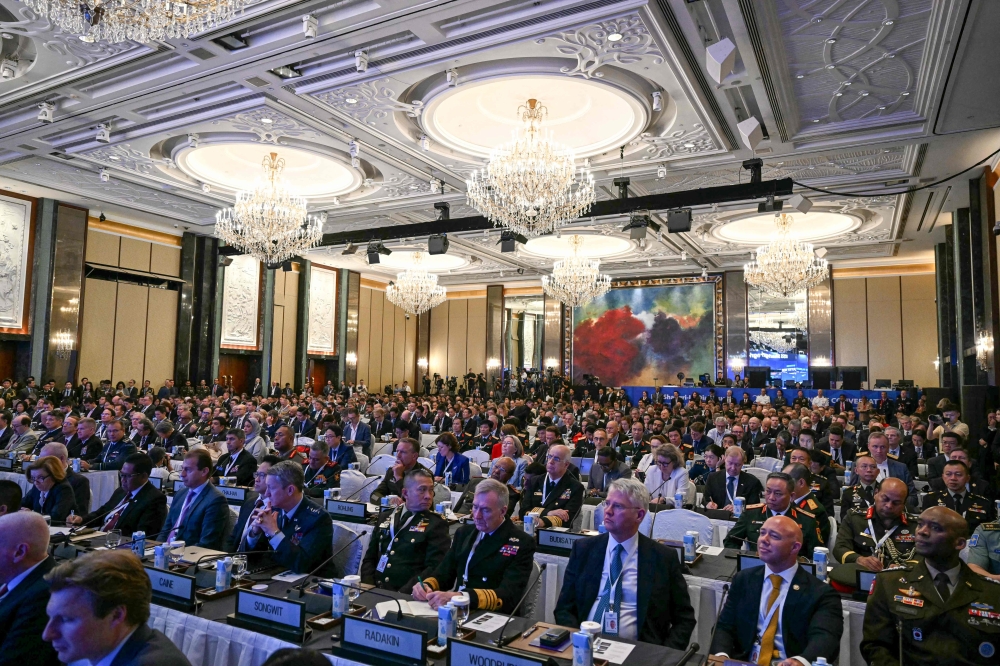
MAY 29 — The upcoming Shangri-La Dialogue in Singapore was once conceived as a platform where the Asia-Pacific could manage strategic tensions through dialogue, confidence-building and military diplomacy. It symbolized a region that, despite its many rivalries, still believed in restraint, predictability and economic interdependence.
Today, however, the Asia-Pacific no longer resembles any mythical Shangri-La.
The prolonged mayhem in West Asia, involving Iran, Israel and the United States, has fundamentally altered the strategic psychology of Asia.
What once appeared geographically distant is now directly affecting the economic and security calculations of every major Asian power and almost every Asean member state.
The recent summit between President Donald Trump and President Xi Jinping in Beijing may have temporarily reset bilateral tensions between the United States and China. Yet the very need for such an urgent diplomatic reset reveals how fragile the global order has become. Strategic mistrust remains deep.
The world is now operating in a condition of overlapping crises where no region can isolate itself from another.
This is particularly true for Asia.
The Indo-Pacific has become inseparable from the instability of West Asia because the economic arteries of Asia remain deeply tied to the Persian Gulf. Energy supplies, shipping lanes, fertilizer exports and maritime trade routes all converge around the Strait of Hormuz. Any prolonged disruption there reverberates immediately across East Asia and Southeast Asia.
The consequences are already visible.
Shipping insurance costs have surged.
Manufacturing uncertainty has increased. Inflationary pressures continue to spread across Asian economies. Countries dependent on imported energy are struggling to contain public anxieties over rising fuel and food prices.
The Philippines has openly warned of stagflationary pressures. Japan remains anxious over energy vulnerability despite its diversification strategies. South Korea is increasingly aware of how supply-chain resilience can be shattered by prolonged geopolitical instability.
Meanwhile, Asean countries are confronted by a painful reality: the region’s economic resilience remains insufficient for a prolonged external shock.
This explains why the Shangri-La Dialogue can no longer be viewed merely as a military conference.
The issues dominating discussions are no longer confined to Taiwan, the South China Sea or freedom of navigation operations. The core issue is now survivability under conditions of prolonged geopolitical fragmentation.
Can Asia maintain economic stability if the Strait of Hormuz remains partially disrupted for months or even years?
Can the United States sustain simultaneous strategic commitments in Europe, West Asia and the Indo-Pacific without overstretch?
Can China continue projecting economic confidence while facing a deteriorating external environment?
Can Asean remain cohesive when member states themselves are under severe economic strain?
These are the real questions confronting Asia today.
The danger is that the Indo-Pacific is becoming militarized at precisely the moment when economic uncertainty is deepening. Japan is expanding its defence posture.
The Philippines is intensifying military cooperation with Washington. China is accelerating naval modernization.
The United States continues strengthening alliance networks across the region.
At the same time, strategic trust among major powers continues to erode.
Even symbolic developments matter.
The absence of China’s defence minister from the Shangri-La Dialogue for a second consecutive year reflects the persistence of deep strategic suspicion despite temporary diplomatic stabilization elsewhere.
Dialogue exists, but confidence does not.
This is what makes the current moment particularly dangerous.
Asia now faces the possibility of strategic overlap, where crises in one region trigger insecurity in another.
The Persian Gulf, the Red Sea, the South China Sea and the Taiwan Strait are increasingly interconnected theatres rather than isolated geopolitical spaces.
The era when Asia could focus exclusively on growth and development while external powers managed distant conflicts is ending.
The Asia-Pacific now lives under the shadow of global fragmentation.
For Asean, this presents both a challenge and a test of maturity.
Since its founding in 1967, Asean has attempted to prevent Southeast Asia from becoming trapped in great-power rivalry.
Through mechanisms such as the Zone of Peace, Freedom and Neutrality (Zopfan), the Treaty of Amity and Cooperation and the Asean Outlook on the Indo-Pacific (AOIP), the regional bloc consistently emphasized neutrality, dialogue and peaceful coexistence.
Yet the strategic environment today is harsher than at any time since the Cold War.
The old assumptions of globalization are weakening.
Economic interdependence no longer guarantees stability. Supply chains are increasingly politicized. Technology is becoming securitized. Energy flows are vulnerable to military conflict.
Under these conditions, Asean cannot afford complacency.
The region must strengthen strategic reserves in food, fuel and critical minerals. It must deepen intra-Asean trade beyond the current level of approximately 23 percent.
Asean must also accelerate financial coordination and strengthen mechanisms capable of cushioning external shocks.
More importantly, Asean must resist being psychologically trapped into accepting great-power confrontation as inevitable.
The region still possesses diplomatic relevance. Asean remains one of the few platforms where all major powers continue to engage simultaneously.
The East Asia Summit, Asean Regional Forum and Asean Defence Ministers’ Meeting Plus continue to provide valuable channels for communication.
But these platforms must evolve beyond symbolism.
The Asia-Pacific is no longer insulated from global crises.
What happens in Hormuz affects Tokyo, Seoul, Kuala Lumpur, Jakarta and Manila. What happens in Gaza or Tehran shapes calculations in Beijing, Canberra and Singapore.
The illusion of regional separation has collapsed.
The challenge before Asia now is whether it can prevent itself from becoming the next epicentre of uncontrollable escalation.
The Shangri-La Dialogue may continue as an institution. But the strategic innocence once associated with the idea of a peaceful and economically unstoppable Asia has disappeared.
The Asia-Pacific is no longer a Shangri-La.
It is now part of a deeply unstable and interconnected world order where the consequences of war travel faster than diplomacy itself.
* Phar Kim Beng is a professor of Asean Studies and a director, Institute of International and Asean Studies, International Islamic University of Malaysia.
** This is the personal opinion of the writer or publication and does not necessarily represent the views of Malay Mail.


