


APRIL 24 — The world is tilting towards India — subtly, but unmistakably. Its rise is no longer a forecast, but a reality — one that is decisively reshaping the global order.
India is set to remain among the fastest-growing major economies in the years ahead, reinforcing its position as a central driver of global growth. Its growing confidence on the world stage reflects a willingness to shape, rather than simply respond to, the evolving global order.
So it is no surprise that the world is looking, with growing curiosity, at India.
Across geopolitics, economics and technology, India is shaping markets, industries and talent flows beyond its borders. Policymakers in Brussels, Washington, Beijing and Moscow are already factoring India into their strategic and economic decisions.
The International Monetary Fund projects India’s growth at 6.5 per cent in 2026 — the fastest among major economies. India is on track to become the third largest economy in the world by 2031.
Speaking at the Malaysia-India Business Council, former health minister Khairy Jamaluddin put it plainly: India is “not simply growing — it is reshaping the global economic landscape.” We must be “clear-eyed about what India is becoming.”
His message is a sharp reminder that Malaysia’s approach must now match India’s changing global role.
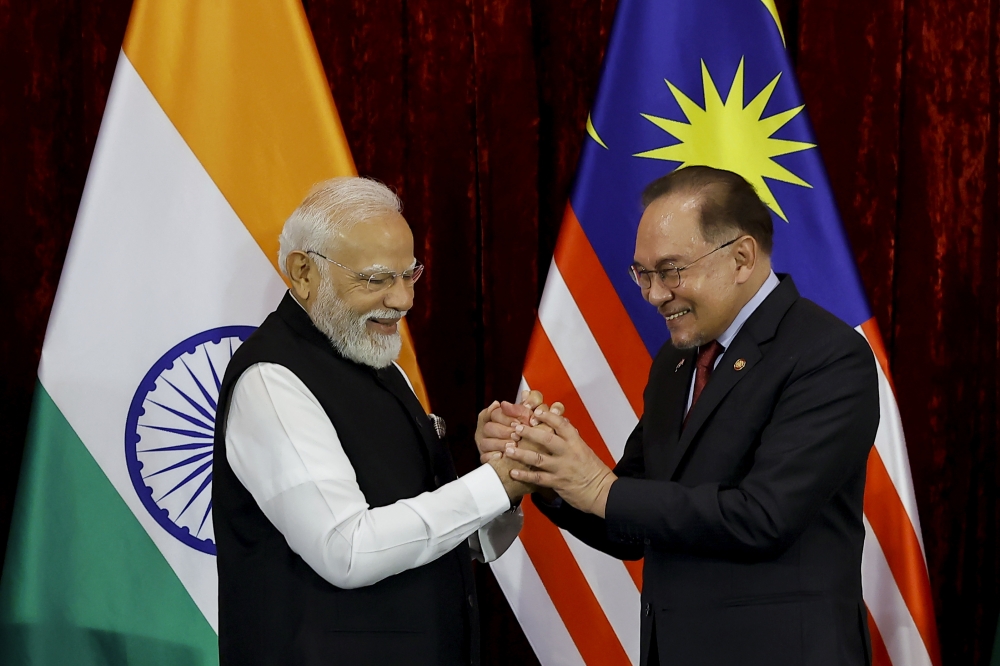
On February 8 this year in Kuala Lumpur, that shift was formalised.
Indian Prime Minister Narendra Modi stood alongside Malaysia’s Prime Minister Anwar Ibrahim as 11 agreements were signed under the Malaysia-India Comprehensive Strategic Partnership. This marks a turning point — shifting Malaysia-India ties from diplomatic warmth to structured, high-value collaboration.
In this context, Khairy Jamaluddin’s message carries particular weight.
“Malaysia’s approach to India has too often been affectionate, episodic, and reactive. That may have sufficed in an earlier era but it is no longer adequate for a country that is poised to become one of the defining economic powers of our time,” he cautioned.
For Malaysia, the implication is clear. The mindset must shift — from familiarity to focus, from sentiment to strategy.
Nowhere is this shift more urgent than in healthcare.
The pandemic exposed a critical vulnerability in Malaysia’s reliance on imported pharmaceutical inputs. But it also revealed opportunity. “Supply chains are not merely economic constructs,” Khairy reminded his audience, “they are matters of national security.”
Engaging India in this space is not simply about sourcing — it is about co-producing resilience.
Co-producing generic medicines with Indian firms in Malaysia — under Malaysian regulatory standards and for Asean markets — would strengthen resilience while opening a high-value industry.
It is, in his words, a “billion-ringgit opportunity” waiting to be realised.
Beyond pharmaceuticals, the convergence of traditional medicine systems — Ayurveda, Malay and Chinese — offers another pathway. What exists today in parallel can be brought together with greater structure and scale. With 2026 designated as Malaysia’s Year of Medical Tourism, and India a key source market, the case for a Malaysia-India health corridor is both practical and compelling.
If healthcare is about resilience, the digital economy is about urgency.
India has built one of the most advanced digital public infrastructures in the world. Its Unified Payments Interface (UPI) processes billions of transactions monthly, demonstrating how digital systems can operate at national scale — efficiently and inclusively.
Payment integration between India’s UPI and Malaysia’s DuitNow, joint fintech sandboxes, and deeper collaboration in artificial intelligence and data infrastructure must move from discussion to implementation.
Malaysia has already taken important steps. Through collaboration with India’s technology industry body, NASSCOM, the Malaysia Digital Economy Corporation is equipping Malaysians with critical skills in artificial intelligence, cybersecurity and software development.
But incremental progress will not suffice when engaging a country operating at scale. Malaysia must engage India as a systems leader, not merely as a technology partner.
In semiconductors, the case for partnership is equally compelling.
Malaysia’s established role in backend assembly and testing complements India’s investments in chip design and fabrication. Together, they form a value chain aligned with global efforts to diversify and secure supply chains.
As Khairy stressed, “these complementarities will not realise themselves — they must be actively shaped. Running through all of this is one decisive factor: talent. Here, the framing matters. The objective is not to import labour but to expand capability,” he said.
Partnerships that train Malaysians in high-value sectors, structured exchanges with India’s leading institutions, and targeted collaboration in emerging industries all contribute to building domestic strength.
At the same time, engagement with Indian expertise in specialised fields can accelerate Malaysia’s progress. Handled well, this strengthens rather than displaces domestic capability.
Within this, the Malaysian Indian community represents a distinct strategic advantage. Their networks and familiarity position them uniquely to bridge both economies—an asset that should be more deliberately leveraged.
The Modi visit has made the intent clear. The shift is already underway.
For Malaysia, the opportunity lies in shaping a partnership with India that is not only aligned and forward-looking, but anchored in long-term national interest.
* This is the personal opinion of the writer or publication and does not necessarily represent the views of Malay Mail.


