


NOVEMBER 2 — When US Ambassador Edgard D. Kagan appeared on Bernama World on November 1, 2025, his interview offered something rare in modern diplomacy: a conversation that was intelligent, historically literate and refreshingly free of slogans.
He neither preached nor patronised. He simply did what good envoys are meant to do — state facts, give context, and extend respect.
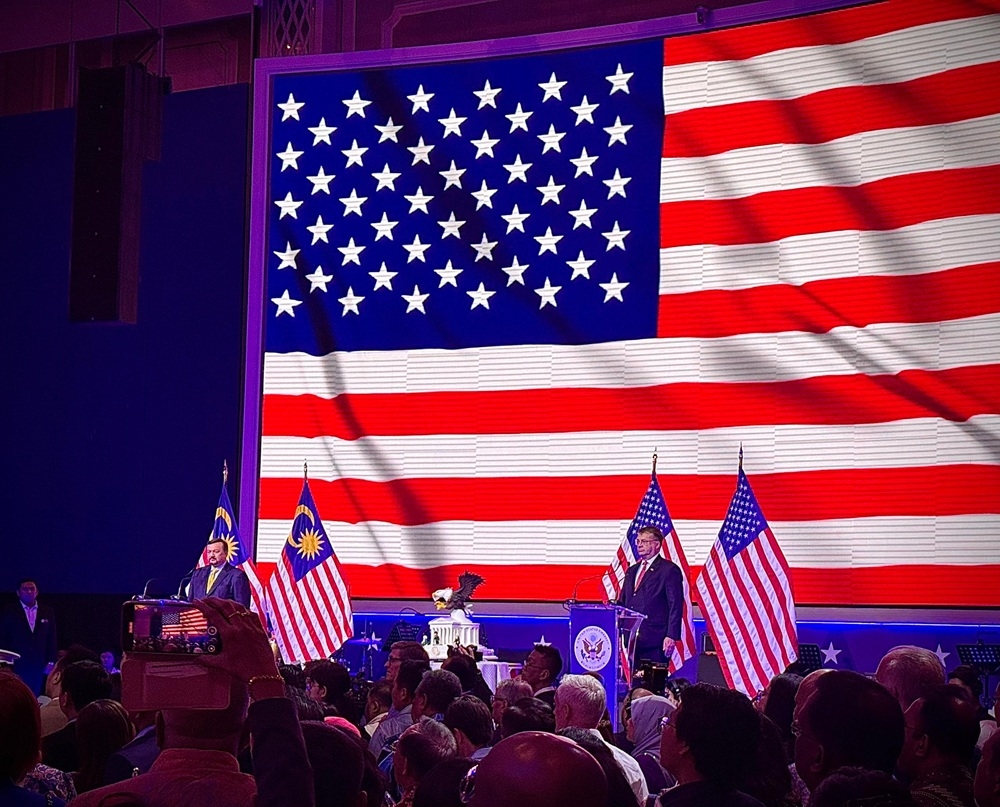
Recognition and respect: The long memory of nations
Kagan reminded viewers of a truth easily forgotten in Malaysia’s often cynical public discourse: upon the Federation’s birth on September 16, 1963, the United Kingdom was the first to recognise Malaysia, and the United States followed within hours — the second nation in the world to do so.
That gesture mattered. It confirmed Malaysia’s sovereignty at a time when its survival was far from assured.
By contrast, Beijing waited more than a decade, formalising ties only in May 1974 under Tun Razak and Zhou Enlai. In diplomatic time, that is an epoch.
Kagan did not say this to gloat, but to remind us that America saw Malaysia early — and still sees it as an equal partner worth investing in.
The new trade reality
At the heart of his message was the new Reciprocal Trade Agreement, finalised during President Trump’s recent visit.
The pact allows over 1,700 categories of Malaysian goods — from palm-oil derivatives and rubber products to cocoa, electrical components and aerospace parts — to enter the US market duty-free.
In return, Malaysia offers preferential access for select US goods in agriculture, energy and technology, and commits to streamlining certification and regulatory barriers that have long slowed bilateral commerce.
Behind the numbers is something larger. The US is effectively signalling that Malaysia is a trusted node in its effort to diversify supply chains and secure critical materials.
The agreement includes clauses to prevent export bans on rare-earths and critical minerals, an acknowledgment that Malaysia’s sub-soil wealth and manufacturing base now matter to American industry beyond semiconductors.
Kagan’s phrasing was deliberate: “We want to rebalance the relationship — make it more equitable.”
It was not charity; it was calculus. America needs stable partners. Malaysia needs open markets.
Rural groundings: Beyond tariffs and tables
While most headlines celebrated the tariff cuts, Kagan drew attention to something subtler — how the deal can reach the grassroots.
He spoke of Malaysia’s rural heartlands, of palm-oil smallholders, rubber tappers and the agrarian backbone of our export economy.
The inclusion of agriculture and agro-based commodities in the zero-tariff list means that this is not merely a high-tech pact for urban factories; it touches lives in Kedah, Kelantan, Sabah and Sarawak.
Whether those gains will flow downstream, however, depends on Malaysia.
If the export windfall is captured only by large corporations, then the promise will ring hollow.
If instead we use this opening to strengthen smallholder cooperatives, invest in rural logistics, and push for value-added agro-processing, the impact could be transformational.
For the first time in years, a trade deal acknowledges that development is not just about GDP; it is about dignity in the provinces.
Realism over rhetoric
Kagan’s style was markedly non-partisan. He avoided the ideological shorthand that often defines US foreign policy commentary.
By recognising that even Donald Trump’s tariffs had a domestic logic — protecting American workers — he did not endorse the policy, he contextualised it.
That nuance is rare. It reflects a realism that mature nations understand instinctively: you don’t have to agree to engage.
Malaysia’s turn to respond
For Malaysia, the ball is now firmly in our court.
This is not the time for political theatre. It is the time for execution.
We must ensure that the zero-tariff access translates into jobs, investment and rural uplift.
We must align our standards, simplify export approvals, and prepare our SMEs — not just the big E&E players — to enter the US market competitively.
We also need to safeguard sovereignty. The agreement’s commitments on transparency, labour standards and digital trade carry expectations. Meeting them strengthens credibility; ignoring them risks marginalisation.
The quiet power of diplomacy
There are ambassadors who recite talking points, and there are those who build bridges.
Kagan belongs to the latter. His Bernama World interview was not theatre; it was strategy — calm, contextual, deeply informed.
It reminded Malaysians that not all terraces are tilted against us, and that partnerships still exist where respect is mutual.
We should not confuse deference with diplomacy. What was on display was something rarer — the soft authority of someone who knows his brief, honours history, and listens as much as he speaks.
Malaysia would do well to meet that tone.
Recognition, after all, is a two-way street.
* This is the personal opinion of the writer or publication and does not necessarily represent the views of Malay Mail.


