











OCTOBER 26 — To understand Asean, one must appreciate the subtle art of silence. The Association of South-east Asian Nations operates like a Sphinx — mysterious, unreadable, yet ever present in the shifting sands of global politics. It is neither static nor inert; rather, it conceals its movements with a deliberateness that confounds even its closest partners.
Observers accustomed to the rapid-fire decision-making of the United States or the European Union often misread Asean’s quietude as indecision. But Asean’s silence is its speech. Its flexibility, discretion, and caution are not signs of institutional paralysis; they are expressions of survival and maturity in a world too quick to judge and too divided to listen.
The sphinx-like nature of Asean
Like the Sphinx that watches over the desert, Asean has endured every storm of modern geopolitics. It was born in 1967 amid wars in Indochina and the Cold War rivalry between Washington and Moscow. Since then, it has weathered coups, invasions, economic crises, pandemics, and now a renewed confrontation between the United States and China.
Each time, Asean is written off as weak, only to reappear stronger. Its enigma lies in its strategic opacity — the ability to say little but do much. When outsiders demand that Asean “take a stand,” it instead takes a seat at the table — and quietly ensures that everyone else remains seated too.
This is not diplomacy by declaration. It is diplomacy by design. The Asean Way — of consultation, consensus, and non-interference — is not a doctrine of inaction but a culture of control. It prevents the eruption of rivalries within the family while allowing each member state to interpret common positions through its own national lens.
Flexibility as statecraft
Asean’s flexibility is both procedural and philosophical. Decisions are made not through votes but through persuasion, personal trust, and patient listening. This approach is what I often call “bamboo diplomacy” — it bends with the wind, but it never breaks.
When formal institutions like the UN or EU often paralyze themselves through vetoes or ideological rigidity, Asean works quietly behind closed doors. Its leaders and diplomats cultivate what might be called a stealth culture — an unspoken agreement that relationships matter more than rhetoric. In that culture, a phone call or a corridor conversation often does more than a press release.
This is the Asean secret: outward stillness, inner movement.
The art of strategic ambiguity
What appears to be ambiguity to outsiders is, in truth, Asean’s shield. In a region of monarchies, socialist republics, and parliamentary democracies, there is no single ideological thread that can bind all members together. Unity, therefore, is achieved not through uniformity but through tolerance of diversity.
Asean’s communiqués are carefully crafted masterpieces of balance — every word negotiated to reflect collective ownership. While this may frustrate Western policymakers seeking clarity, it ensures that no member is humiliated, no capital feels cornered, and no decision becomes a wedge that divides rather than unites.
This strategic ambiguity allows Asean to maintain relevance in an increasingly polarized world. It can work with Washington on maritime domain awareness, with Beijing on trade and connectivity, with the EU on sustainability, and with the GCC on energy and halal ecosystems — all without appearing to betray its neutrality.
Backroom diplomacy and the stealth culture
Much of Asean’s true diplomacy happens far from the cameras. Backroom diplomacy — or what some call Track 1.5 and Track 2 engagement — thrives in Asean precisely because of this stealth-like culture.
At the height of the Thai–Cambodian border conflict, it was Malaysian and Indonesian envoys who mediated without ever issuing public statements. During the Rohingya humanitarian crisis, Asean convened special retreats and working groups to prevent the issue from fracturing its unity. Even now, as the South China Sea remains a point of contention, Asean continues to shepherd a delicate Code of Conduct negotiation with China through patient dialogue rather than coercive confrontation.
Each of these quiet efforts defies the logic of headline-driven diplomacy. Yet they are precisely why Asean remains intact — the only regional organization in the developing world to have expanded, not contracted, since its founding.
The power of surprise
Asean’s greatest strength lies in its ability to surprise. The 1976 Treaty of Amity and Cooperation, which laid the foundation for regional peace; the 1994 establishment of the Asean Regional Forum; the 2008 Asean Charter; and the 2025 Asean–GCC–China Economic Summit in Kuala Lumpur — all began as improbable dreams. Each matured quietly until the moment was right, then emerged fully formed.
This pattern — long silence, sudden delivery — is quintessentially Asean. It frustrates those who equate diplomacy with speed, but it delights those who understand that in South-east Asia, patience is policy.
Asean’s flexibility in an age of flux
In an era of tariff wars, maritime tensions, and technological rivalries, Asean’s flexibility is its best defense. It refuses to be drawn into binary alignments, instead preferring “omni-directional diplomacy.” This allows it to remain indispensable to both Washington and Beijing, while deepening ties with Japan, South Korea, India, Australia, and the Gulf States.
This posture is not neutrality born of weakness. It is equidistance born of prudence. Asean knows that survival in a volatile world requires keeping all doors open and no bridges burned. Its leaders understand that one must sometimes bow to endure — not as submission, but as strategy.
Conclusion: The riddle that endures
To outsiders, Asean’s quietness will always appear puzzling. But to those within the region, it is the only way forward. The Association remains the Sphinx of Asia — silent yet watchful, flexible yet unbreakable.
Its riddles are deliberate, its pace deceptive, and its diplomacy unseen. Yet, in that ambiguity lies Asean’s genius: the capacity to absorb contradiction, to mediate without domination, and to turn stillness into strength.
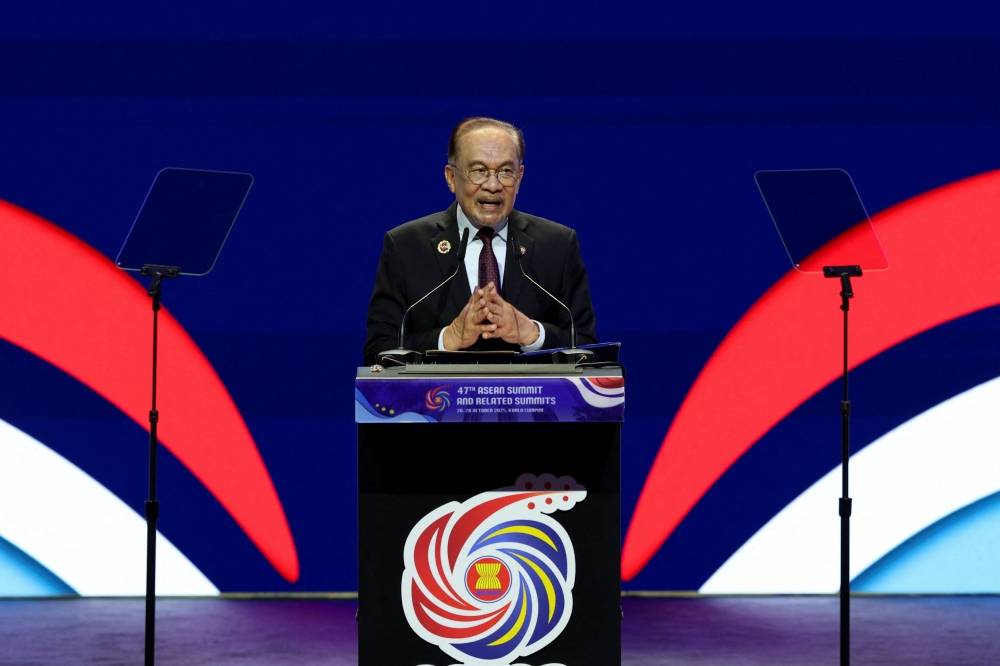
Prime Minister Datuk Seri Anwar Ibrahim understands this instinctively. Having mastered the art of quiet persuasion, he will be consulted time and again — even when the Philippines assumes the next Chair of Asean and Related Summits — for his ability to bridge contradictions with calm reason and cultural empathy.
The Sphinx does not speak because it does not need to. It endures — and so does Asean. Trump and other global leaders are here for its flexible and sublime nature.
* Phar Kim Beng, PhD is the Professor of Asean Studies at International Islamic University of Malaysia and Director of Institute of International and Asean Studies (IINTAS).
* This is the personal opinion of the writer or publication and does not necessarily represent the views of Malay Mail.