


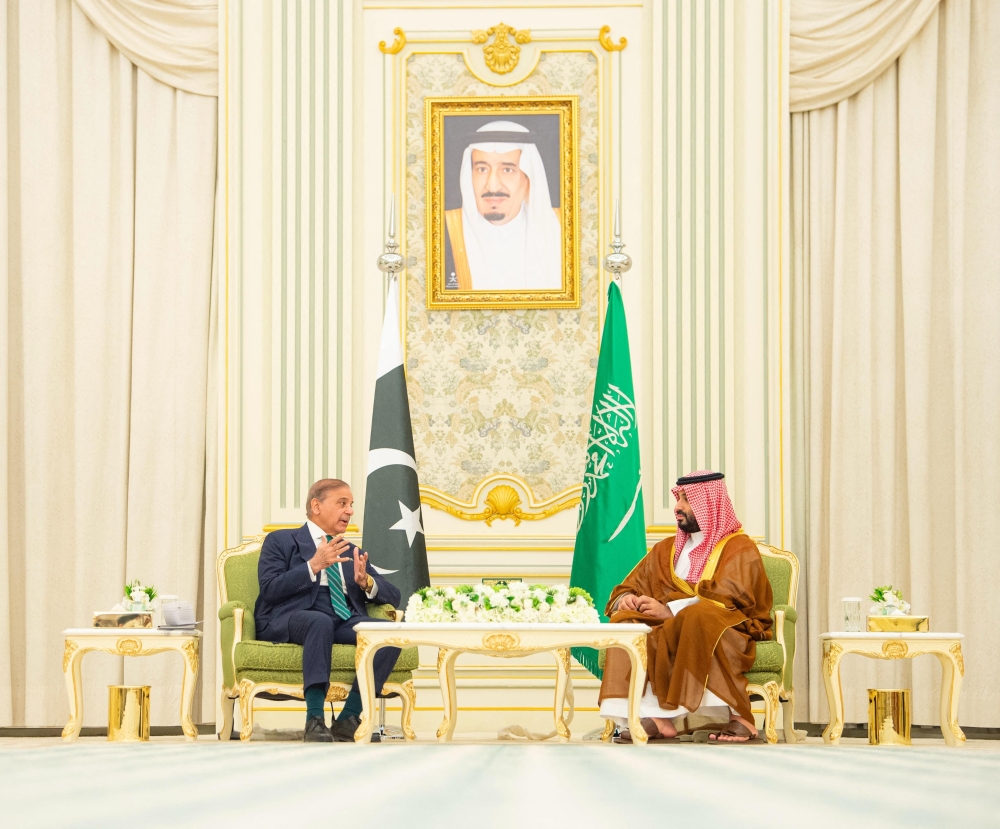
SEPTEMBER 20 — When Saudi Arabia and Pakistan signed their Strategic Mutual Defence Agreement on September 17, 2025, they did more than cement bilateral ties. They anchored the Kingdom’s security to the nuclear deterrent of Pakistan — a South Asian power whose arsenal, unlike India’s, is now explicitly extended to cover Saudi soil.
The pact, which declares that “any aggression against either country shall be considered an aggression against both,” transforms Pakistan’s nuclear capability from a national shield into a regional buffer. For Saudi Arabia, this is nothing less than strategic insurance against a volatile neighbourhood.
South Asia’s nuclear paradox
Pakistan is not South Asia’s only nuclear power. India too maintains a sophisticated arsenal, developed largely to deter China and Pakistan.
But where India’s nuclear doctrine has remained nationally focused, Pakistan’s has always carried a more flexible, outward-facing character — open to being extended under special circumstances. Saudi Arabia has long cultivated this option.
Through decades of financial aid, military training exchanges, and political support, Riyadh has positioned itself as the partner most likely to benefit from Pakistan’s nuclear umbrella.
For the Kingdom, the logic is straightforward. Its proximity to Iran, its vulnerability to regional proxy wars, and the shifting reliability of the United States all make a conventional alliance insufficient.
Extended deterrence from Pakistan, unlike India’s more inward doctrine, offers a credible insurance policy: if Saudi Arabia were attacked, any adversary would now face the spectre of a nuclear-armed Pakistan entering the fray.
The logic of extended deterrence
Extended nuclear deterrence is as much psychological as it is military. By raising the cost of aggression to catastrophic levels, it discourages hostile powers from even testing the limits.
For Riyadh, the pact sends a clear message to potential adversaries in the Middle East and beyond: the Kingdom’s security is not confined to its own forces, but is tied to the strategic depth of Pakistan’s arsenal.
This concept is not new. During the Cold War, the United States extended its nuclear umbrella to Nato allies in Europe and later to Japan and South Korea.
The logic was the same: reassure partners that they would not face aggression alone, while deterring adversaries by making clear that any attack would invite a nuclear response.
For decades, this prevented Europe from descending into direct conflict with the Soviet Union, and continues to reassure Seoul and Tokyo in the face of North Korean and Chinese assertiveness.
The risks, however, are obvious. Iran may accelerate its own capabilities in response. Israel may interpret the pact as a shift in Gulf security alignment. Even Washington could see this as a challenge to its primacy. But for both Saudi Arabia and Pakistan, the benefits outweigh the dangers.
Riyadh gains nuclear-backed deterrence without violating its own non-proliferation commitments, while Islamabad elevates its global status by extending its deterrent beyond South Asia.
Asean’s different path
What does this mean for Asean? At first glance, South-east Asia’s nuclear-weapons-free zone could not be more different from the Saudi–Pakistan pact. Yet the lessons are clear.
In a world where nuclear umbrellas are being extended and formal defence commitments tightened, Asean’s choice of building security through dialogue stands out as a deliberate counter-model.
When Cambodia and Thailand clashed along their contested border, Asean did not rely on deterrence. Instead, through the good offices of its Chair, it brokered a ceasefire.
No nuclear umbrella was invoked, no mutual defence treaty activated — only trust built through years of regionalism and a willingness to use quiet diplomacy. Imperfect as it was, the ceasefire demonstrated that regional stability can be preserved without recourse to nuclear guarantees.
Asean’s approach reflects its unique environment
By prioritising consensus, non-interference, and confidence-building, Asean has managed to keep inter-state wars at bay for decades.
Its security rests less on the threat of retaliation and more on the prevention of escalation. In this sense, Asean represents a softer but no less credible form of collective security.
Respect and vigilance
Asean must remain respectful of the choices made by others.
Saudi Arabia’s pursuit of extended nuclear deterrence from Pakistan reflects its vulnerabilities — encircled by regional rivalries, threatened by non-state actors, and uncertain of external guarantors. Asean’s environment is different, but the principle of respecting sovereign choices is central to its credibility.
At the same time, Asean must stay vigilant. Extended deterrence elsewhere may inspire debates closer to home.
Should regional states feel compelled to seek similar guarantees — whether from the United States, China, or others — Asean’s unity could fray. Its greatest strength lies not in entangling alliances but in its ability to act swiftly to prevent disputes from escalating, as seen in Cambodia and Thailand.
A world of two logics
The Saudi–Pakistan pact and the Asean model represent two different logics of security.
One builds safety through extended deterrence, with all the risks and responsibilities that entails. The other relies on early de-escalation and consensus. Neither is perfect. But both respond to the environments in which they are embedded.
The critical lesson is this: the world must learn to respect different security pathways.
Where Riyadh turns to Pakistan’s nuclear shield, Asean turns to its Chair’s diplomatic shield. Both are mechanisms of survival. In a fractured world, survival itself is the ultimate measure of success.
*Phar Kim Beng, PhD, is professor of Asean Studies at the International Islamic University of Malaysia and director of the Institute of International and Asean Studies (IINTAS).
**This is the personal opinion of the writer or publication and does not necessarily represent the views of Malay Mail.


