


JULY 30 — The Thai-Cambodian border conflict of July 2025, which escalated into a full-scale military confrontation and displaced more than 300,000 people, may have been halted temporarily by a midnight ceasefire agreement.
Yet, beneath the apparent calm lies an asymmetrical truth: Thailand, with overwhelming military superiority, can afford to wage a war of attrition. Cambodia cannot. Thus, for Phnom Penh, peace is not merely a diplomatic choice — it is a geopolitical necessity.
The ceasefire, brokered at a moment of intense regional and global scrutiny, was welcomed across Asean. Its immediate enforcement on July 28 was a diplomatic feat, especially given the speed at which it was organised. The top brass of both nations’ armed forces met within 24 hours at a forward post in Surin Province, Thailand, reaffirming their intention to hold the line.
The two sides agreed to halt troop movements, avoid provocations, and establish four-member liaison teams for future coordination. Importantly, both defence ministries backed the plan. Thailand, having called out Cambodia for ceasefire violations earlier in the week, softened its tone after the military-to-military interface.
Cambodia, for its part, categorically denied any breaches, claiming it had respected the ceasefire from the very beginning.
Yet, no amount of face-saving declarations or tightly scripted meetings can hide the lopsided military equation.
Thailand’s military, with its F-16 fighters, advanced armoured divisions, and formidable naval power, dwarfs Cambodia’s capabilities in every conceivable category.
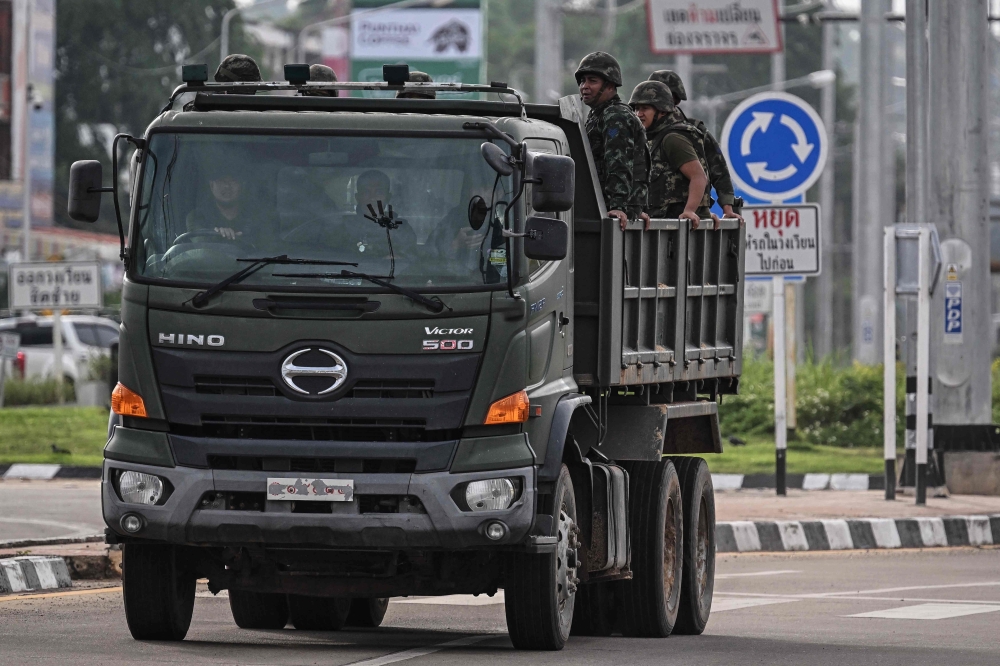
Cambodia’s only tactical advantage in recent years has been its acquisition of long-range rocket artillery, but even this cannot offset Thailand’s dominance in the air, on the ground, and in its command-and-control structures.
Any further escalation would expose Cambodia’s vulnerabilities in the field, in logistics, and in sustaining a prolonged campaign.
Given this reality, Cambodia’s best chance at asserting its interests lies not on the battlefield but in the courtroom and the diplomatic chamber.
As early as June, Cambodia sought adjudication from the International Court of Justice (ICJ) to resolve the long-running territorial dispute.
This was a calculated decision — one that aligns with Phnom Penh’s historical preference for multilateral arbitration and reflects an understanding of its limitations. Thailand, however, has repeatedly rejected third-party mediation, insisting instead on bilateral talks.
This mirrors Bangkok’s longstanding aversion to international legal interventions that may lock it into outcomes contrary to its national narrative and perceived territorial integrity.
It is precisely here that Cambodia must walk the tightrope. While invoking international law and seeking external legitimacy, it must also engage Thailand on bilateral terms to ensure that diplomacy remains alive. The ceasefire agreement — while commendable — exists in a fragile ecosystem.
It is held together by Asean diplomatic activism, threats of high tariffs from the United States, and the blunt warning that trade talks could be stalled completely by President Donald Trump if fighting resumed.
For a Cambodian economy grappling with post-pandemic recovery and attempting to wean itself off illicit digital revenues along the border, this external pressure was both timely and decisive.
Likewise, Thailand, eager to secure its own economic gains and maintain regional legitimacy as a future Asean Chair, could not afford to appear belligerent in the eyes of Washington, Beijing, or the broader Asia Pacific.
Nevertheless, Cambodia’s decision to comply with the ceasefire must not be mistaken for surrender. Rather, it should be interpreted as a pivot—toward law, diplomacy, and international solidarity.
Hun Manet’s government, still under the long shadow of his father Hun Sen, must now articulate a coherent peace strategy that goes beyond ceasefires.
That includes pushing for the August 4 General Border Committee meeting to deliver tangible results: demilitarised buffer zones, joint border demarcation teams, and confidence-building mechanisms supervised by Asean monitors, if not neutral third parties.
Yet spoilers remain. Wars — especially border wars — attract those who thrive in chaos.
There are factions within both militaries who believe victory is the only deterrent, and within civilian power circles who seek to elevate their political stature through brinkmanship. Sun Tzu once wrote that the best victory is one not fought.
But Clausewitz warned that war is politics by other means. Cambodia cannot afford to indulge in the latter interpretation. In an asymmetrical confrontation, the stronger party always sets the pace, and the weaker party must navigate with greater wisdom.
Cambodia has that wisdom — if it can remain disciplined. It must elevate its diplomatic efforts, consolidate its case at the ICJ, and secure support from Asean’s current and future Chairs.
Malaysia and the Philippines have already endorsed a peaceful resolution. Now is the moment for Phnom Penh to push for Asean centrality — not in name, but in deeds.
This conflict has already cost too much. Border towns on both sides have been shelled. Livelihoods have been destroyed.
Trust has eroded. Every new skirmish risks drawing in larger powers, further complicating an already combustible region. China and the United States are watching, not just to prevent war but to test the resilience of Asean as a rules-based regional order.
Come hell or high water, Cambodia must make peace. Not because it is weak — but because peace, in this asymmetrical war, is its strongest form of power.
* Phar Kim Beng is a professor of Asean Studies at the International Islamic University Malaysia.
** This is the personal opinion of the writer or publication and does not necessarily represent the views of Malay Mail.


