


JULY 13 — News reports that EPF mulls introducing an Account 3 for all members to allow unconditional withdrawals at any time. This proposal undermines the original intention of this savings scheme as contributors may not have sufficient funds at retirement if unrestrained regular withdrawals were made.
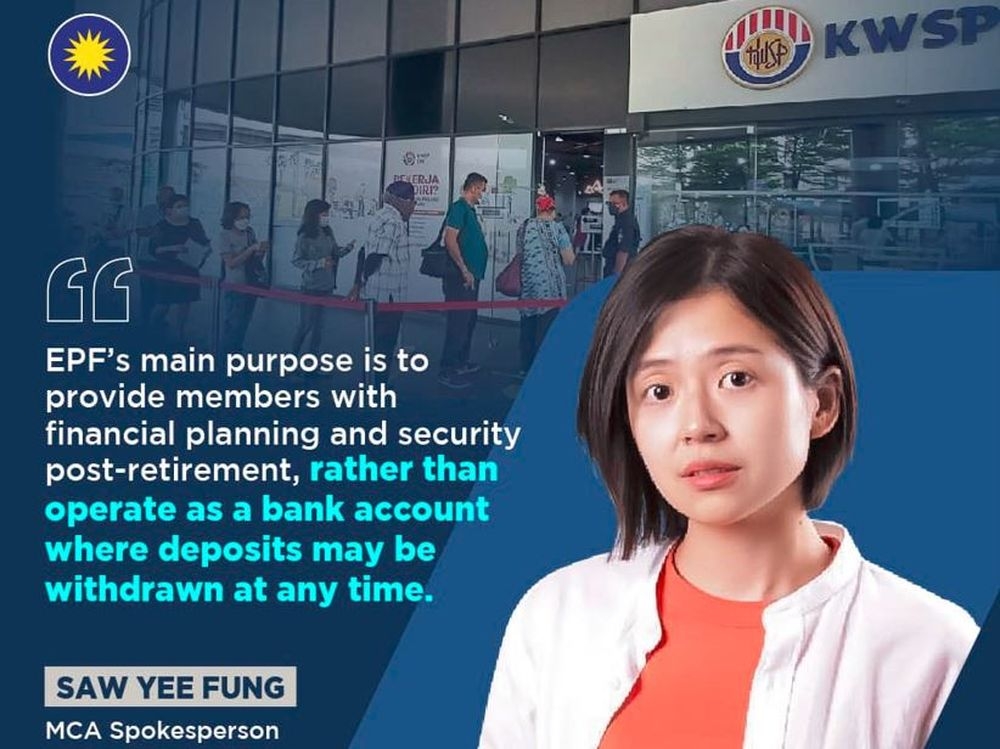
EPF’s main purpose is to provide members with financial planning and security post-retirement, rather than operate as a bank account where deposits may be withdrawn at any time.
Meanwhile, the authorities have yet to clarify details on the proposed EPF Account 3, for example: will a certain portion from the original 12% or 13% (employer) + 11% (employee) be transferred to Account 3; or, will the contributors’ rate be increased for deposits into Account 3? Regardless, these two methods are not ideal options.
MCA is concerned that if initial EPF contributions are now to be shifted into Account 3, this is tantamount to an indefinite extension of measures to allow members to withdraw EPF funds uncontrollably.
Moreover, according to EPF statistics, as of May 2023, only 18% of total members meet basic savings by age, which will enable them to have at least RM1,000 a month over a 20-year retirement age. The benchmark which EPF uses to determine Basic Savings achievement by retirement age of 55 years is RM240,000. This proves that the retirement savings of EPF contributors in general are grossly insufficient resulting with a worrisome situation.
As Malaysia enters an ageing society, to ensure that citizens have sufficient savings after retiring, it is important to plan for one’s golden years. However, if EPF allows anyone to take out their deposits at any time, this is equivalent to weakening one’s management of funds and depleting opportunities for members to enjoy higher savings. Account 3 is not a solution to have better purchasing power, but instead, generates more problems in the long term.
EPF should focus on two aspects: One, rebuilding public trust towards EPF; and Two, raising awareness on the importance of saving up for retirement. This is the only way we can resolve the root of the problem as to why some Malaysians face financial difficulties after retirement.
Furthermore, the flexible nature of the Account 3 can be promoted to encourage additional self-contributions by EPF members, which could serve to alleviate fears of being unable to withdraw money until after retirement, as well as nurture the good habit of saving for their own future.
Aside from nurturing the habit of saving for the future, EPF could further incentivise members who are willing to save up for long periods of time in Account 3. For example, while Account 3 has a lower interest rate compared to Account 1 and Account 2, EPF could consider giving equal interest rate to Account 1 & 2 for Account 3 as well, as long as the account holder has not made any withdrawals.
Next, the rollout of Account 3 should be on an opt-in basis, instead of requiring members to opt-out after automatic registration. This is because some members may become conditioned to regularly withdraw from Account 3 for various reasons, which defeats the purpose of saving up in the first place.
* This is the personal opinion of the writer or organisation and does not necessarily represent the views of Malay Mail.


