


JANUARY 22 — I do not like cliches, and to say “there are no words” to describe something is more likely an unintended admission of a writer’s limited vocabulary rather than an accurate assessment of the constraints of language.
But since the passing away of my younger brother last Friday, I have realised that truly, some thoughts cannot properly be expressed with words. No article, no book, no movie, would adequately describe the emotional aftermath of his death, much less the story of his brief life.
However, in the wake of the public outpouring of condolence, sympathy and prayer, I hope to share in my column a tiny glimpse of Tunku Alif.
When my family suddenly became a public one at the end of 2008, there were those who were already aware of the corporate endeavours of Tunku Ali, and the public policy interests or articles of Tunku ‘Abidin (though there was initially some confusion as to whether Tunku Zain was another person).
Naturally, there was much curiosity about Tunku Alif, too. He was described in newspaper reports and a book published to commemorate the installation of the Yang diPertuan Besar (Payung Berdaulat Warisan Beradat. Istana Negeri Sembilan 2009) as a special child, and photographs of him appeared in a photo book on the Ruler published by the Information Department (Bertakhta Duli Sejahtera Negeri. Jabatan Penerangan Malaysia 2010).
He also made a brief appearance in a Discovery Channel documentary that showcased the history and traditions of the royal household (Revealed: Malaysia’s Royal Rites: Negri Sembilan. Discovery Channel/Tourism Malaysia (2010).
Since then, the public would most likely have seen him on the big festive days in Seri Menanti: the prayers and open houses during Hari Raya Aidilfitri and Aidiladha, and at events held in conjunction with the birthday of the Yang diPertuan Besar, where I noticed that people would warmly respond to his presence.
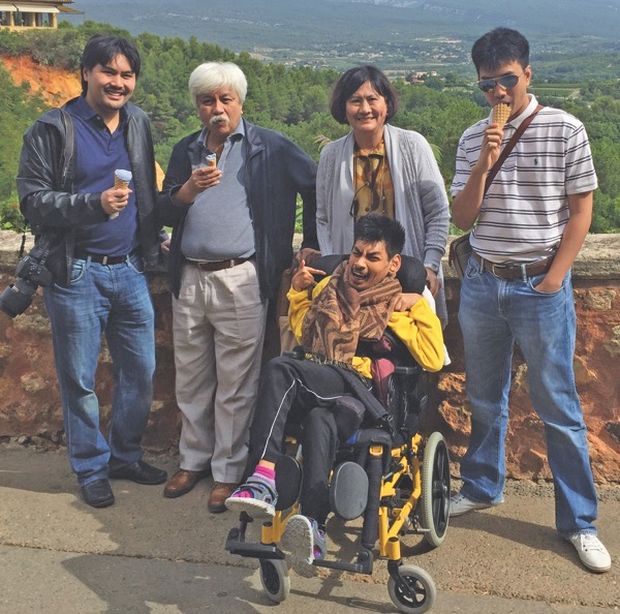
As with any family, however, the most significant interactions took place in private. The memories of my childhood with him are too numerous (and again, words cannot do them justice), but one enduring longing I held was that one day, he would be able to tell me what he thought of things: Even mundane aspects of life, like what food he liked, or whose side he would take in a brotherly argument.
Seeing my parents make such undaunted, extraordinary efforts to make him better convinced me that one day he would be able to join us in playing video games.
Family time inevitably decreased when my older brother and I went overseas to study, enforcing important formative experiences and the eventual transition into different career paths. Fortunately, since I returned to Malaysia permanently in 2007, we have managed to go on family holidays which have provided the most precious moments together in the last decade of Alif’s life.
I was glad that he got to experience the waters of the Mediterranean, the expansive deck of a cruise ship, the gardens of beautiful old villas and the many stunning landscapes where I would sometimes push him on his wheelchair.
I hope that one day he will be able to tell me what he thought of all these things, just as I hoped when I was a child. I pray that God will let me join him, for in the hearse from Seremban to Seri Menanti, my uncle (known in the family as the religious one) said that Alif died on the best day (Friday, just before prayers) but in any case, as a special child he is guaranteed the highest level of paradise.
The weather was uncanny. Dark clouds filled the sky when he left Hospital Canselor Tuanku Muhriz in Cheras. When he arrived at home in Seremban, it drizzled. When he passed through the gates of the Seri Menanti palace, it began to rain heavily.
And after the eighth cannon shot (given by adat upon the death of a child of a reigning Yang diPertuan Besar for the first time since 1914 (for Tunku Abdul Aziz ibni Tuanku Muhammad, elder brother of the future first Yang diPertuan Agong Tuanku Abdul Rahman ibni Tuanku Muhammad)), a massive thunderclap pounded the valley upon arrival at the royal mausoleum. The menteri besar told me that was God’s cannon shot for him. No one could recall rain like that in Seri Menanti before.
That day, so many people worked hard: soldiers, policemen, adat officials, and the doctors who had been treating him over the previous three weeks, for which I am thankful.
Still, nothing can compare to the courage and dedication of my parents who loved and cared for him for 31 years, many multiples more than the life expectancy doctors gave to him after birth. Since 2008, Negri Sembilan has had them as their King and Queen but for me, that’s secondary compared to the inspiration they have provided as a mother and father.
Regular readers will know that I usually end my column with some sort of public policy angle. All I will say is that soon I will have many, many words to write about hospital-acquired infections.
* Tunku ‘Abidin Muhriz is president of IDEAS
** This is the personal opinion of the writer or publication and does not necessarily represent the views of Malay Mail Online.


