


DECEMBER 9 — The moment I read his business card, I could sense he was getting ready to respond to my question.
Why does it read “Major General Datuk Mohd Yunus bin Long (Retired)” and not “Major General (R) Datuk?”
It seems his is the correct presentation, meaning the person is retired from the job but the commission stays.
 His destiny
Born in 1951, Yunus attended Sekolah Rendah Bongek in Negri Sembilan until Standard Four when he passed a transfer test to the Undang Rembau English School. He was one of the two who succeeded from a list of 25.
During the British Administration, schools were separated into English, Malay, Chinese and Tamil medium. Those from English schools were socially considered “educated” while those from the vernaculars were, well… from Malay, Chinese or Tamil schools. In practical terms, the former supplied government clerks and teachers (in “superior” English schools) while the latter supplied peons, despatch riders, hospital assistants and so on.
In Undang Rembau secondary school, he earned his King’s Scout badge while in Form Four. He secured Grade Two in the Form Five MCE (Malaysian Certificate of Examination) and was also awarded the OSC (Overseas Senior Cambridge), owing to the pass in English.
The Form Five results then were published in The Straits Times, till 1970 I think. Yes, the whole country knew who passed.
Naturally, he applied to the police and the armed forces. Unfortunately, the police only accepted those with a credit in English. His was a Pass 7. In 1970, he was admitted into the Pre-Officer Cadet Training Unit (OCTU) in Seginting Camp, Port Dickson.
He can still recall with amusement the trainees trooping in with Beatle-like mop hair and drainpipe hipsters, and trooping out with regulation crew haircuts in green T-shirts and blue shorts. We had to leave our individualisms outside the camp and be indoctrinated physically and mentally into the military persona, says Yunus.
During his time, the attrition rate was 20 per cent. Of the remainder, about 25 per cent would be offered a place to join the regular service (his was Regular 15) and the rest, the short service, which is about 10 years.
During the OCTU 10-month training, they were paid 242 dollars per month (a lot of money 45 years ago).
Being in the regular service had Yunus joining the Boys Wing as a cadet in the Royal Military College (RMC) for two years. Others were sent to the Royal Military Academy Sandhurst, UK, or Officer Cadets School Portsea, Australia.
In 1973 at age 22, he was commissioned second lieutenant and posted to the Recce Regiment in Kuantan.
Commissioned officer Mohd Yunus bin Long
By 1976, he made captain and three years later, he was a major, leading a squadron in Kuching. The Armed Forces Council regulates that examinations are mandatory in promotions to these two positions. Yunus passed in single sittings for both, becoming a major at just 28 years old.
His service to the nation includes stints as Instructor in Pulada (army training combat centre), head of Strategic Studies & International Relationship (or Hossir — his predecessor was Abdul Razak Baginda) and military attaché in our South Korean mission.
His five-year adventure (1997-2002) in Seoul as a colonel was his most memorable. His wife Datin Jumainah and three children ages 10, eight and six accompanied him.
Yunus admires the industriousness and discipline of the Koreans and said that although they are known worldwide for their successes in technological and automotive products, Korea is also a marvel in their agricultural endeavours.
Upon his return, he was promoted to brigadier-general to head the 6th Brigade in Sungei Petani. In 2004, with the rank of major-general, he was the director-general of Perhebat (Perbadanan Hal Ehwal Bekas Angkatan Tentera), which offers various skills training to assist retiring personnel in resettlement. He retired in 2007.
Yunus also has a Masters in Security & Strategic Studies from UKM.
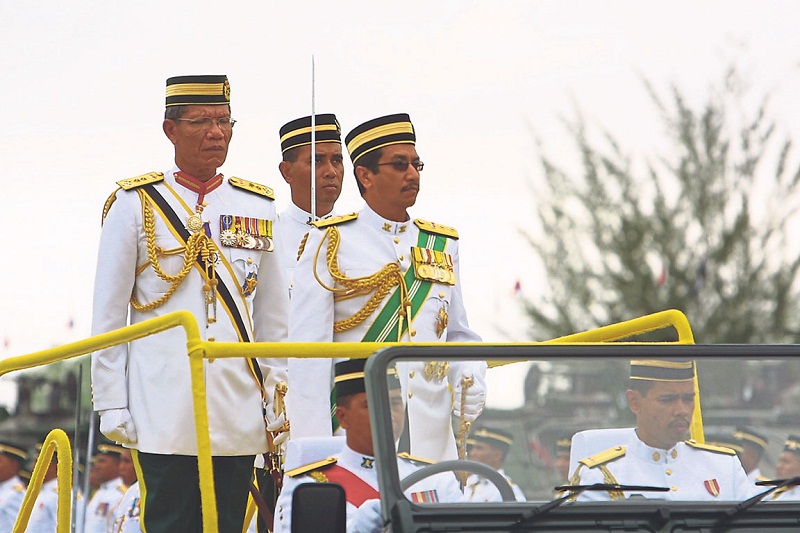
It was a good life
Why is the absence of non-Malay senior officers so apparent?
Yunus remarked several times that the ethnicity of officers had never crossed his mind. He remembers well his superiors, Major Andrew Ong and Major Godfrey Chang. He rattled off names of Major-Generals Selvarajah, Leong Siew Meng and Lai Chung Wah, and Lieutenant-General William Stevenson. Currently, he thinks there are at least 10 non-Malay brigadier-generals in service.
He can’t put a finger on it but reckons it is mostly the more attractive pay in the private sector that is causing less non-Malays to opt for a military career, thus less to choose from for posts in the higher echelons.
Datuk Yogalingam was the ambassador during his time in South Korea and Tan Tai Hing, the first secretary. Their wives are Datin Mary Lim and Binder Kaur respectively. Thus, an almost unavoidable talking point during receptions was on the racial make-up of Malaysia.
The only blot arose from the Sheikh Abdullah Committee Report 1972, which divided the armed officers corps into three classes, i.e. Red, Green and Amber officers. Red were those commissioned before August 1, 1972 and placed on the higher pay scale, and Green, commissioned after, on the lower scale.
Amber Officers were those appointed, like Red, before August 1, 1972 but commissioned later.
The 404 officers affected (Amber 404) felt that the report effectively downgraded them to second division salaries and perks upon being commissioned as second lieutenants, whereas they were offered first division pay scales when appointed as officer cadets.
Yunus is an Amber 404.
Postscript
Yunus noticed that the espirit de corps element, so essential in training, vanished in the early 80s. Consequently, the camaraderie was no longer evident. Looks like the developments in civvies life seeped through our parallel world in the military.
Asked about his 37 years with the armed forces, Yunus said he would do it again, without hesitation.
* This is the personal opinion of the writer or publication and does not necessarily represent the views of Malay Mail Online.


