


SINGAPORE, Feb 6 — The land underneath rail viaducts beside Yishun and Choa Chu Kang MRT stations — recently earmarked for potential development — both enjoy similar high footfall. Residents, however, want very different things to be built there, TODAY has found.
Those in Yishun, for example, hope to see more shops and eateries pop up under MRT tracks in the area. Conversely, Choa Chu Kang residents are more inclined to have communal spaces or greenery under their rail viaducts.
TODAY spoke with 20 residents in both areas to find out their wish lists for such spaces, after the authorities said last month that underutilised land beneath MRT tracks could be leased out for commercial or community use in future.
Experts who spoke to TODAY also agreed that the unique needs of each community must be considered in land-scarce Singapore, rather than blanket, profit-driven developments.
They noted that sometimes leaving land undeveloped leaves the authorities more options in the future if residents’ needs change.
On January 19, the Land Transport Authority (LTA) called a tender for a property valuer to assess open-market rental rates for two land plots underneath MRT tracks beside Yishun and Choa Chu Kang stations.
Each plot has an area of about 5,000sqm.
The site in Yishun starts near Block 749 Yishun Street 72 and ends near Block 757 on the same street.
The space in Choa Chu Kang is split into three plots — one near Keat Hong Community Club, another near Block 346 Choa Chu Kang Loop, and the third segment near Block 345 Choa Chu Kang Loop.
Responding to TODAY’s queries yesterday, LTA and the Ministry of Transport (MOT) said exploring land use underneath the MRT tracks is part of efforts “to increase station vibrancy”.
As this project is still in its exploratory phase, a study will be conducted to understand the cost and feasibility of such a project, said an LTA spokesperson.
The issue of land ownership will also be considered later if and when LTA proceeds with the plan, the spokesperson added.
“If LTA decides to proceed with the project, we intend to consult stakeholders such as relevant government agencies, social and business entities and local grassroots advisors in deciding the uses for the sites.”
LTA noted similar projects have been introduced in Japan, where such spaces have been “activated for community use” to provide a range of services such as retail and food establishments.
Residents’ wish list
TODAY spoke to 11 residents in Yishun and nine in Choa Chu Kang, who had differing views about how spaces under MRT viaducts in their respective estates should be used.
“I think if there were more cafes or restaurants, it’d be cool,” said 27-year-old Zoey Lee, a Yishun resident for nearly her whole life. The professional dancer also said having bars is something that would add vibrancy to the neighbourhood.
Another Yishun resident, Jimmy Foo, 70, said he would prefer more convenience shops or provision shops. “For art (installations) that kind of thing, I don’t think it is a good idea,” said Foo, who has lived in Yishun for 42 years.
Student Loke Yee Ying, 18, added that while the Northpoint City mall at Yishun MRT has plenty of stores, the possible development of the space nearby may allow residents to support smaller businesses.
Over in Choa Chu Kang, Elnita Firdaus, 18, said that if the viaduct underneath the tracks were to be developed into retail space, it would have to be “really exciting” for her to spend time there.
Otherwise, she would prefer more communal spaces to hang out after school.
“I find in (Choa Chu Kang), there is not so much space that we can relax or chill. Choa Chu Kang feels a bit tight,” said Elnita, a student at the Institute of Technical Education College East.
Agreeing, Hah Ching Lin, 28, who works in biotechnology, said Choa Chu Kang is a densely populated area, where sometimes not everyone gets a chance to use communal facilities like the basketball court.
“Community or shared spaces would be best,” said her husband Paul Librojo Ganaban, 31.
“The library can be quite packed, and if students want to study, they have to (sit at) Starbucks,” he said.
How Singapore’s viaducts have been used over the years
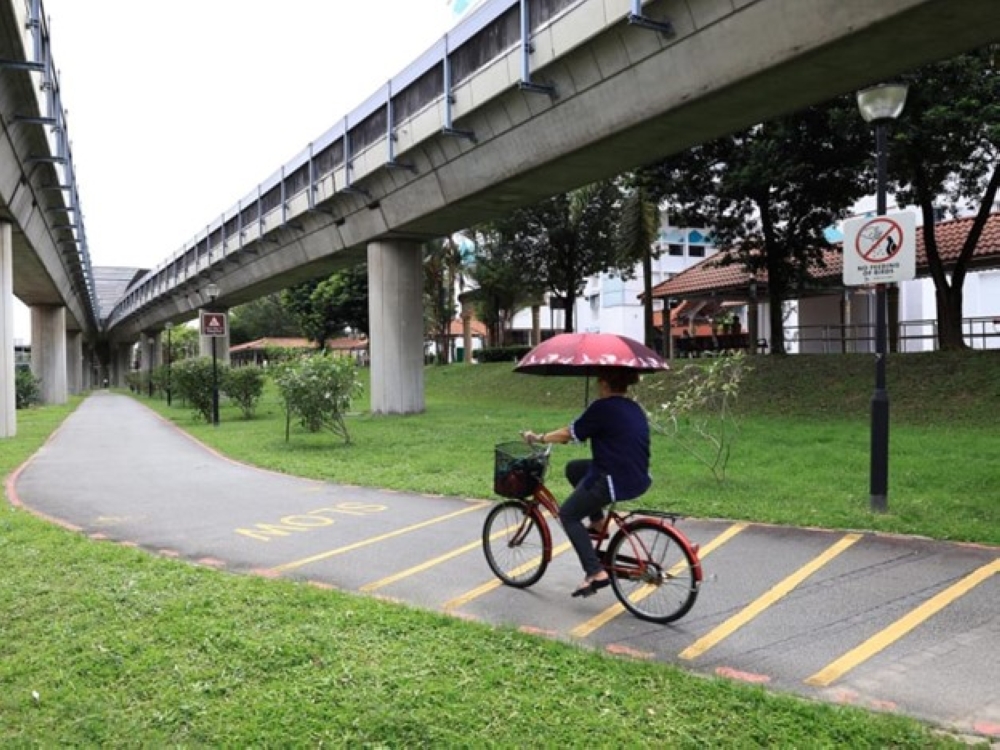
Given that Singapore has more than 100 flyovers and viaducts, the authorities have for years explored more creative and unconventional ways to use the approximately 60ha of “dead spaces” underneath them.
Dead spaces refer to sterile pockets of land that result from infrastructural development.
For example, the space under the Bukit Merah viaduct, dubbed Viaduct@JBM, was fitted with electricity, water, and lighting and turned into a recreational community space for residents to enjoy in the area in 2017.
In early 2017, the space under the West Coast viaduct was used to launch a night art market, followed by a test-bed for urban farming by social enterprise Edible Garden City for three months.
To contend with the lack of sunlight under the viaduct, edibles such as microgreens and mushrooms were grown in climate-controlled container units that provided sufficient light.
“Container farming is one of many options that can be adopted to maximise farming space in land-scarce Singapore,” said Sarah Rodriguez, the head of marketing and human resources at Edible Garden City.
“Activating other underutilised spaces, like rooftops or even ornamental landscapes, into farming spaces could also help boost our food resilience.”
More recently, the space under the West Coast viaduct has been developed into an archery range.
Salt & Light Archery has been a tenant since 2017 and has grown to be Singapore’s largest archery club.
One of the founders, Israel Tan, 35, said that the large, sheltered 70m-long space allows their archers “to train rain or shine”.
“Many competitive school students really appreciate this space, which allows them to train as often as they want after school,” said Tan.
Meanwhile, a fishing and prawning venue under the Yio Chu Kang MRT tracks, dubbed Fish at AMK, lets enthusiasts try their hand at catching fish in a “longkang”, or drain.
The flexibility of spaces under viaducts or flyovers can also be seen in how the space has changed under the Thomson flyover.
In the 1970s to early 1980s, it was known as Whitley Road Hawker Centre for many famous stalls. It shuttered in the late 1980s to early 1990s.
Then, in 2012, the space was transformed into a futsal park that drew many avid amateur soccer players.
When TODAY visited the space, the area had been cleared and is under construction for the North-South Corridor.
Profit shouldn’t be the aim
Experts TODAY spoke to said they are for the idea of developing spaces underneath viaducts but emphasised that choosing the right development is important.
Associate Professor Walter Theseira from the Singapore University of Social Sciences (SUSS) said that given the proximity to the trains, noise and dust are factors to consider when deciding what kind of development to build.
“In fact, most of the commercial viability is likely to be near existing MRT stations. It certainly wouldn’t be so viable further away from the various MRT stations,” said Assoc Prof Theseira.
“That limits what you can do (with the space),” he added. Even so, he pointed out that some cities, such as Paris, use street-level viaduct spaces as parking lots, while Japan utilises the spaces under train tracks for dormitories.
“You can actually do quite a lot with the space, but it would be really on a case-by-case basis,” said Theseira.
Property analyst Nicholas Mak said developing spaces under viaducts “can be a good idea”, adding that the best way to use them is to meet the community’s needs.
For this to happen, Mak and Theseira agreed that if these spaces are for the benefit of the community, it cannot be thought about as “purely maximising revenue”.
Mak notes that spaces like this must consider the community’s changing needs.
“We may be successful for a few years, but people’s needs change over time,” he said, adding that there may not be a need to develop every single space under the viaduct.
“Years later, you find that the community needs something different,” said Mak, “but now you’ve got no more space”. — TODAY


