


SINGAPORE, Dec 14 — To curb the misuse of personal mobility aids (PMAs) by able bodied persons, only individuals certified by a medical professional to have problems walking will be allowed to use mobility scooters, if a new set of recommendations is accepted by the government.
In a report published today, the Active Mobility Advisory Panel that oversees the safe use of active mobility devices sets out five key recommendations to ensure the safe and responsible use of PMAs.
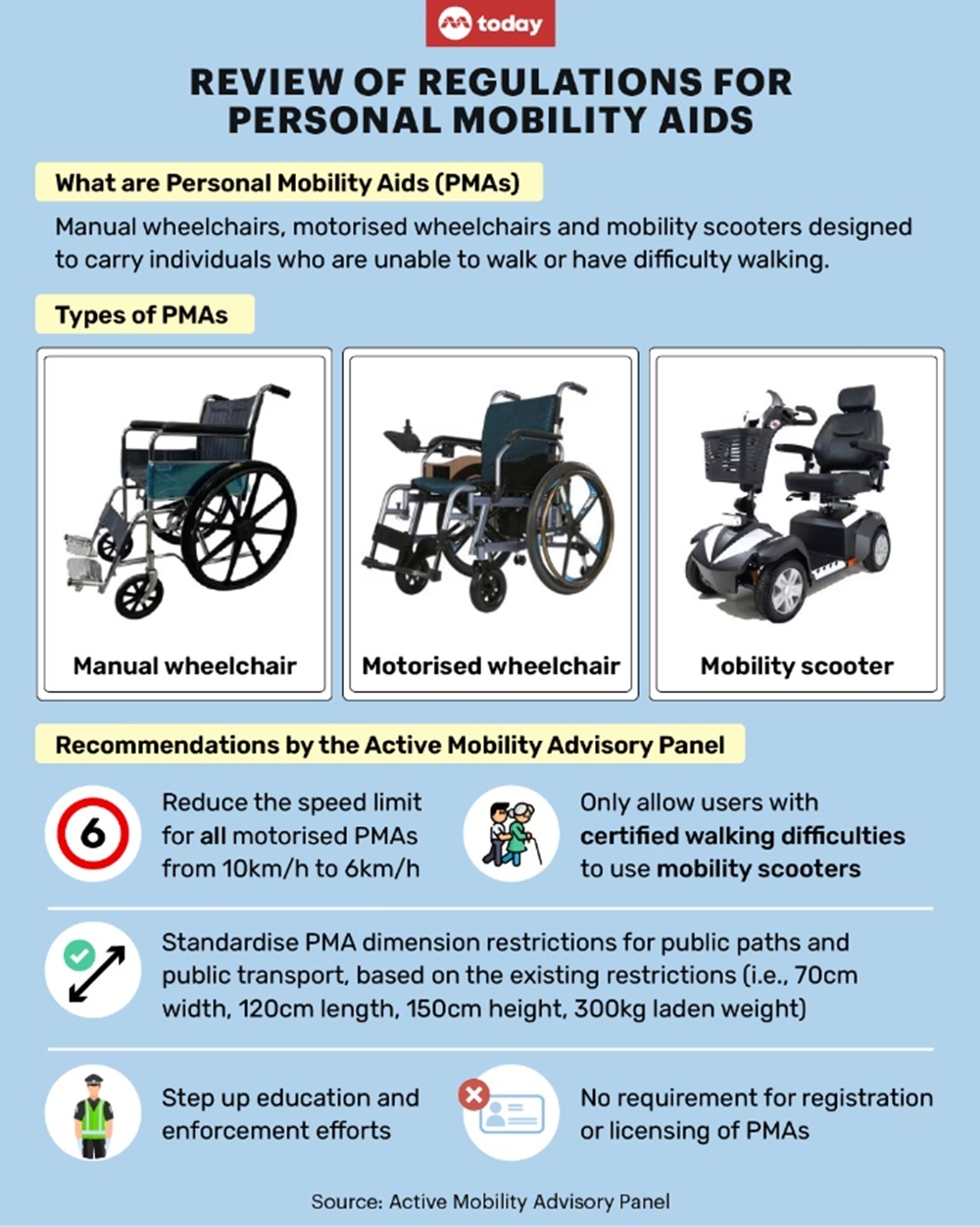
PMAs refer to manual wheelchairs, motorised wheelchairs and mobility scooters, designed and intended to carry an individual with difficulty in walking.
The recommendations were submitted by the panel to the government today following a series of focused-group discussions with various stakeholders in June and July.
The stakeholders consulted include PMA users, caregivers, representatives from a disability-focused organisation and the National Delivery Champions Association, among others.
Speaking at the sidelines of a media briefing today, panel chairman Baey Yam Keng said the Government will review the recommendations and consider implementation at a later date.
Why it matters
The use of PMAs is currently subjected to relatively laxed regulation. Users are not allowed to go on the roads and are subject to a maximum speed limit of 10km/h.
Unlike personal mobility devices like electric scooters, PMAs are allowed on footpaths and at void decks.
The panel said it decided to review on such devices as there have been increasing concerns about the misuse of PMAs, especially mobility scooters, by able-bodied persons.
These include the use of overly large devices and using them in an unsafe manner such as by speeding, said the panel.
“AMAP (Active Mobility Advisory Panel) decided to review the current guidelines in order to preempt a situation where there are a lot of disamenities or accidents happening and that would affect genuine users from continuing the use of PMAs,” said Baey.
TODAY has asked the Land Transport Authority (LTA) for figures on incidents or complaints relating to the irresponsible use of PMAs.
Persons with genuine need for such mobility aid have also found that these issues have “tarnished the reputation of PMA users”, said the panel, which comprises 16 members including Baey, representatives from LTA, National Parks Board, the Traffic Police and a non-profit organisation focused on people with disabilities.
The panel reviewed practices done in other jurisdictions like in the United Kingdom, Spain and Australia before coming up with the recommendations.
TODAY takes a look at the panel’s five main recommendations in the report and the considerations behind them.
Medical certification required
- The panel recommended allowing only users who are certified to have medical needs or walking difficulties to use mobility scooters
- This can be in the form of a memo from a registered medical professional
- However, users who already have existing certification or disability identification will not have to go for additional assessments
- The recommendation only applies for mobility scooters, as the feedback of abuse among able-bodied users are typically linked to such devices only
- This targeted approach aims to minimise the impact on users with genuine need who are using manual and motorised wheelchairs
- The panel said that it did not recommend having a blanket allowance by age, as it may lead to a proliferation of PMA usage
Lower speed limit to 6km/h
- The panel recommended lowering the maximum device speed for all motorised PMAs to 6km/h from the current 10km/h as this better reflects the intended use of PMAs, to replace walking for users with mobility challenges
- Transitionary measures should be put in place to allow genuine users to use their existing PMAs but at a lowered speed
- Retailers will be required to sell PMAs with a maximum speed of not more than 6km/h, with reasonable transition time given to them to make necessary changes to their business
Restrictions on size of mobility scooters
- Existing dimension restrictions on PMAs for public transport should apply to devices used on public paths, said the panel
- LTA currently imposes a dimension restriction of 70cm by 120 cm by 150 cm with a 300kg laden weight for PMAs on public transport
- A small proportion of users who may need to use bigger PMAs for medical reasons will be exempted from this requirement
More awareness
- The panel recommended that public education efforts be ramped up on who can PMAs, along with the rules and regulations
- Users should also be educated on the code of conduct for PMA and other path users
- Safe usage of PMAs, fire safety tips and safe charging practices should also be taught
- Enforcement should also be stepped up with appropriate penalties to deter sale of non-compliant devices, said the panel
No licencing regime for PMAs for now
The active mobility panel recommends not introducing a licencing regime for users, registration of PMA devices or mandatory training at this point in time.
“While some have called for registration and licencing to increase accountability and enforcement against errant PMA users, its effectiveness must be carefully weighed, including the impact on genuine users,” said the panel.
The panel believes that the current set of recommendations will achieve a balance between inclusivity and ensuring safety for all path users, the report added.
How will delivery riders, users be impacted
Baey, who is also Senior Parliamentary Secretary for Transport said that when the panel set out on the review, it was first about promoting active mobility.
“We would like people to live an active life to be able to get around, including people with walking difficulties, and that’s where they have been relying on PMAs to get about,” he said.
However, given the bigger and heavier nature of such PMAs, the public is “naturally more concerned about safety”.
“That is why we felt that it’s timely for us to look at how we can introduce some recommendations so that people can still enjoy these common spaces.”
He said that genuine users with walking difficulties should not face any adverse impact by the set of recommendations.
Baey acknowledged some food riders also use PMAs in their job, and reiterated that users with genuine need of PMAs would not be adversely impacted, besides being subjected to a lower speed limit.
He said that delivery platforms would typically indicate to customers when a delivery is being made by a person with a disability condition and more time is given for such delivery persons to complete the job.
“And I know that customers or members of the public are generally more accommodating towards these people with (such) conditions,” he said.
Asked about the possible timeline for implementation, Baey said that based on past experiences by the panel, the Government would usually take “a few months” to review the recommendation and come up with implementation measures.
Florence Cheong, a panel member and head of Tan Tock Seng Hospital occupational therapy department said PMAs benefit not only those with visible physical disability but those with less discernable conditions like cardiopulmonary or renal conditions that limit their ability to walk far distances.
Given the ageing population, there are “more and more” people who may develop conditions that can limit their mobility, she added.
Asked if the set of recommendations might discourage users with genuine need from using PMAs, she said that it would not.
“I think in the long run, it will benefit them as well as society together because it will actually likely be less crowded, less burden on the infrastructure and (result in a) safer commuting experience for everyone,” she added. — TODAY


