













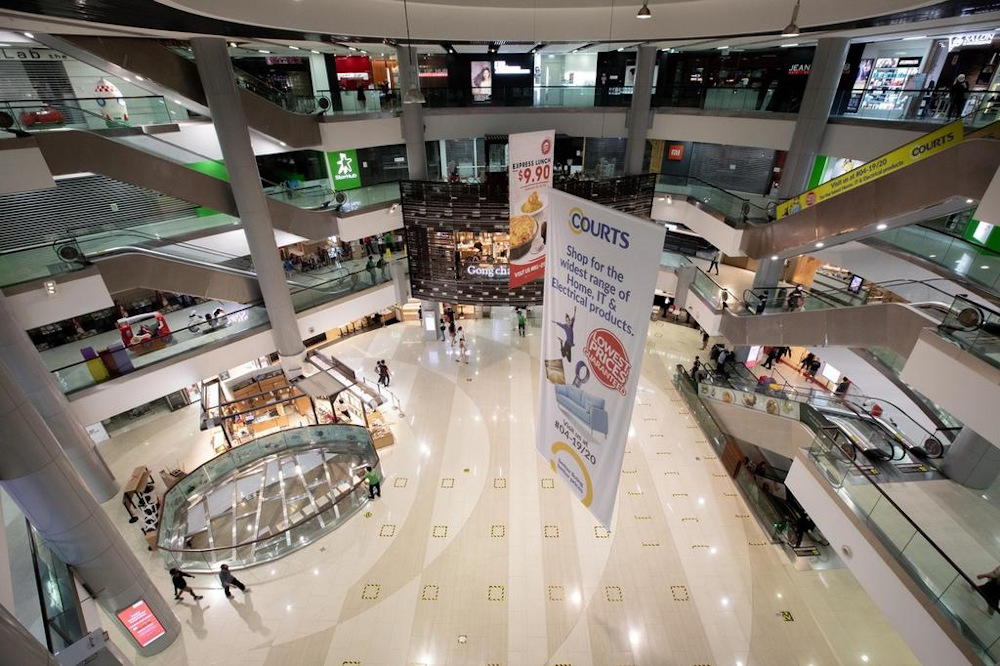


SINGAPORE, March 26 — The Government will be introducing fair tenancy laws involving the leasing of retail premises, and will be consulting with landlords and tenants in the next few months to work out details of the legislation.
The new legislation will be based on a set of guidelines, termed as a code of conduct for the leasing of retail premises, which were put forth by a committee made up of landlords, tenants, government representatives and industry experts.
Released today, the guidelines came about after nine months of negotiations between landlords and tenants and were developed with the aim of levelling the playing field in the retail leasing space. Tenants have long complained that it has been tilted to the advantage of landlords.
The issue was brought to the fore last year when the Covid-19 pandemic struck, leaving many retail businesses, including food and beverage outlets, struggling to survive. Reports emerged that some landlords did not pass down savings from government property tax rebates to their tenants, for example.
Speaking to reporters at a media briefing today, Low Yen Ling, Minister of State for Trade and Industry, said that the Government was announcing its decision early so that all parties involved would have enough time to make the adjustments needed to comply with the code.
“The government will be a lead adopter of this code of conduct and that all government landlords will lead by complying with the code, unless there are other statutory obligations that we need to abide by,” she added.
She also noted that major trade associations have committed to this code of conduct, and she hopes that many more companies and parties in the retail scene will also start observing the leasing practices set out in the code even before legislation comes into effect.
Landlords and tenants that have decided to adopt the code would have to abide by the leasing guidelines and negotiation principles set out in the 32-page document from June 1, this year.
The code of conduct will also apply to lease agreements that were signed on or after June 1 this year with a tenure of more than one year.
The leasing principles set out in the code include:
- Landlords can collect rent from tenants based only on a single rental computation.
- Currently, the monthly rent is generally derived from two formulae, and the final amount paid depends on whichever is higher. One formula consists of a base rent dependent on the size of the shop space in addition to a percentage of total gross sales, while the other formula computes rent based on a percentage of total gross sales.
- Landlords can terminate rental agreements before their leases are up only for substantial redevelopment works, and tenants can terminate if they have become insolvent or lost franchise rights.
Currently, landlords can terminate the lease for whatever reason without compensating the tenants even before the lease term is up. Leases are usually three years. Tenants, however, are not able to do the same.
Landlords must bear the costs of preparing the lease agreement, unless there are terms that are not compliant with this code that the tenants asked to be added.
Currently, tenants have to bear the full legal costs for the drafting of the lease agreement.
A fair tenancy industry committee will also be set up to look into instances where landlords and tenants do not comply with the code.
Any disputes that arise will be referred to the Singapore Mediation Centre.
Recalcitrant landlords or tenants that continually fail to uphold leasing guidelines in the code may also be named and shamed by the committee, whether by having the particular company’s name published through a media statement or on its website, said the chairman of the Singapore Business Federation, Lam Yi Young.
Andrew Kwan, president of the Restaurant Association of Singapore, said in a media briefing on Friday that this code of conduct is not the end, but the beginning of a new journey between landlords and tenants.
However, before the code becomes law, landlords are not obliged to take it up.
Chia Ngiang Hong, president of the Real Estate Developers’ Association of Singapore (Redas), said during the briefing that the association will persuade its members to come on board.
Having a reputation as a responsible landlord could be one way to incentivise more to commit to this code as well, said Lam. — TODAY