


MARCH 3 — And oh, the baggage she carries! Many more Americans have an unfavourable impression of her than a favourable one: In a Quinnipiac University poll from early February, the split was 56 to 39 per cent.
She conquers that ... how? By introducing herself better to voters? They know her plenty well. By unveiling yet another new image? It’s hard to imagine there are any permutations left.
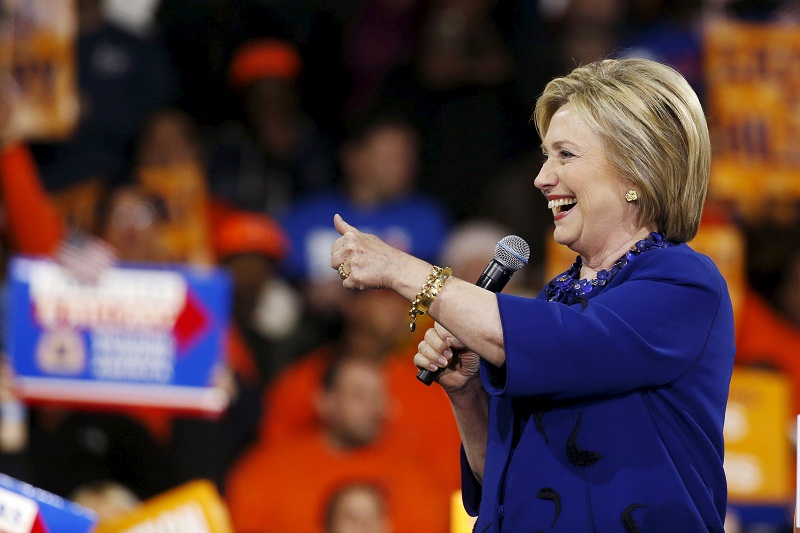
Democrats are aware of that, and have consoled themselves by focusing on who her Republican opponent might be: Trump. He racked up victory after victory on Tuesday, and Clinton’s remarks at a celebratory rally in Miami on Tuesday night were a targeted rebuke of him.
Mocking his slogan, she said that the country’s challenge was “not to make America great again. America never stopped being great. We have to make America whole.”
She added: “Instead of building walls, we’re going to break down barriers.”
Trump, at his own victory party, was more explicit and more derisive in his invocations of her. Referring repeatedly to the ongoing investigation of her email practises as secretary of state, he said that he’d be surprised if she were even allowed to remain in the presidential race.
He argued that she can’t credibly promise America any progress or solutions, given that she’s been involved in politics for decades and, in his estimation, has never delivered.
“You look at her record as secretary of state — it’s abysmal,” he said in a voice dripping with contempt, adding that it would be easy to defeat her and he relished the thought of her as an adversary.
To attain the presidency, a politician needn’t be adored — just less loathed than the alternative.
In that same Quinnipiac poll, Trump’s unfavourable to favourable ratio was even worse than Clinton’s: 59 to 34 per cent. Her supporters and advisers are accordingly crafting a strategy of brutal negativity and relentless attacks, as The New York Times reported earlier this week. Envisioning that, David Plouffe, who managed Barack Obama’s 2008 campaign, said that a Clinton bid would be less “hope and change” than “hate and castrate.”
There are several problems with “hate and castrate.” One is that Trump already dwells in the sewer and most voters know it; to join him there isn’t to expose him but to degrade yourself.
Another is that it doesn’t address the ire I mentioned earlier, the yearning to rebel. And a disappointed Sanders voter with that yearning could, in a general election, sit on the sidelines or vote for Trump before siding with Clinton, unless she makes some adjustments defter than any that she has made so far.
Worst of all, an epically nasty general-election campaign would do nothing to unite the country and give the next president much of a chance of governing effectively.
Clinton has the toughness to engage in — and survive — a brutally ugly contest. She also has the smarts to know the cost of it. Has she honed the character and nimbleness to prevail in a more inspiring, unifying way?
As well as we know her, this is yet to be revealed. — The New York Times
* This is the personal opinion of the columnist.


